All Articles
Thank you! Your submission has been received!
Oops! Something went wrong while submitting the form.
No items found.
Why Modern Love is So Damn Hard
This week, I write to you about the expectations that can derail our relationships. Starting with the wedding vow.

Last week, I posed a question on Facebook, “Why is Modern Love So Hard?” You responded with amazing reflections, questions, and stories. For today’s article, I want to focus on one set of these responses.

I want to speak to those of you who view commitment as a loss of self

The idea that we lose ourselves in the presence of our partner is deeply ingrained in the modern perception of love, particularly in the United States. As almost all of our communal institutions give way to a heightened sense of individualism, we look more frequently to our partner to provide the emotional and physical resources that a village or community used to provide.

Is it any wonder that, tied up in relying on a partner for compassion, reassurance, sexual excitement, financial partnership, etc. that we end up looking to them for identity or, even worse, for self-worth? 

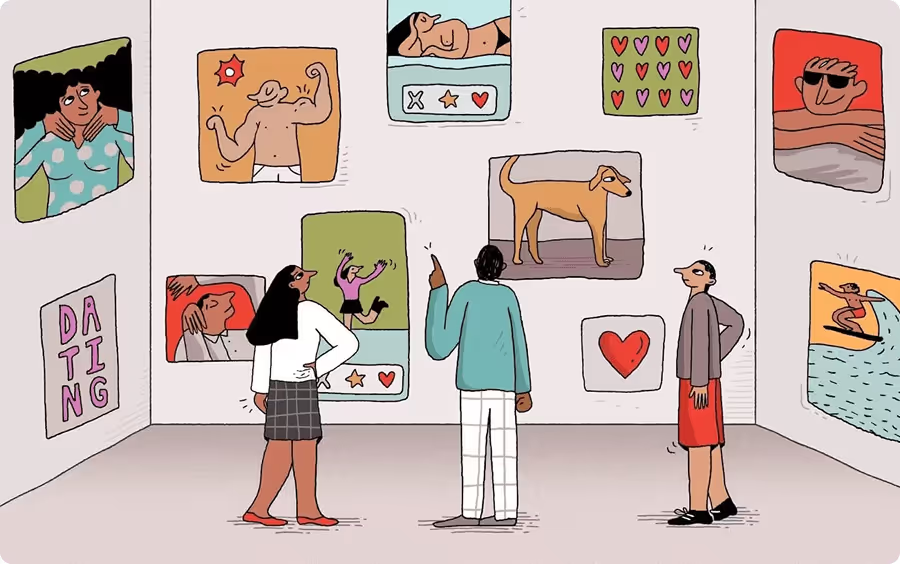
Combine that with the commodification of love, the increasingly omnipresent “is there somebody better?”, and we have a recipe for decreasing the perceived “cost” of love. All the while increasing our expectations on our partnerships, and even adding more to the list, without really understanding what we’re asking. 

This year, I’ve made it a point to take notes at any weddings I attend about the marital vow. I think this single speech is so reflective of the way our expanding expectations have gotten out of control. Here I offer you a poignant, if exaggerated, example of how these typically go:
“I promise that I will always be there for you, honest with you, kind, patient and forgiving. For you are my lover and my teacher and I honor the divinity in you,” says the groom, with an uncharacteristic quiver in his voice.
“I promise to be your greatest fan and your toughest adversary, your partner in crime, and your consolation in disappointment,” responds his bride, in almost perfect cadence. With unquestionable sincerity, he continues, “I promise to tell you everything, to have no secrets except those we share.”
“I promise faithfulness, respect, and self-improvement,” she declares. To which, he one-ups her by replying, “I will not only celebrate your triumphs, I will love you all the more for your failures.” Smiling through her tears, she says, “I promise never to wear heels so you won’t feel short. And to comfort you when your football team loses and drink with you when they win.”
Taking a small box of her favorite chocolates from his best man, he says, “I promise to always bring these at that time of the month, and never to ask you if it is that time of the month.” Having promised each other the heavens and the earth, they kiss to rapturous applause.
This litany of expectations is a grand setup for failure. Once we strayed because marriage was not supposed to deliver love and passion. Today we stray because marriage fails to deliver the love, passion, and undivided attention it promised.
These expectations are extremely difficult for us to provide to one another because they are contradictory, or even in some cases incompatible. I write in The State of Affairs that, “contained within the small circle of the wedding band are vastly contradictory ideals. We want our chosen one to offer stability, safety, predictability, and dependability… and we want that very same person to supply awe, mystery, adventure, and risk.”
So, what is the solution? How can we commit to another without losing ourselves in trying to meet these vast expectations? How can we be in a fulfilling partnership that also helps us grow as individuals?

Here’s a place to start.
We can think more clearly about our expectations from a partner. Research shows that people who have more social resources, and more people to talk to about various issues in their lives, do better in marriage. So in what areas do we want to invest with our partners, and in which areas do we need to invest in ourselves and our personal networks?*

And once we’ve had a chance to think more clearly about our expectations, how do we meet the expectations that we’ve set for ourselves and our relationships? 
We can stop thinking of love, desire, and relationships as commodities. They are not. When a jacket doesn’t meet our expectations, we can easily purchase another one. The same is not true about our relationships. We have to work to make our expectations come to reality, setting expectations is only the start. 
The next step is to actually go about achieving them by investing the time, patience, and space necessary with our partners. This process might not be perfect, but aside from the moment we recite them, neither are our vows.
*Two books that I recommend from guests of mine on the Sessions Clinical Education platform are:

  • The All or Nothing Marriage by Eli Finkel. Eli, a psychological scientist, goes into some depth about the research behind modern marriage, focusing in particular on the increasing set of expectations behind marriage and the ideology behind the institution. 
  • Loving Bravely by Alexandra Solomon. Alexandra is the founder of Marriage 101, a course at Northwestern University that teaches undergraduates how to prepare for the types of relationships they want to have. Her book is a wonderfully written insight into the process of developing “relational self-awareness”, the prerequisite to being in a healthy relationship.
    What challenges do you see in modern love? And where are you at in the journey? I’d love to hear and respond to your stories. Visit out Facebook post pinned to the top of my Facebook page to offer your insights or share your experiences with the community.
Read More
No items found.
In Long-Term Relationships, When Do You Find Yourself Most Drawn to Your Partner?
Reconciling the domestic and the erotic is a delicate balancing act in long-term relationships. It requires knowing your partner while recognizing their persistent mystery. Read more on the one simple question that reminds us to appreciate our partner’s otherness and what the four most common responses tell us.

Modern relationships are cauldrons of contradictory longings: safety and excitement, grounding and transcendence, the comfort of love and the heat of passion. We want it all and, in long-term monogamous relationships, we want it with one person. Reconciling the domestic and the erotic is a delicate balancing act that we achieve intermittently at best. It requires knowing your partner while recognizing their persistent mystery; creating security while remaining open to the unknown; cultivating intimacy that respects privacy. Separateness and togetherness alternate in point and counterpoint. We need both but it's an intricate dance. Desire resists confinement, and commitment mustn’t swallow freedom whole. 

​​Faced with the irrefutable otherness of our partner, we can respond with fear or with curiosity. We can try to reduce them to a knowable entity, or we can embrace that which makes them enigmatic. When we resist the urge to control, when we keep ourselves open, we preserve the possibility of discovery. Eroticism resides in the ambiguous space between anxiety and fascination. And when we can harness it, we remain interested in our partners; they delight us, and we’re drawn to them. But, for many of us, renouncing the illusion of safety, and accepting the reality of our fundamental insecurity, proves to be a difficult step. 

It can help to ground these ideas down with a simple question: when are you most drawn to your partner? Really think about it. Being drawn to our partner isn’t an inherently sexual experience; it’s not “when am I most turned on by my partner” or “when do I crave their touch.” That can be part of it, of course, but when we take sex out of it, we find that the answers to this question tend to fit into four categories. 

1. “...when I see them in their element” 

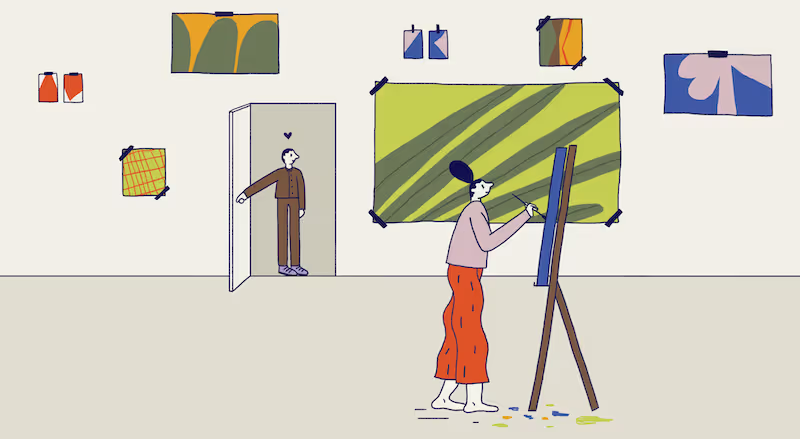
This is the category of radiance and confidence—and it’s probably the biggest turn-on across the board. This group of answers is about seeing our partner from a comfortable distance. “I am most drawn to my partner when I see him in the studio, when she is onstage, when they are doing something about which they’re really passionate.”

When we see our partner in their flow state, it’s as if this person who is so known to us, is momentarily once again somewhat elusive. And in this space between “me” and “the other” lies the erotic élan—that movement toward the other. Because sometimes, as Marcel Proust said, “mystery is not about traveling to new places but about looking with new eyes.” And so, when we see our partner on their own, doing something in which they are enveloped, the ensuing shift in perception allows us to stay open to the mysteries that are living right next to us. It also gives us a glimpse of what it looks like when our partner doesn’t need us—how they behave when they are engaged in self-reliance. There’s something inherently sexy about that. We’re allowed to let go of our caretaking impulse and bask in their shine.

2. “...when they are away; when we are apart; when we reunite”

We tend to think that relational disconnects happen as a result of a lack of closeness, but perhaps the way we construct closeness reduces the freedom and autonomy needed for desire. When intimacy collapses into fusion, it is not a lack of closeness but too much closeness that impedes desire. No wonder they call it “drifting apart”—we all need a little space.

Desire is rooted in absence and longing. And the experience of “not having” increases our “wanting.” If our partner is in front of us all the time, a business trip away or time with friends can give desire the space it needs to thrive. It’s so easy to grow frustrated with each other when we’re constantly in each others’ spaces, making every decision together, going through the motions of a long life together. So, when they’re gone, it’s actually nice to miss them. Absence, it turns out, really does make the heart grow fonder. Spending time apart allows our partner to re-occupy our imagination—particularly the part that shrinks when daily life together becomes predictable. It allows us to reconnect with the way that we imagine them without being instantly constrained by reality.

3. “...when they surprise me” 

This category is the hardest one to recognize because, to the question of “when am I most drawn to my partner,” people don’t tend to answer “when they surprise me.” Answers in this category range from silly to sexy to serious, but the throughline is always surprise and novelty. “When we go on vacation” is a big one. But so are “when she tells a joke I’ve never heard” and “when he plays with new style elements in his wardrobe.” Sometimes surprise can come from having the same old fight in a new way, weathering the storm together instead of falling apart: “when we are in a hard conversation and there’s so many moments where we could just stop, but she decides to stay in it—and we walk through the dark tunnel and come out together on the other side with a different perspective than either of us could have come up with on our own.” 

Even the answer “when my partner is vulnerable” falls in this category. Why? Because if our partner was vulnerable all the time, we probably would not be drawn to it. It’s the fact that they are someone who usually doesn't show that side of themselves that makes their moments of vulnerability so compelling. And it surprises us when it happens. The same is true of the answer “when they make me laugh.” Laughter is surprising because it disrupts banality or seriousness. It takes us out of the linearity of whatever came before it. In each of these answers, we might never even say the word “surprise,” but each scenario is characterized by improvisation, spontaneity, refreshment, and rejuvenation. It’s about those experiences that show us our ability to bring out new parts of each other. But it also makes us ask: what parts of ourselves are we just now allowing to be seen by our partner for the first time?

4. “...when I see them through the eyes of another” 

It could be seeing them with their colleagues, or at a party, or even seeing them field romantic advances from a stranger. Scenarios that show us our partner through the eyes of another can remind us of what we used to see in them or the parts of them we’ve maybe come to take for granted. Seeing someone else react to our partner’s humor or charm or intellect can even make us feel validated, proud, even lucky. 

All four categories show us how a little distance can help us see our partner more clearly, but this one makes us stand back the farthest. It allows a new portrait of our partner to come into view. It reminds us that we can always find the stranger within this person who has become so familiar to us. We can appreciate their otherness as an intrinsic part of our love story, rather than a mystery to fear.

Read More
No items found.
What You Don't Understand About Sexual Fantasies
This week, Esther explores what is meant by sexual fantasy.

This week, Esther explains her definition of what exactly constitutes a sexual fantasy.

“What is sexual fantasy?” – Dylan, Columbus, OH

People sometimes confess to me that they don’t have sexual fantasies. They assume they have no imagination. I want to tell you that everyone has the capacity for fantasy.

But what is fantasy? The idea of it has been coopted so that we view it through a narrow lens. It has come to mean costumes, porn-star poses, elaborate accouterments and role-play. You can certainly introduce role-play into your relationship and here’s how.
But here is the radical but simple definition of fantasy: sexual fantasy is simply anything that enhances excitement or pleasure. Whether it’s the time of day, the way the breeze drifts across a field or a story you create about the way someone looks at you. Let’s continue to unpack the idea of fantasy.

Fantasy is a story
This story – our fantasy realm – is what allows us to distinguish between sexuality and eroticism. Sexuality is instinct or biology. Eroticism is sexuality that is transformed by the human imagination.
We all have these imaginative resources that allow us to play and be curious, to go beyond our lived experience. The wonder of fantasy is that it allows us to bypass reality; we can let go of the constraints of age, physical limits, material realities, health conditions and religious restrictions.
What a relief to know that the central agent of the erotic act is our imagination rather than the toned abs we can’t ever quite seem to achieve. Fantasy is our very human ability to come back to something and forever change or relive it. Fantasy has the power to connect us to hope, playfulness, and mystery. I believe, if we didn’t have fantasy, we couldn’t live.

Fantasy is a gift
It can transform the traits that irk you – your shyness for instance – into something that you imagine turns someone else on. Or you can become all-powerful and confident – fearless and bold – in your fantasies.
Fantasy allows us to bifurcate our inner blocks. The fears, anxieties and inhibitions that roil inside you can dissolve so that you can experience the joy of sexuality. The pitfalls of your relationship can be sidestepped in the moment of fantasy.

Fantasy is an imagined place
Does that mean that the fantasies that you have are what you really want to happen? Not necessarily. As we’ll discuss in detail next week, a fantasy is a game, an imagined place. Fantasies are different from what we want in the cold, harsh light of our daily reality.
If you know how you want to experience sexual pleasure, even if it’s simply the way someone strokes your hair, you are already in the realm of sexual fantasy. Embrace it.
Let me know your thoughts about the definition of sexual fantasy. And look out for an upcoming post on how to deal with your partner’s unsexy fantasies.

Read More
No items found.
What Does it Mean to be a Man?
A reader asks about how to handle his feelings of inadequacy after circumstances force him to become a stay-at-home dad.

“I had to quit my job because of a health issue, and now I’m home taking care of our kids. My wife has become the breadwinner. I know I should be happy that we could make it all work, but I feel like a loser.” – Zach, San Francisco, California

Zach’s dilemma is the dichotomy of the modern male; emotionally evolved and willing able to care give, but pulled toward gender norms ingrained in us all.
The construction of gender identity for men is more fragile than for women. In many cultures, one is born a woman — and one becomes a man. Chip Brown explores wide-ranging rites of passage into manhood from around the world in this National Geographic article.
Often, masculinity is defined as the disavowal of the feminine inside of us. This is complicated for both women and men as we redefine modern gender roles.

Zach, I have worked with many men in your position — lead dads shunned by moms on the playground. Men who feel inadequate because they’re not financially providing for their family (even though they are raising children). For some, pent-up frustration even causes angry lash-outs at their children.

While you cannot control what happened to your health, you can control the outcome. To paraphrase Viktor Frankel’s Man’s Search for Meaningyou cannot always control the conditions you find yourself in, but you have the freedom to choose your reaction to them.

You need to feel worthy, useful and socially connected. Seek out other men who are parenting. Look into the possibility of part-time work. Speak to your partner about how you’re feeling, so you can help one another find a balance. When you’re in the eye of the storm, it seems impossible to find a way out. But know that you are not the first to encounter the shifting sands of gender. As you wrestle with this new world, know that you are not alone.

Read More
Taboo
Arguing about Money Again? Understanding Financial Tension in Relationships
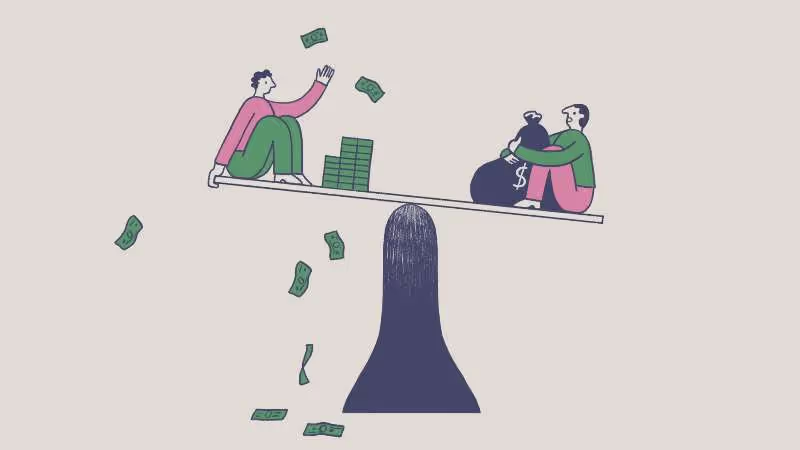
Talking about money is no easy feat. But, it is an opportunity to understand the deeper beliefs and vulnerabilities it represents in your relationships and to grow your partnerships. Read more about why tensions in your relationship arise around finances and the money questions you can ask to start an open conversation.

Do any of these scenarios sound familiar?

Ever since your partner lost their job, things have been tight; but every time you talk about it, they shut down

You’re spending your own money online shopping, but still, your partner judges every time you receive a package. It was annoying; now it’s tense.

Your partner makes significantly more than you but you want to have an equal say in your shared finances. You’re wondering how to address it when you feel like you don’t have a leg to stand on. 

You found out that your partner has a ton of debt and they let it get out of hand. You want to be supportive, but you can’t get past how irresponsible you feel they’ve been. Now they feel judged and regret ever bringing it up. 

Your fiancé is asking for a prenup. You feel it means they don’t trust you and want to protect their money from you, even though you say you know your feeling isn’t rational. 

You feel like you never know when it’s the right time to bring up finances. And you’re afraid if you do, the love and romance will suffer. Most of all, you wonder why it’s all so heavy in the first place. It’s just money, right?

The 5 Things We Often Forget About Financial Tension in Relationships

  1. We live in a society that places high value on financial success even though it’s also a society that makes attaining financial security difficult. 
  2. Individually, we form a complex relationship with our finances based on how societal messages about money are communicated to us via our families and institutions. 
  3. We carry that long lineage of beliefs and behaviors—as well as quite a few taboos—into our relationships. So does our partner.
  4. Even though many of us have been financially active for most of our lives, humans only have little more than half a century of experience talking about money with their partners. 
  5. Most importantly, we often forget… money is never just about money.
    Let’s do a quick historical recap. Marriage has always been an economic enterprise, an alliance of families, land, resources, and wealth. Love, and certainly sex, didn’t enter the equation until the late-eighteenth century. And in the western world gender equality didn’t come into play until the 1970s. Traditionally, in heterosexual marriages, the man worked outside the house, gave a portion of whatever he made to his wife, and his wife made do with whatever she was given. The husband had authority and the wife figured out her zone of independence within his control. 

A lot has changed. Marriage is no longer only between a man and woman. Gender roles are flexible and, for some couples, obsolete. Women make up half of today’s workforce and many American women outearn their husbands. Marriage itself has become highly optional. These days, the typical conversation isn’t about what a husband is willing to give his wife as an allowance; it’s whether a couple will open a joint bank account. With the old rules out the door, we’ve had to create new ones.

And that means talking about money—no easy feat. But it’s also an opportunity to understand the deeper beliefs and vulnerabilities money represents in our relationships and how we can use it to grow our financial partnerships. 

Money Is Never Just About Money

Currency was invented as a representation of value, so keep in mind, our beliefs and taboos about money aren’t typically about dollars and cents—it’s about what it represents. And in many countries it’s also about how those representations are shaped by capitalist society. Money is about status, access, comfort, freedom, interdependence, trust, loyalty, betrayal, fairness, and more. Money is tied to our sense of self-worth and our feelings of power and powerlessness. Financial success is often interpreted as proof that we’re “doing something,” and even more so, that we’re “worth something.” Whereas financial failure can feel like we’ve failed at life itself and that we’ll never get out of the hole. 

When those narratives enter our relationships, they become entire stories about who we are and how we live. It’s not about how much spending money we give the kids, it’s about whether we’re generous or cheap, or trying to be the “favorite” parent. It’s not about how many times a week we go out to dinner, it’s about whether we feel taken care of, considered, lavished. When we discuss what trip to take, what home renovation to make, what wedding gift to give, we are really asking: where do we deserve to go and what do we want to show people on Instagram? What kind of home do we want to have? How much do we value our relationship to the bride and groom and how do we communicate that? 

We all respond differently to those implicit questions based on how we were raised. If we witnessed our father get laid off, fall into depression and drink, and then be berated by our mother for it, our ideas about success, failure, and vulnerability in our own partnership is going to be tied to that experience. If we had less money than our friends growing up, we might always have a chip on our shoulder about needing to prove our worth. If we were raised in an affluent family and marry someone who was not, we may not even realize why financial discussions are so difficult for our partner. The list goes on. And, by the way, all of this is true for friendships, siblings, roommates, and colleagues. 

Our response to financial tension in relationships is also based on how we’ve raised ourselves. Because people are marrying, on average, ten years later than previous generations did, by the time we enter into marriage, many of us have already established economic independence, worked multiple jobs, made large purchases, and cultivated debt along the way. 

By the time we join financial forces with a partner, we’ve written an entire encyclopedic collection of stories about money and what it represents, often without realizing it. Why is it all so heavy? Because we equate money with love. We withhold money as punishment. We enforce compliance through money. We live with the belief that we could always be making more and that having more is better. We idolize the wealthy and the homes, cars, vacations, and clothes they show us on social media. We live with the stigma that people who have a lot of debt have weak characters, especially if we’re thinking of ourselves, all the while forgetting that important reminder. We live in a society that places high value on financial success even though it’s also a society that makes attaining financial security difficult. 
It’s time to re-evaluate what success and security really represent for you. 

The Money Questions to Ask Your Partner Now

Pandemic, wildfires, hurricanes, job loss, prolonged uncertainty. The narratives we’ve built up about money just got a whole bunch of new characters and plot lines. We have the power to write the next chapter. Plan instead of panic. This is a year of reprioritization across the board, from how we live, work, parent, and play to how we spend and save. It’s an important time to make plans for the unexpected. Remember, money is never just about money—financial plans are also emotional plans. Not just asking “what should we cut if one of us gets laid off,” but adding “how will we support each other if one of us gets laid off.” It’s about prepping a go bag in advance of an impending climate event and having the hard conversation about what the items in that bag mean to us. 

Recently, I was invited by a company that helps millennials with finances to lead three couples sessions for a virtual event. In choosing me, a relationship therapist, to discuss money matters in couples, they understood what we’ve been writing about here. Financial challenges are driven by the health of our relationships. That’s why money is one of the leading causes of divorce. Along with hosts Lauren Speed-Hamilton and Cameron Speed, we discussed the following questions. 

As we embark on making new financial and emotional plans, getting to the heart of what money represents for us, and deepening our financial partnerships, these are the questions to ask each other now.

  • What does having money mean to you?
  • What does it mean to be good with money?
  • Did your family talk about money growing up?
  • Do you think your parents were good with money?
  • On a scale of 1-10 how would you rate how we spend our money?
  • If I spent $100 on something and didn’t tell you, would you be upset with me? How about $1,000?
  • What decisions do we make about money that are individual versus team? 
  • Why don’t you buy me gifts? / What do you think about when you buy me gifts?
  • What is your biggest money regret or mistake?
  • What keeps you up at night about our finances?
  • Do you appreciate the gifts I buy you? Why or why not?
  • Why is it so hard for you to ask for a raise?
  • What would we do if one of us were laid off?
  • How has the pandemic changed how you think about our finances?
  • What are our financial goals?
  • Do you feel like we're on track financially to achieve our goals? 
  • What’s one money habit that you admire about me?
Read More
No items found.
The Value of Letter Writing
Letter writing allows for a deeply private space for reflection and, if appropriate for sending, potential communication. The trick is knowing the difference between what we should keep for only ourselves and what should be sent—and being able to manage what we open up in ourselves and in others if and when we decide to reach out. Read more on why letters are important to me and how to write your own.

I owe you an apology. 

I owe you a thank you. 

I owe you an explanation.

I owe you the truth. 

I owe you respect. 

Can you help me?

I love you.

I miss you.

I’m leaving.

Why did you leave me?

And so I’m writing to you. 

There are so many different kinds of letters that I’ve written and received over the years. I remember running to the mailbox as a child and as a teenager, glancing quickly through the stack to find my name, immediately turning the envelope to identify the sender—a girlfriend, boyfriend, crush, or my twelve-years-older brother who often lived elsewhere—and then running to a quiet place where I could read and re-read my letter in private. As I got older, I delighted in reading the epistolary exchanges between Sigmund Freud and Carl Jung, Ernest Hemingway and Georgia O’Keefe, and the letters of Antonin Artaud and Albert Camus. I enjoyed learning from Peggy Penn about the therapeutic benefits of letter-writing, and from the Hindu priest Dandapani about how writing by hand imbues letters with one’s personality. 

Though the inbox has mostly replaced the mailbox, letters remain an essential part of my life. I have always loved receiving them, knowing that I exist in the inner life and the memories of others. I have written many letters: long ones, short ones, some oozing with love and kindness, others, absolutely mean. I have five boxes of letters tucked away in my library closet, organized by year and by author. They have traveled with me from Belgium to Israel to Boston and to New York. Every few years when I reorganize, I stumble upon a bundle from a particular friend and spend hours reading and remembering. 

In lieu of a diary, which I never could master, I have these letters: those that I received, those that I wrote and photocopied before stuffing in an envelope, and my folder of unsent letters to my friends, husband, parents, and former employers. And, of course, I have every email and letter my kids have sent me from summer camp and their travels. And yes, if I deem an email to have a letterly identity, it gets moved to its own “Letters” folder, which is further divided into sub-folders: one for each family member, one for friends, and another for the many strangers who email me long accounts of their relationships.  

That last batch of letters falls into what’s often referred to as “therapeutic writing,” and it’s a fundamental aspect of my work. Before I meet any new patient, I ask them to write me a letter describing the situation that brings them to seek help, what they would like to accomplish, what they are prepared to do to accomplish their goal, and what they expect from me, their therapist. And throughout therapy, I often coach people through the process of writing letters that will help them navigate their most challenging relational dilemmas. These letters—to a deceased or estranged parent, sibling, or friend; an influential teacher; an ex; someone who sexually molested them; someone they wish to thank; someone to whom they owe an apology; someone they’ve fantasized about getting revenge on for years; the one that got away—allow for a deeply private space for reflection and, if appropriate for sending, potential communication.

The trick is knowing the difference between what we should keep for only ourselves and what should be sent—and being able to manage what we open up in ourselves and in others if and when we decide to reach out. 

Letter Writing is Varied

We all know the feeling of hitting send too soon, or of discovering a letter we sent years ago and reading in horror as we realize just how naive, vulnerable, or even wrong we were. We know how amazing it can be to reestablish contact with a long lost friend and pick up where we left off. We have experienced the fear of sending a letter that we know may not deserve a reply—the letter of apology, accountability, and hopeful absolution. And who doesn’t know the sting of not getting a reply to a letter we were so sure deserved a response?

Letters that are just for us give us space to rehearse a new script. Sometimes, it’s with the lost or exiled parts of ourselves, our invasive inner-critic, or our self-love. It’s a dialogue with the voices that comprise our identity. At other times, it’s a chance for us to talk to people without them ever knowing what we are saying, that we love them, hate them, or that we will never talk to them again. 

Letters that really need to be sent usually follow a few drafts that end up in the trash can before hitting send. I especially like to coach people who need to write letters of accountability to partners, family, or friends. These are letters in which we take responsibility for what we’re bringing and not bringing into the relationship, in which we finally tell someone how much we love them and how have been remiss in telling them. This is where we can take all the space on the page to tell them how we know that we’ve been missing in action and it’s time to show up. It’s the letter where we toll the bells before it’s too late, where we promise to try harder.

And then there is the letter of closure, where we say that we will not try anymore. For example: “I have decided to stay with my partner. I cannot continue this. I want you to know that everything I said when I said it—that we would meet, that we would go and be together, that I loved you—all of this was real. But I can't destroy my family, or I can't leave my country, or I can't come and be with you. I know that this is not at all what you expected. It was not what I expected either. And I know it will hurt you and it hurts me that I have to hurt you, but I know that if I don't do it, I will drag this out further and that would be even less respectful. Nothing pains me more than to see you go. I will remember you. I will treasure you. What we lived, it will always stay with me.” 

This letter, more than any other, tends to serve as a relic, a reminder of the realness of our experiences. Ultimately, all letters are about saying what you haven't said that you need to. 

Practice Courageous Letter Writing

Example: I don’t like the way you kiss. Use this example and adjust it for your own difficult conversation and make it yours. 

Dear you,

This is hard for me to say in person and might be hard for you to hear. So I am writing you a letter. If you feel shocked by this, know that I would feel no different if you were doing this to me. But I believe in us and I believe that we can do better. We have the capacity to be more honest with each other. I want to say this in utter respect and love for you, because there's so many things I adore about you. I love the way you touch me, I love the way you hold me, and I love the way you open the door for me. I love the way you put your hands in my hair.

Yet there's something that I would love to love, and I don't. And that is the way we kiss. It's not about how you kiss, because you could kiss another woman or man, and they may be perfectly fine with that. But you kiss me, and there's something I don't like. I would like something softer, and I don't know how to say this to you because I'm not sure you will accept this or be offended by it. So I'm writing this so you can take it in. You're welcome to answer or not. But I felt I really needed to say this for us because I think that 'us' is stronger than my fears.

Love, from me

Read More
No items found.
Valentineusall: Three Suggestions to Elevate Your Valentine’s Day​
This Valentine's Day, why not start a new tradition?

There is no greater source of joy and meaning in our lives than our relationships with others. This Valentines Day, I’m doing something a little different to celebrate the love in my life. I want to share with you my plans, in the hope they inspire you to think outside the box too. 
On February 14th, I’m co-hosting a 20-person dinner at my home in New York for a close circle of friends. I’ve named it Valentineusall, with the intention that it celebrates love and support we derive from others, not only our romantic partner. I’ll be making the main dish, and each guest will bring a dish inspired by connection (whatever that means to them). Over dinner, we’ll reflect on our stories of connection to one another. 
My hope is that this dinner will remind us all of the web of support we have, and the love inherent in our everyday relationships. It takes a village to nurture and support every human being. This Valentine’s Day, I invite you to reach out to your village. 
Here are three ways you can reflect on your relational life with your village this month.  

Write the “Story of Us” 

Relationships do not only have a story, they are a story. Tell it. Plan to get together with an important person in your life (it could be your best friend, brother, spouse, aunt, etc.). Bring a little notebook (a real paper notebook) and spend the dinner writing your Story of Us. 
You can co-author the story, or a fun way is that one person writes a paragraph and the other must pick up where the first one left off, then the first one does the same. Your story can be soulful or irreverent, as you like. Relationship stories are told in many tones. 
For some of you, this might be the beginning of a multi-year journal entry you add to in years to come. Hold on to your notebook and next year, add another entry. I am borrowing this exercise name from the beautiful work of colleagues who created a program called Relationshift

Dedicate time

It’s not what you do or how you do it: it’s quality of time. A memorable dinner can be had no matter how nice the restaurant is or how expensive the wine. We often evaluate our dedication to others through money spent, but this can be a falsity. Show love by removing distractions (like smartphones or work woes) and instead be present, together. 

Speak your truth 

There’s something so powerful about reading and receiving messages of love. It’s why wedding vows are spoken, and why they remain powerful in our memories. Write a message of love for your friend or partner and, instead of giving it to them on card or email, read it to them. You’ll be surprised by how powerful simply speaking the words can be! We all need positive affirmations and a small statement goes a long way in making us feel valued and important. 
We are all in relationships, whether in a committed romantic one or not. Hence, let’s make February 14th a day to honor all the love in our lives, not only the romantic kind.
Let us know in the comments on Facebook how you celebrate the love in your life. 

Read More
No items found.
Unsent Love Letters - Young and In Love
In this Unsent Love Letter, the author writes to her high school sweetheart who called her out of the blue eight years later. We discuss the themes of paths not chosen and how reflections on past intimacies can be positive. Read more to hear what the letter holds.

The Letter

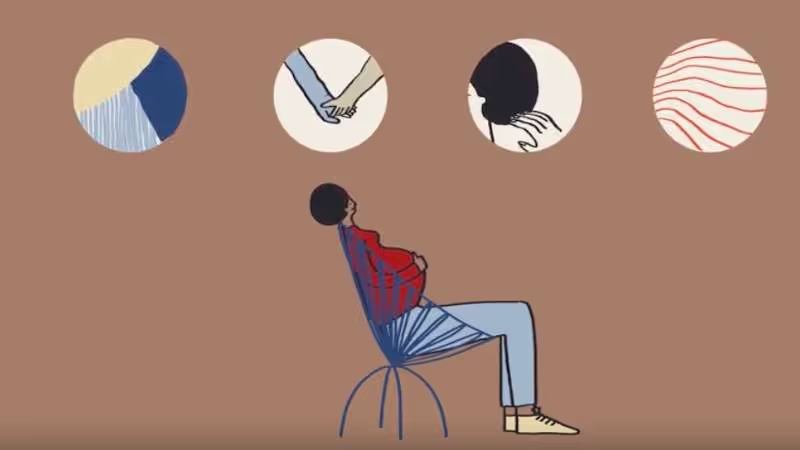
A pregnant mother of three writes to her high school sweetheart -- a football star turned NFL player. He called her out of the blue 8 years after graduation. In the aftermath, she bounces between memories of the past and fantasies of what could have been if he had showed up at her door instead of calling.

A Look Inside with Esther + Meredith

Overview

When you choose someone you renounce others, but the others don’t disappear from your life or your memory. There is always an allure of life unlived and the paths not chosen. 

The details and the sentiments of this letter are so vivid — the way the author describes her excitement, her wanting, her feeling of being young and in love. You don’t always make a life with your best lover, but you can remember that lover and energize yourself at any time.

An Exercise in Reflection

Do you find yourself pining over past lovers? This isn’t necessarily a bad thing. In fact, channeling the energy from our past intimacies can inspire and remind us of what is possible in our current and future relationships. Try this exercise to reflect on a past lover: 

First, take out a pen and paper. Physically writing will help you think more deeply and connect with your emotions and reflections. 

Choose a past partner to think about. It doesn’t matter who you choose, so long as you know there is something important or lingering that will benefit from reflection. If you have a picture of that person, of the time you were with them, or an artifact that reminds you of them, take that out too . 

With your materials assembled, reflect on the prompts below and write out your answers:

  • How do you see your relationship to this person now?
  • What stays with you from this relationship: the good, the less good, the bad.
  • What did you learn, take with you that has guided you since?
  • Who were you in that relationship, and who are you today?
  • Are there parts of you that need reclaiming in the aftermath of that relationship?

Producer & Editor: Anush Elbakyan, Producer & Script: Courtney Hamilton Knight, Animation: Daniel García, Illustration & Direction: Natalia Ramos

Read More
No items found.
Unsent Love Letters - Love Across the Decades
In this Unsent Love Letter, a woman writes about a relationship that was unlikely to succeed, but after three decades it is still strong. We discuss the nuances of love across the decades and how breaking routine can bring energy back to a relationship. Read more to hear what the letter holds.

The Letter

The relationship was unlikely to succeed, but after three decades it is still strong. A woman, pushing 80 years old, writes a letter to her blind partner of 30 years. She considers him her soul mate and her rock, despite their hurdles. The letter remains unsent because “he already knows the story.”

A Look Inside with Esther + Meredith

Overview

Not all unsent love letters have unhappy backgrounds. This letter is full of romance. The author provides in loving detail, a description of the nuances of love across the decades, the highs and the hurdles, and the reality of lives interwoven.

Letter writing can serve as an opportunity to conduct a mini evaluation. It’s a moment for the author to take inventory of their story and create a map of where they are and how far they’ve come.

An Exercise in Breaking Routine

Have you been in a relationship that defeated the odds? Whatever the hurdles may be, your love is not in question but the challenge might cause your energy to wane. How do you keep the spark alive?

For couples who are feeling a lack of energy, my suggestion is to do something together that takes you out of your comfort zone or breaks your routine. 

When you take a risk to try something new and bold, it connects to you the erotic and creates a feeling of aliveness. It can be hard to take this abstract prompt and apply it - being creative and breaking routine takes practice, so it’s OK to start small. Do something active together, like dancing or hiking. Take a class on a topic that neither of you is an expert. Or keep it as simple as this: Switch which side of the bed you sleep on. The person closest to the door brings the other coffee in the morning. 

Breaking routine and stepping out of what feels comfortable connects you to curiosity and discovery. So, ask yourselves, what is something new you can do together? 

Continue the series. Up next in Unsent Love Letters - Healing After Betrayal.

Producer & Editor: Anush Elbakyan, Producer & Script: Courtney Hamilton Knight, Animation: Daniel García, Illustration & Direction: Natalia Ramos

Read More
Discover more from Esther on Substack.
Explore articles and resources to help you find aliveness and vitality in your relationships.
Subscribe on Substack
Where Should We Begin Podcast COver

Where Should We Begin? with Esther Perel

Join Esther in her office every Monday to listen in as real couples in search of help bare the raw, intimate, and profound details of their stories.
Listen to the Podcast
Recent Episodes
View All Episodes

Where Should We Begin?

A Game of Stories

where should we begin at work product image
New
Where Should We Begin?
At Work
New
Where Should We Begin?
At Work
Improve team dynamics with Esther Perel’s renowned card game—now available for the workplace.
A live event with Esther

Sessions Live 2026

An unforgettable two-day event on relationships, love, and desire
May 15-16, 2026 | Online & In-Person in New York City
Get Your Early Bird Tickets

Courses Taught by Esther

Turning Conflict Into Connection
Uncover why you keep having the same fights over and over again. Learn how to break free from habitual patterns and responses. Find peace and reconciliation even when you disagree.
Gain new insights in just one hour
Downloadable workbook filled with guided exercises
Improve conflicts with or without a partner
View Course
Playing with Desire
Uncover and learn how to speak about your desires. Bring more aliveness into your sex life. Create rich, erotic rituals. Cultivate a more vibrant and fulfilling erotic relationship.
Perfect for date night
Playful exercises and prompts to tap into new erotic possibilities
Based on the same processes Esther has used to help real couples for 40+ years
View Course
Bringing Desire Back
Uncover what blocks desire. Learn how to tap back into pleasure and get unstuck. Discover a new sense of hope and possibility.
Perfect for date night
Guided exercises to turn insights into action and understanding
Based on the same processes Esther has used to help real couples for 40+ years
View Course
The Desire Bundle
Two courses designed to help you and your partner break out of sexual ruts, explore new possibilities, and build deeper connection.
Understand, communicate, and explore your sexual needs
Spark honest and constructive conversations about sex and desire
Designed to reignite curiosity, intimacy, and deeper connection in your sex life
View Course