All Articles
Thank you! Your submission has been received!
Oops! Something went wrong while submitting the form.
No items found.
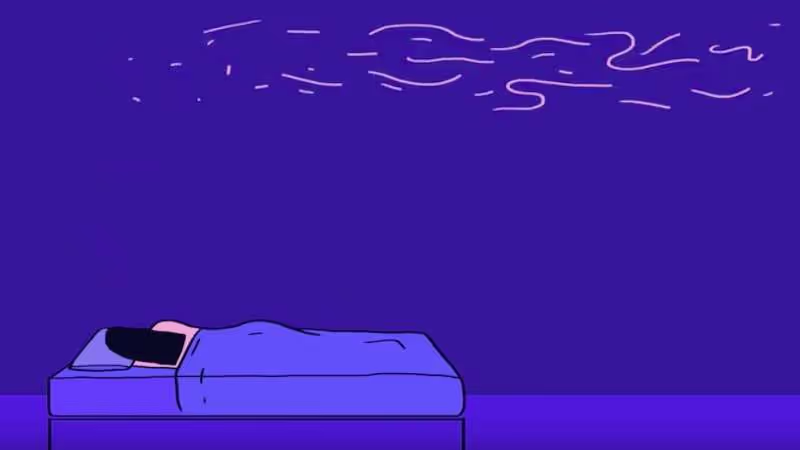
Unsent Love Letters - Lingering Loss
In this Unsent Love Letter, the author writes to a former long-term partner who she hasn't seen for eight years. We discuss the themes of lingering loss and celebrating what once was. Read more to hear what the letter holds.

The Letter

A 40-year-old woman writes to her lover for the better part of a decade. It’s been eight years since their relationship ended, and she doesn’t have anything to remember their relationship. No gifts, no way to contact him, and no photos of him or them together. Only a selfie of herself that reminds her of how she felt during that time.

A Look Inside with Esther + Meredith

Overview

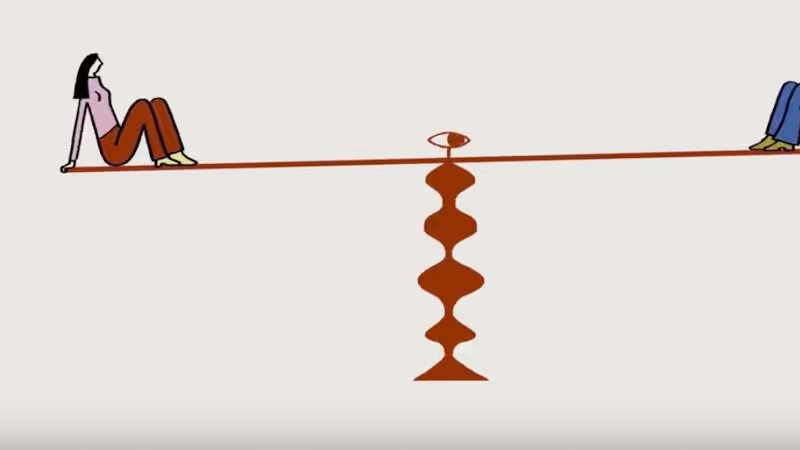
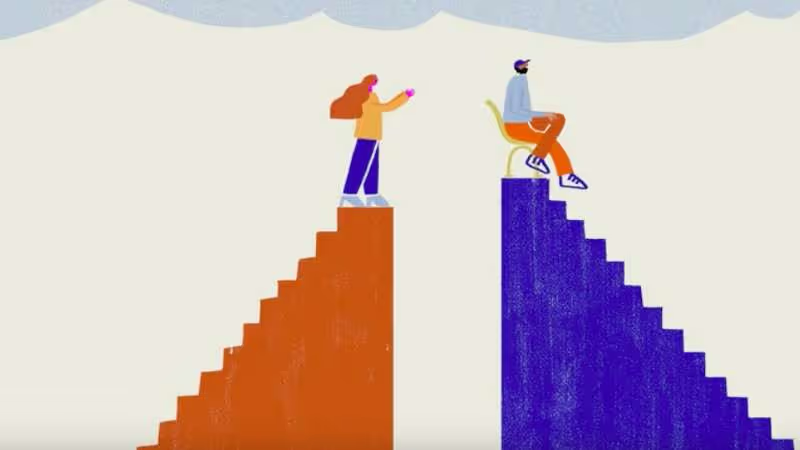
This is the kind of letter that helps you accept that it’s over. It’s a letter that is written to process the obvious. The author writes about a world her former lover has entered without her. We get a sense of loss that still lingers despite the time that has passed.

Though no other physical trace of their relationship exists, a single selfie brings our author back to her former lover and the feelings they shared. It is a beautiful example of what love is - how someone can make you feel and how you feel about yourself when you’re with them. Even in a time when we are almost all one click away, this selfie is all she needs.

An Exercise in Celebrating

It is possible to let go of a relationship without forgetting or devaluing it. The mourning process includes processing loss, but it also involves celebrating what once was. One of my favorite recommendations is to hold a celebration for the relationship as an experience that is now in the past. Bring close friends together and sing your heartbreak.

Continue the series. Up next in Unsent Love Letters - Young and In Love.

Producer & Editor: Anush Elbakyan, Producer & Script: Courtney Hamilton Knight, Animation: Daniel García, Illustration & Direction: Natalia Ramos

Read More
No items found.
Unsent Love Letters - An Introduction
Welcome! Unsent Love Letters is a six-part series of real unsent love letters from people who wrote to a loved one, but in the end kept their words to themselves. Each article includes the original letter, a playful video discussion, and an exercise for those who resonate. Read more to get started.

Unsent Love Letters is a project in collaboration with The Boston Globe’s Love Letters columnist Meredith Goldstein. We collected real unsent love letters from people who wrote to a loved one, but in the end kept their words to themselves. Each article includes the original letter, a playful video discussion between Esther and Meredith, and an exercise for those who resonate. Watch the introduction video below to get started. Then jump over to the first letter of the series.

Unsent Love Letters with Esther + Meredith

Letters are a treasured part of my life. Collaborating with the Boston Globe on the Unsent Love Letters project has been an exciting opportunity to celebrate the richness of this lost art. I am moved by the stories that you have graciously shared with us. Each letter, a ticket into the inner world of the author, inviting us to access hidden parts of ourselves. I've been an active letter writer for most of my life. I like writing, and I love receiving letters. It confirms that I exist in the mind and memories of others.

I have boxes of letters that have traveled with me from Belgium to New York, and all my homes in-between. These notes serve as markers of different important moments in my life. They are authored by my husband, sons, family members, friends, past lovers, and strangers who reach out to share their stories.

The process of writing allows us to speak to parts of ourselves that can be hard to access
 — lost parts, exiled parts, or invasive parts. Letters create space for our unique inner voice, and give us a place to internal conversations.

In therapy too, I often coach clients to write letters to the important people in their lives, whether they decide to send them or not.

Letters help you sort through and express difficult feelings and experiences.
 Some are a gesture of gratitude. Others, a long-overdue apology. And others yet, an attempt to clarify, establish boundaries, and be heard. Love notes range from lustful narratives to longings for "the one that got away" to flat out detailed revenge fantasies. Sometimes, they aren't meant to be delivered. Sometimes they’re just for you.

We selected six unsent letters from the many submissions to discuss. Each article includes the unsent letter, a playful discussion between me and Meredith, and an exercise for those who resonate with the theme. 

Start with the first Unsent Love Letter of the series, or explore any of the themes below.

  1. Fantasy and Unrequited Love
  2. Love Across the Decades
  3. Healing After Betrayal
  4. Lingering Loss
  5. Young and In Love

Producer & Editor: Anush Elbakyan, Producer & Script: Courtney Hamilton Knight, Animation: Daniel García, Illustration & Direction: Natalia Ramos

Read More
No items found.
Unsent Love Letters - Healing After Betrayal
In this Unsent Love Letter, the author writes to her partner of a year who’s been living a parallel life. We discuss the themes self-blame after a betrayal and the importance of social connection during a time of healing. Read more to hear what the letter holds.

The Letter

A woman writes to her partner of a year who’s been living a parallel life. He’s just revealed his engagement to another woman. He says he’ll choose between them, but she only hears silence as she watches him post happy pictures with his wife-to-be.

A Look Inside with Esther + Meredith

Overview

When faced with a breakup or betrayal, many of us seek to find fault with ourselves as a first step in understanding the loss and pain.

Our author proclaims, “What could I have done differently?”, “I tried so hard to give you what you wanted.”, and “I was everything you wanted me to be.”

Self-blame can spiral endlessly, but is not usually reflective of the story of a heartbreak. We’d rather insert ourselves into a lousy plot than to think it wasn’t about us to begin with. Often, the narrative is “I feel like I am not enough” rather than “you weren’t enough for me.” In truth, neither narrative is likely to accurately describe your story.

An Exercise in Healing

If you’re facing heartbreak or betrayal, the temptation to blame yourself may be strong. It’s hard to take care of yourself when you feel terrible because someone has just rejected or betrayed you (or both). 

In these moments, social connection is of the utmost importance. Grief and mourning should not be experienced alone. So reach out to people who love you, the people who were there before the breakup and who will be with you long after. Connect with those who don’t offer too much advice, but who can sit with you as you process and grieve.

As a gesture of moving forward, try this ritual: 

  1. Find three objects that remind you of this person. 
  2. Create an environment that you’re comfortable in - add music, invite your closest friend or circle of friends, etc.
  3. Bury the items and leave them behind.

Continue the series. Up next in Unsent Love Letters - Lingering Loss.

Producer & Editor: Anush Elbakyan, Producer & Script: Courtney Hamilton Knight, Animation: Daniel García, Illustration & Direction: Natalia Ramos

Read More
No items found.
Unsent Love Letters - Fantasy and Unrequited Love
In this Unsent Love Letter, a woman writes about a future she'll never have with a man she'll never be with. We discuss the themes of fantasy and unrequited love and the ritual of closure. Read more to hear what the letter holds.

The Letter

In this submission, a woman lays out a future she’ll never have with a man she’ll never be with. She was his colleague, he was her friend… and he was engaged to someone else. This unsent love letter reads as a poem, detailing the simple future she longed for but never revealed out of respect for his relationship.

A Look Inside with Esther + Meredith

Overview

The importance of this letter for us is how it helps us learn about fantasy and about unrequited love, and how they relate to one another.
Fantasies are detailed scripts. This letter is incredibly specific about a future that will never be. It’s a simple example of how fantasies are deeply personal and how every small detail matters. The fantasy our author describes is a wish of what could be, but fantasies can also be unrealistic - they don’t always represent what we want in real life.

When I asked our author if she regrets not sending the letter, she replied, “a bit.” Her feelings of unrequited love persist, but this fantasy was not meant to be. Sometimes we have to walk away from the person we want so much. Out of respect for the other or ourselves.

An Exercise in Closure

Have you ever had to walk away from something you wanted? Do you still cling to the “what ifs?” -- What if I had said something? What if we had met at a different time? Under different circumstances? 
No matter the circumstance, it can be hard to process love unreturned. For those of you in a similar situation, I suggest you create a ritual of closure. To perform an act that closes the door completely and does not keep it cracked.

  • Write a final letter using one or all of the prompts below (to share or keep to yourself)
  • This is what I hope you take from me.
  • This is what I wish for you.
  • When I think about x, y, or z, I’ll smile.
  • Take yourself to a beautiful place in nature. Hike, collect rocks and throw them far away. Releasing yourself from the hold the relationship still has on you with each throw.
  • If you’ve been together, give them back their belongings. Or anything that no longer makes sense to hold on to and keep.

Continue the series. Up next in Unsent Love Letters - Love Across the Decades.

Producer & Editor: Anush Elbakyan, Producer & Script: Courtney Hamilton Knight, Animation: Daniel García, Illustration & Direction: Natalia Ramos

Read More
Eroticism
Crisis
Feeling Touch-Starved? How Our Sense of Touch Keeps Us Radically Connected to Ourselves
Our sense of touch is a powerful tool for self-care. Nothing can replace the touch from a loved one, but this period of distance from others gives us an opportunity to explore a type of physical intimacy we often neglect: that which lives inside of us. Read more about why self-touch is important for the relationship we have with ourselves and how it can help us through this moment in time.

We can live without sex, but we can't live without touch. When we are not touched, we become irritable, aggressive, dysregulated, and depressed. We need touch to feel safe and to establish secure attachment. We need touch because it signals trust and connection. We need touch because it soothes and is pleasurable. 

Pause for a moment. As you read that, did you immediately think of the touches you’ve shared with another person? Read it again now and think about the sense of touch you share with yourself. 

In the last twenty years—as we’ve transitioned to often connecting more with people online than in person—have you felt a sense of touch hunger? 

In the last year—as connection with a stranger has gone from an opportunity for spontaneous engagement to an opportunity for spontaneous contamination—has that touch-hunger become touch-starvation? For the foreseeable future, sharing touch with others comes with side-effects: danger, paranoia, frustration when we accidentally trespass our new regulations, and defiance if and when we make our own rules. But one of the hardest side-effects has been loneliness, especially in the moments when we’ve needed touch the most. 

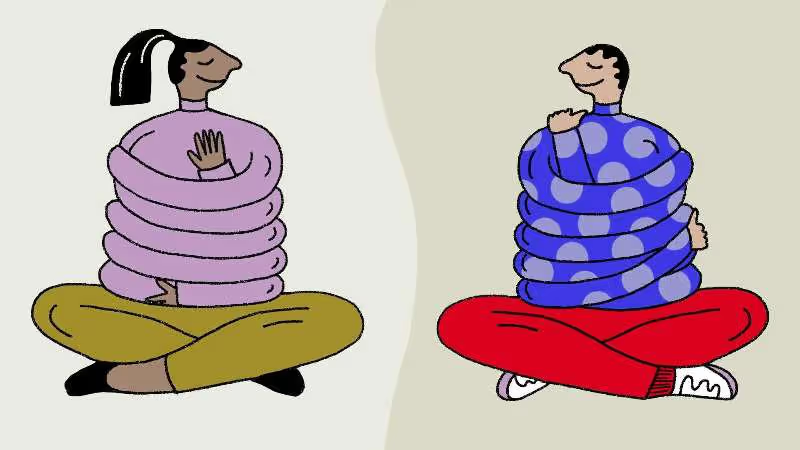
Nothing can replace holding a loved one’s hand, a tight hug with an old friend, a first kiss, or sitting next to a kind stranger. But this period of distance from others has given us an opportunity to explore a type of physical intimacy we often neglect: that which lives inside of us. Not only can self-touch help us through this moment, it can have lasting effects on the relationship we have with ourselves. Self-touch, whether through massage, masturbation, or tuning in to the way the elements feel on our skin, has always been about self-soothing. These days, it has also become our safest and most powerful tool for self-care

The Human Need for Touch

In the beginning of life, touch is the first sense that we develop. As babies, we suck our thumbs, twirl our hair, and clutch a blankie. We seek softness because we like the way it feels on our skin. Each of these self-touches are a baby’s search for self-soothing when skin-to-skin contact with another isn’t available. In these moments, we learn to calm ourselves, lower our heart rate and cortisol levels, and to release oxytocin. A baby doesn’t know the science, but is unmistaken for what feels good and what feels bad. That dynamic follows us into adulthood. We know what we like and don’t like even when we don’t have the words for it. That’s because touch itself is a language, our first one, and it’s comprised of an intimate vocabulary that includes pain and pleasure.

When someone touches us and we recoil under their fingertips, we’re communicating that we’re uncomfortable. When someone touches us and our muscles relax, we’re saying “I feel good. I feel safe.” The same goes for when we touch ourselves. When we give ourselves a warm touch, gently rubbing our belly or scratching our head, we calm our cardiovascular stress and activate the body's Vagus nerve. This is intimately involved with our compassionate response—both giving and receiving, to others and to ourselves. So when we touch ourselves kindly, we’re communicating tenderness and care to our whole body. When we smack our palm to our forehead upon realizing a mistake, we’re saying “I messed up.” When we masturbate, we’re reminding ourselves that we deserve to feel good, to relax, to be turned on, to take time for our own pleasure. 

Our Sense of Touch Develops in a World of Mixed Messages 

When we think of touch as a language, we can go deeper than good versus bad touch, touch that gets green light or red light. We can also look at the societal, cultural, and interpersonal messages that inform the language of touch. We grow up and live in a world of mixed messages about physical touch, and particularly self-touch. 
The fundamental physiological, emotional, and psychological reasons for touch evolve as we do, but we learn to suppress the need. In the western world as we enter school-age, we’re told that masturbation, a natural self-soothing practice, is a no-no. In junior high, Sex-Ed tends to focus on penetrative sex or no sex at all, cutting out the wide range of options in between or with oneself. The concept of pleasure doesn’t even enter the equation. By the time young Americans begin sexual activity, the vast language of touch—what sexologist Jaiya breaks down as affectionate touch, healing touch, sexual touch, and erotic touch—has been collapsed into one big NO. 

It’s not just sex-ed. From our teenage years into adulthood, our dominant sexual model focuses so much on orgasm that many of us, when we don’t want to engage in the full production, block off the basic pleasures of touch altogether. This dynamic often manifests as a disengagement from the self-soothing tools with which we are born. The body begins to forget how natural and good it feels to take care of itself. We forget the power we have to make ourselves feel valued, satisfied, worthy—even loved. Unfortunately, certain sectors of society count on this, and not just to sell beauty and wellness products. 

Reclaiming Our Sense of Touch is a Radical Act 

For all of human history, cultures have used the body as a vessel for social control. At a very basic level, our internalization of negative messages about our bodies—and prohibitive instructions surrounding our agency—block our ability to turn to ourselves for a sense of well-being. This is particularly so for peoples whose boundaries have been infringed upon and violated, those whose bodies have been radically changed by illness, and those for whom society’s biased standards reinforce unworthiness and shame. 

Perpetuating the idea that pleasure, acceptance, value, and care can only come from an external source keeps us dependent on people, companies, governments, and systems—not to mention loads of products—that don’t serve us. When we take our pleasure into our own hands, so to speak, we’re expanding the language of touch to include a declaration best explained by self-described “black, lesbian, mother, warrior, poet” Audre Lorde. “Caring for myself is not self-indulgence. It is self-preservation, and that is an act of political warfare.” 

One such example is the work of Rafaella Fiallo and Dalychia Saah, the pleasure advocates, educators, social workers, and creators behind Afrosexology. Their vision for a liberated Black sexuality “is that reclaiming and having agency over our bodies will transfer to other aspects of our lives and incite us to reclaim political, economic, and social agency.” 

Go Ahead and Touch Yourself 

It’s time. Turn the computer off. Put your phone out of reach. Declare to whomever that you’re taking time for yourself.

Find five objects that you might love to touch. Maybe it’s a silk scarf, a stress ball, a leather-bound book, a body oil, or a new favorite: slime (to play with). Try to describe exactly how each of these objects feel on your skin and what makes the sensation pleasurable.

Now that you’ve tuned into how something else feels on your skin, explore how your own hands feel. Experiment with different touch: fast and slow, shallow and deep, circular and linear, back of palm, front of palm. Reverse your palm up and use your index finger to trace a path from the tip of your middle finger to the crease of your elbow, with a slow—even slower—circular motion. What is the slowest you can go until you reach your elbow? If you do this with your eyes closed, you’ll think you’re there long before you are. See how many tries it takes to accurately sense it. 

As you engage in these exercises, think about the places on your face and body you never touch. Explore them. Take note of how, when you touch yourself, you’re giving and receiving at the same time. How does hedonic contact with yourself make you feel?

Read More
No items found.
When Transitioning Between Stages of a Relationship, Practice Adaptability
Adaptability in couples is about responding to life’s changing circumstances with good communication and a lot of flexibility. Read more about why adaptability is an important element in helping couples navigate the different stages of a relationship.

A relationship is like a perennial plant; both become more resilient as they learn how to balance the contradictions required for growth. Under the earth, the plant needs sturdy roots. Above, it needs to be able to dance on the wind. It needs sunshine and rain. It needs attention and space. It changes with the seasons, dying back and growing up over and over again. And when it outgrows its pot or plot, it needs to move. 

Moving a plant is a careful process. We have to consider its internal needs and how to prepare its new home. We have to prioritize what will help it survive the transition and adapt to its new circumstances. When we’re preparing ourselves to move from one relationship stage to another—from casual to serious; dating to engagement to marriage; or partner to parent—the same considerations are necessary. 

Every relationship, every person, and every living organism straddles stability and change. If our relationship doesn’t change, it fossilizes and dies. But if it changes too much and too fast, it dysregulates and becomes chaotic. Navigating this back and forth between old and new, order and surprise, roots and buds is the key to adaptability within relationships. 

We’re Changing Faster Than Ever Before

Over time, how we balance stability and change in our romantic relationships has evolved. As strict gender roles have faded in the western world, our roles and responsibilities have become less fixed and more fluid. For most of human history, there was very little ambiguity about how to transition from one relationship stage to another. Religious and societal rituals around birth, puberty, courting, marriage, pregnancy, and death made life’s additions and subtractions a neat and predictable equation. 

These days, many of us have kids or move in together before getting married, have multiple long-term relationships, or are raising our families in multi-generational households. To put it simply, we are making up the rules in real time. The rise of egalitarianism, autonomy, authenticity, and personal growth has become part and parcel of modern love. And that means that our relationships are in a constant state of development. This transition—from institutional regulation to intra- and interpersonal responsibility—has left us expecting more from our romantic relationships than ever before.

We still want the traditional elements of companionship, economic support, family life, and social status, but on top of that, we also want our partners to be a salve against our existential loneliness, a passionate lover, an intellectual equal, and a person who will help us become the best version of ourselves at every stage of our lives. Many of us don’t just want stable and lasting relationships; we want successful relationships. To meet these romantic aspirations, we find ourselves having to confront change constantly. And change is rarely easy. Now, as founder and director of The Couples Institute, Ellyn Bader, says “the task is to learn how to be open and authentic with each other about what you think, feel, and desire, and to be able to hold still while your partner does the same thing—and then to learn how to manage those differences successfully.”  

Growing Through Stages of a Relationship Together

Ever heard the phrase “opposites attract?” It’s not always true, but there is an element of that phrase that exists in every relationship and at every stage. If we’re a big planner, we may find ourselves attracted to a person who goes with the flow, loving the spontaneity our partner brings out in us. But the easy-going nature which once filled us with possibility may induce anxiety when planning our first big vacation. A minimalist boyfriend may love his girlfriend’s maximalist style until they move in together. The couple who initially prioritized their independence may struggle when getting pregnant necessitates a massive redistribution of resources, energy, and attention.

The couples who stand strong in their convictions and hold tight to who they’ve always been, or how they were in the beginning, are the ones more likely to walk away in separate directions when confronted with change. On the other hand, extreme compromise—in which one partner tosses their own needs to meet the others’ demands or to avoid conflict—doesn’t work either. We may not walk away from each other, but we won’t be happy if we stay. In a healthy relationship, the solution is almost never to demand that our partners change while we stay the same. To be more adaptive, we must ask what we’re contributing to the existing dynamic. And then we must ask each other the fundamental questions that will help us become more adaptable. 

Questions to Build Adaptability

  • Does this arrangement still work?
  • What will help us survive and thrive during this transition? 
  • What do we want to take with us from our previous relationship stage into our next one? 
  • What do we want to leave behind? 
  • What do we want to try that we never have before?
  • What does it mean to consciously move forward into a new relationship stage together? 
  • What conversations need to be had?
  • What affirmations need to be given?
  • How do we redistribute our resources to meet this moment?
  • What do we do when we’re finding it difficult to adapt?
  • How do we remind each other that we’re in it together?

Adaptability in couples is about responding to life’s changing circumstances with good communication and a lot of flexibility. Just like a big body stretch, pushing past our resistance helps us become more flexible. Think about all of the changes you’ve made before: how you’ve grown around the change, how you’ve held it. Transitioning through relationships stages means growing around the change together, keeping the roots sturdy while giving the buds room to dance. Being adaptive is a constant engagement with the unknown—but also with possibility.

Read More
No items found.
The Power of Apologizing: Relearn How to Say “I’m Sorry”
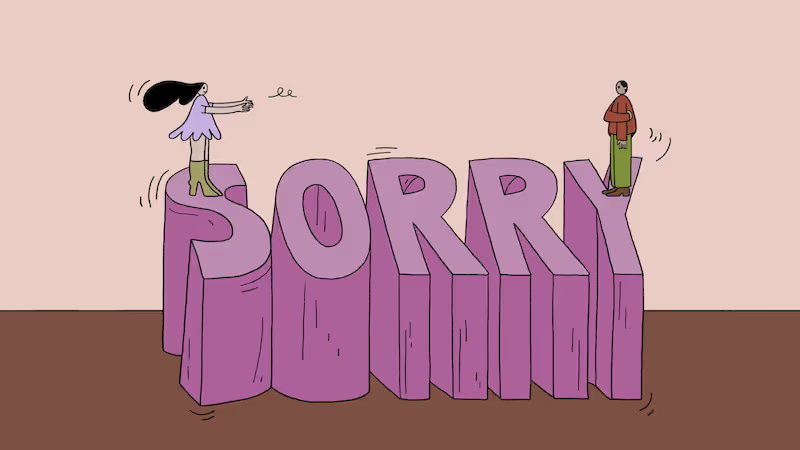
A strong, meaningful apology goes a long way in repairing major and minor rifts in any relationship. Intellectually, we know this. Apologizing is one of the first relationship skills we learn as young children. But it’s a skill that needs to grow with us. Read more on the power of apologizing and relearn how to say "I'm Sorry."

To whom do you owe an apology? Before you read on, take a moment. Say their name aloud. 

Now, answer the question: why do you feel the need to apologize? 

  • Did you do something wrong? Hurtful? 
  • Was it on purpose or accidentally? 
  • Have you been careless with this person? Negligent?
  • Did you say or do something you regret? 
  • Do you need to take accountability for something that has been weighing on you? 
  • Are you just as angry with them as you are with yourself?
  • Are you craving reconciliation? 
  • Would you like to be able to move on?
  • Would you like to try to make them feel better? 
  • Are you trying to make yourself feel better?
  • Do you feel you deserve to be forgiven? 

A strong, meaningful apology goes a long way in repairing major and minor rifts in any relationship. Intellectually, we know this. Apologizing is one of the first relationship skills we learn as young children. But it’s a skill that needs to grow with us. When we first learn to apologize, we often do it because we are told we need to—apologize to your brother for taking his toy. Say you’re sorry to your classmate for not including them in the game. The other child is told to reply I forgive you. There is a clear outcome of this dance: repair in the service of getting back to what matters—play. 

This knowledge becomes less obvious as we get older, more layered with complexity. We forget how much we need play and connection—how much we love it—and how apologizing can lead us back to it. Instead, we cling to our position. We convince ourselves that apologizing means admitting defeat. Or that, no matter how much we apologize, we’ll never be forgiven. We know the way back to each other, to lightheartedness, to connection, to play. But it feels tremendously hard. It can feel shameful. And that shame can prevent us from reaching out. I don’t even know what to say so I’m not even going to try. And why am I the only one apologizing in this relationship?

Apologizing Puts the Relationship First

“A good apology is when we take clear and direct responsibility without a hint of evasion, blaming, obfuscation, [or] excuse-making—and without bringing up the other person's crime sheet,” says Harriet Lerner, clinical psychologist and author of Why Won't You Apologize? Healing Big Betrayals and Everyday Hurts.

One way to interpret this is that a good apology puts the relationship first. It doesn’t find a way to justify what you did or to go tit for tat with the other person. Repair, in general, puts the good of the collective above the interests of the individual. Even when you want to scream, slam a door, bring up what they did, slip into feisty blaming, or not talk to them for the next three days, ask yourself: “if I do this now, what will this do to our connection? What does our relationship need?” 

Some apologies swim in murky waters. Even if you don’t regret what you did (going out without your partner, not inviting a friend to your wedding, refusing to lend money to your brother), you can apologize for the impact it had on that person. However, be careful of the language you use. “I’m sorry if I made you feel” may sound appropriately apologetic but it puts the responsibility on the other person. 

Redemption requires accountability. A good apology includes: 

  • awareness of what you did
  • responsibility for how you behaved
  • acknowledgment of the impact this had on the other personeven if they hurt you, too. 

From this place, you can stand accountable without needing the other person to validate, redeem, or forgive you. You just do your part, for the good of the relationship.

A Good Apology Empowers Us

There is power in apologizing first. It’s not only because there is power in vulnerability. It’s because there is something about owning, claiming, and taking responsibility that gives you a sense of agency. It’s not power “over” another; it’s power “to”—to clear the debris, to reorganize the pieces, to make things right. When you apologize, you choose to change the story, to move the plot forward. As the apologizer, you are the person who is saying “Enough. We may have made this mess together, but I own my part and I’m sorry to you for what I’ve done.” 

Apologizing also helps us to realize how much impact we can have on another person. There is weight to our actions. If we have the power to hurt, we also have the power to take a step toward healing. And, when we apologize first, we open the door for the other person to meet us in that place of open communication. We lessen the shame for them. We acknowledge together that being on good, or at least neutral, terms is more important than winning. 

Forgiveness Can’t Be Forced

While you have the power to say sorry, the other person has the freedom to forgive or not to forgive. Perhaps this is what makes it so hard. We know that once we make the first move, we’re no longer in control. Our vulnerability can be met with rejection. 

A good scenario: you apologize and the other meets you there by saying thank you or I forgive you or by coming forward with their own self-awareness. 

A less ideal scenario: you are on your knees with someone who seems to relish your self-flagellation. The sadist may want to humiliate you. More often, the person is just so hurt, they want you to join them in that feeling. 

A worse scenario: The apology has never been made or accepted and the unfinished business follows us to the end of life, even traveling across generations. (There’s a reason why this is a central plot of countless books and films.)

So much has been said across history, culture, art, and religion about this power dynamic. Judaism, for instance, dictates that it is the apologizer's responsibility to stand accountable but, if after three times, the person who was aggrieved has not received the apology, the burden passes to them. A serious offense requires a serious apology, sometimes more than once, but there is a limit. Sometimes forgiveness takes time. Sometimes it doesn’t come at all. 

Apologizing Connects Us to Our Humanity 

Lerner believes that “I’m sorry” are the most important words in language. “We’re all connected. We all screw up. We’re all imperfect human beings. When they’re done right, apologies are very healing. But when apologies are absent or they go south, it will compromise or lead to the end of a relationship. Apologizing is central to everything we hold dear—to family, to marriage, to leadership, to parenting, to our ability to love ourselves and love other people.” 

Throughout life, we have lots of opportunities to say “I’m sorry,” to others and to ourselves. With each one, we gain a deeper understanding of the power of apology—and how to do it right. One of the most healing aspects of repair comes when we see each other trying. Even if we’re not getting it exactly right, we’re getting a little better at it each time. The poet Rumi said “out beyond ideas of wrongdoing and rightdoing, there is a field. I'll meet you there.”

Read More
No items found.
The Language of Gender: Beyond Boy and Girl
Esther explores the importance of language in our experience of gender.

Today, Esther covers the importance of language in our experience of gender.

From the debate around bathrooms to transgender celebrities on magazine covers, gender has become the new frontier for self-expression and self-determination. The sexual revolution is far from over, but the gender revolution has arrived. An entirely new vocabulary is emerging for people to understand the differences between body, sex (i.e. anatomy prescribed at birth) and gender.

So how do we begin to talk about gender? How do we understand gender beyond the simple binaries of, boy and girl, man and woman that we have been raised with?
Similarly to sexuality, it comes down to linguistics. When we have the language it helps us identify who we are, but more importantly, it helps us understand the other. When we only have two categories and think in shades of blue and pink, we end up stigmatizing and rejecting those who don’t fit these boxes.

We need a glossary of terms to navigate the colorful spectrum of possibilities. With that in mind, National Geographic released a stimulating issue on gender at the beginning of 2017, in which they redefined gender in a glossary of 21 terms (although there are many more that could be added).

Having a vocabulary is crucial. Language shapes our experience, it gives us access, understanding, emotional resonance, and meaning. So let’s begin with a few terms from Nat Geo as we expand our understanding and join this cultural revolution:
Genderqueer: Someone whose gender identity is neither man nor woman, is between or beyond genders, or is some combination of genders.
Cisgender (pronounced sis-gender): A term to describe a person whose gender identity matches the biological sex they were assigned at birth. (It is sometimes abbreviated as “cis.”)
Intersex: An umbrella term that describes a person with a genetic, genital, reproductive, or hormonal configuration that does not fit typical binary notions of a male or female body. Intersex is frequently confused with transgender, but the two are completely distinct. A more familiar term, hermaphrodite, is considered outdated and offensive.

Check out the entire piece to begin to understand the gender revolution. And look out for next week’s blog post in which we’ll talk about why gender is so important and the deep-seated roots of our old gender binary system.

How do you define your gender? How has the gender revolution opened your mind or challenged you?

Read More
No items found.
The Best Steamy Movie Scenes—And Why You Should Indulge
There is something to be said for the specific elixir of escapism and engagement that a great sex scene can inspire in us, whether we’re watching alone or with a partner, in bed or cozied up on the couch with candles lit. Read more for a collection of steamy movie scenes from Esther and our community, and why you should indulge.

A great sex scene. There’s nothing like it, especially now—when the world outside is full of strife and so many of us long for touch. These days, we’re more likely to binge watch our favorite comfort shows, the ones that wash over us like a warm bath, than to seek out films and t.v. that go directly into us, igniting our deepest needs and desires. But there is something to be said for the specific elixir of escapism and engagement that a great steamy movie scene can inspire in us, whether we’re watching alone or with a partner, in bed or cozied up on the couch with candles lit. We get on a roller coaster of heightened tension and release, up and down, without ever having to leave home. The arts grant us permission for new experiences. Plus, we get a bit of a cheat sheet to jumpstart real-life intimacy if we feel so inclined. 

When we enter the onscreen erotic landscape, the fantasy enters us, too. And when we do this with a partner, we can explore the same erotic universe together, fully fleshed out with characters, plot, and setting. When we watch an erotic scene, our system of wanting is triggered—maybe not precisely what they are doing in the scene, but wanting what they are feeling or our version of it. 

Our entrance into these worlds often begins before we know it. A glance, touch, or words spoken between characters that indicate some private tension, immediately tickling the voyeur in all of us. Watching intimacy that feels like it isn’t meant for us allows us to see something that might otherwise be forbidden. As a result, it allows us to see parts of our own erotic blueprint that might also be forbidden. It’s part of the reason why people enjoy “Where Should We Begin?” and “How’s Work?” You are allowed into a space and a story that is private, one that is normally behind a closed door because of the vulnerability of what is discussed. 

An Invitation to Fantasize

Physiologically, watching erotic scenes triggers arousal, adrenaline, a dopamine rush. It awakens us to our own desires and projections. We identify or idealize those who break out of shame and restraint. Sometimes we imagine ourselves in the situation, which triggers memories and feelings of prior experiences or something we want to try. Sometimes we wonder what it would be like to have someone watch us in the act the way we’re watching the characters on screen. To be gazed upon or to gaze—both deeply sexy. Moreover, sex scenes express the confidence, irresistibility, or sensation of being wanted to which we aspire. 

Watching erotic scenes is an act of desire. Desire, as in owning a wanting that is made ever-stronger by not having the very thing we covet, as Plato so well outlined in “The Symposium.” Who can’t relate to that? The sense of deprivation combined with the rush of fulfillment fits squarely within the great sexologist Jack Morin’s erotic formula: attraction plus obstacle equals excitement. A central theme of the erotic crescendo is overcoming the obstacle. They finally are able to meet. They've been able to escape. They've been able to let each other know the secret love they’ve held for their whole lives. The merging of lovers is the victory against forces trying to keep them apart. In some scenes, desire is devouring them to the point that they betray their own moral principles. Giving in to their deepest yearnings, they find themselves with people and in places beyond the scope of their imaginations. In other scenes, it isn’t so much about engaging in the forbidden but in marrying the emotional and sexual—sex and love; sex and grief. Erotic scenes can be light, others dark. 

Watching Morin’s erotic formula play out on screen shows us how life’s trajectory can change in a moment. They fuck. They fall in love. They throw the rules out the window. They give in to some greater arc, some irrepressible cosmic force. We know the feeling, don’t we? To connect with the parts of us we never knew existed is an experience of freedom, power, greed, ardor, intensity. When we watch these scenes, we also get to play with the constraints of morality, reality, properness, or good citizenship, without ever having to learn the hard way. Oh, the fantasy of Transgression! Just like our own internal fantasies take us outside of our everyday lives and counter the fears and inhibitions that live inside of us, so too do erotic moments in film. 

A Sampling of Some of the Best Steamy Movies

A partial list of films that contain some of the best erotic scenes

  • 9 and 1/2 Weeks — Adrian Lynn (US) 
  • 50 Shades of Grey — Sam Taylor-Johnson (US)
  • An Affair of Love — Frederic Fonteyne (France) 
  • Atonement — Joe Wright (UK)
  • Black Swan — Darren Aronofsky (US)
  • Blue is the Warmest Color — Abdellatif Kechiche (France)
  • Broke Back Mountain — Ang Lee (US)
  • Carol — Todd Haynes (US)
  • Diary of a Mad Black Woman — Darren Grant (US) 
  • Exotica — Etom Egoyan (Canada) 
  • Eyes Wide Shut — Stanley Kubrick (US)
  • Far and Away — Ron Howard (US) 
  • Friday Night — Claire Denis (France) 
  • Hamam (Steam) — Ferzan Ozpetek (Turkey)  
  • History of Violence — David Cronenberg (US) 
  • In the Mood for Love — Wong Kar Wai (Hong Kong)
  • Intimacy — Patrice Chereau (France) 
  • Kama Sutra: A Love Story — Mira Nair (India) 
  • Late Marriage — Dover Kosashvili (Israel)
  • Les Liaisons Dangereuses — Roger Vadim (France) 
  • Moonlight — Barry Jenkins (US)
  • Portrait of a Lady on Fire — Céline Sciamma (US)
  • Secretary — Steven Shainberg (US) 
  • She’s Gotta Have It — Spike Lee (US)
  • Shortbus — John Cameron Mitchell (US) 
  • The Last Mistress — Catherine Breillat (France/Italy)
  • The Lover — Jean Jacques Annaud (France) 
  • The Unbearable Lightness of Being — Philip Kaufman (US) 
  • Unfaithful — Adrian Lyne (US)
  • Y Tu Mamá También — Alfonso Cuaron (México) 

The Steamy Movie Scenes You Love The Most

We put out a call on social media for your all-time favorite erotic scenes

  • “Film - Reaching for the moon. Scene - first sex scene between Lota and Elizabeth” 
  • “Season 2 of Fleabag when she is in the confession booth and hot priest tells her to kneel” 
  • “In the boat on THE WEDDING DATE” 
  • “Ingrid Bergman and Cary Grant’s long balcony kiss Notorious”
  • “From the German film The Lives of Others. The Stasi officer hires a prostitute, then asks her not to go” 
  • “Dirty Dancing - Patrick and Jennifer dancing to Cry To Me on the vinyl player” 
  • “The Blue Lagoon - when they make love for the first time” 
  • “The kiss between Willow and Tara from Buffy the Vampire Slayer” 
  • “Bank robbing fighting kissing scene in Godard’s Prénom Carmen” 
  • “The orchestra scene at the end of Portrait of a Lady on Fire” 
  • “The first kiss between Marianne and Connell on Normal People” 
  • “Queen and Slim having sex in the car” 
  • “Grey’s Anatomy: S5E19: Cristina and Owen’s sex scene after his PTSD episode.” 
  • “Call me by your name. When they first kiss.” 
  • “Julia Roberts & Jude Law in Closer in her atelier” 
  • “New Girl TV show - Nick kissing Jess saying “hat is what I meant, when I said I want to do it like that”
  • “Outlander, Jamie and Clair’s wedding night” 
  • “Titantic’s erotic car scene” 
  • “A recent one is from Netflix Mexico “oscuro secreto” from the first chapter “Es solo sexo”
Read More
Discover more from Esther on Substack.
Explore articles and resources to help you find aliveness and vitality in your relationships.
Subscribe on Substack
Where Should We Begin Podcast COver

Where Should We Begin? with Esther Perel

Join Esther in her office every Monday to listen in as real couples in search of help bare the raw, intimate, and profound details of their stories.
Listen to the Podcast
Recent Episodes
View All Episodes

Where Should We Begin?

A Game of Stories

where should we begin at work product image
New
Where Should We Begin?
At Work
New
Where Should We Begin?
At Work
Improve team dynamics with Esther Perel’s renowned card game—now available for the workplace.
A live event with Esther

Sessions Live 2026

An unforgettable two-day event on relationships, love, and desire
May 15-16, 2026 | Online & In-Person in New York City
Get Your Early Bird Tickets

Courses Taught by Esther

Turning Conflict Into Connection
Uncover why you keep having the same fights over and over again. Learn how to break free from habitual patterns and responses. Find peace and reconciliation even when you disagree.
Gain new insights in just one hour
Downloadable workbook filled with guided exercises
Improve conflicts with or without a partner
View Course
Playing with Desire
Uncover and learn how to speak about your desires. Bring more aliveness into your sex life. Create rich, erotic rituals. Cultivate a more vibrant and fulfilling erotic relationship.
Perfect for date night
Playful exercises and prompts to tap into new erotic possibilities
Based on the same processes Esther has used to help real couples for 40+ years
View Course
Bringing Desire Back
Uncover what blocks desire. Learn how to tap back into pleasure and get unstuck. Discover a new sense of hope and possibility.
Perfect for date night
Guided exercises to turn insights into action and understanding
Based on the same processes Esther has used to help real couples for 40+ years
View Course
The Desire Bundle
Two courses designed to help you and your partner break out of sexual ruts, explore new possibilities, and build deeper connection.
Understand, communicate, and explore your sexual needs
Spark honest and constructive conversations about sex and desire
Designed to reignite curiosity, intimacy, and deeper connection in your sex life
View Course