All Articles
Thank you! Your submission has been received!
Oops! Something went wrong while submitting the form.
Security vs Freedom
Letters from Esther #6 - Promises and Resolutions
Letters from Esther is my monthly newsletter to stay in touch and inspire reflection and action in areas that are important for our relational intelligence. In celebration of the new year, this month's theme is: Promises and Resolutions.

Shall We Begin?

Contained within every promise is an oath of accountability: an understanding that something will or will not be done. I promise to love you until death do us part. I promise I’ll never cheat on you again. I promise I’ll pay you back. I promise I’ll be there.

A resolution, on the other hand, is a declaration of desire. I want to spend more time with my family and friends. I want to lose weight. I want to make time to travel. Resolutions activate a mental state of regard for our quality of being. In this mindset, we live in the exhilarating in-between of who we have been and who we wish to be. The fantasy of a clean slate motivates us to change. But will we?

Personally, I have not made a resolution in years. The minute I set a goal of restriction, I trespass it. I hate rules, and more so the ones I impose on myself. It’s been said that Susan Sontag could say “I don’t drink” while pouring herself a glass of whiskey. I can relate, but with food. Dissociation is at the root of compulsive behavior—like when I say I’m full while en route to the fridge for more. There’s an intervention I’ve used on occasion, with the right amount of humor, where I ask people to write an undated check with a major amount to be sent to their most despised politician in the event of a significant lapse of commitment. I’ve often looked for such creative ordeals to keep me on track.

But no matter how creative we get, we still struggle with getting in our own way. Ambivalence is a very interesting piece of the human psyche. I want and I don't want. I want but I don't believe I can. I want but I would feel guilty if I did. We’re always playing this game with ourselves, but it intensifies around the new year. Our resolutions reflect this juxtaposition of self-criticism and self-optimization. The simple statement that we will change makes us think that the parts of us we struggle with will disappear. We fantasize about that other person, the person we could be. Such magical thinking.

What if we tried to better understand how the parts of us which we perceive as shameful hold us back—instead of burying them under unfulfilled gym memberships and the dreaded quest to “be our most authentic selves?” Truthfully, if we wanted to be our most authentic selves, we would binge-watch Netflix, eat cookie dough for breakfast, and never lean in to our most optimized selves—the versions of us that meditate and exercise daily, and travel the world while our well-invested money compounds in our well-managed accounts. Instead, we often reward our efforts by momentarily indulging in the very habits we’re trying to break. We rationalize that what we do in one moment doesn’t get in the way of the larger goal. What’s your vice? 

The reality is that we live in stereo. On one side: who we are. On the other: who we’d like to be. Between them, there’s another force at play—the person we no longer want to be, holding on to commitments that no longer serve us, ready to break a promise but unsure of how. What outdated stories are masquerading as promises in your life? I’m not successful because I didn’t start with a trust fund. I’ll never find a partner because I’m unlovable. I will fail my children because my parents failed me. The new year is a good time to be forward-thinking about who you want to be; but it’s also a great time to look back at what you’re ready to let go of: the wrong partner or job; the narratives we use to justify our setbacks; the versions of ourselves—past, present, future—that no longer make sense. 

There are plenty of articles that will encourage you to make new year’s resolutions. I would like to invite you to think about the promises you need to break instead. (If you want to think about this more, read the poetry of David Whyte; he put me on this track.) Ask yourself: What would 2020 be like if our resolutions—that mental state of activation—was informed by the promises that we’re finally ready to break?

Let’s Turn the Lens on You

You’ve identified what you want to change; how do you stick with it?

  • Identify the stories no longer serving you. You can do this alone in a diary or bring a couple of friends together. It’s a great question for a group conversation over dinner.
  • Take it a step further: invite each other to be witnesses of the changes you claim to want to make. Set up an accountability schedule, i.e. commit to checking in with each other by sending quick updates or scheduling your next dinner that way you’ve got two things covered: your own plan and staying connected to your friends. 
  • Make a promise to yourself and a promise to your loved ones. Sometimes it’s easier to be accountable when we know someone else is counting on us. 
  • Don’t be afraid to break promises; it’s an important process.
  • When you slip, know that you can always start again tomorrow. Getting derailed doesn’t cancel the entire promise or resolution. But don’t spend 365 days restarting.

More From Esther

What Couples Therapy Can Teach Us About Conflict in the Workplace / Blog Article

A recent article I wrote about relational dynamics in the workplace, connected to my new podcast, “How’s Work?”

Bringing Home the Erotic / Blog Article

I share five ways to create meaningful connections with your partner, explain the difference between sexuality and eroticism, and encourage you to explore your erotic blueprints with each other. 

Books I’ve Loved / The Tim Ferriss Show 

I shared my some of my favorite books with Tim Ferriss for a new segment on his podcast, “The Tim Ferriss Show.” 

Conversation Starters

A compendium of highly recommended sources of inspiration and information

I’m Reading: 

I’m Watching: 

Read More
Communication & Connection
Letters from Esther #57: “What if I break up with my dad?”
My monthly newsletter is meant to inspire you to reflect, act, and develop greater confidence and relational intelligence in all of your relationships.

Shall We Begin?

His explosive rage. His lying. His affair that led to the divorce. His mistress who became the new girlfriend. His consistent lack of emotional support.

The twenty-five-year-old woman who called to talk about her father had an endless list of his bad behaviors. “His issues are cast aside as being a result of his environment,” she told me. “He grew up very poor, so people attribute him being rough around the edges to that, but to me, that [gives] him so much grace, and I’m the one who’s the recipient of all his harshness.”

THERE WERE SO MANY LAYERS TO HER HURT.

And—because we were having a one-time anonymous conversation for my podcast Where Should We Begin?—we had so little time to really dig in. My goal with these sessions is to give participants clarity, whether it's a shift in perspective or identifying skills for them to cultivate once we’ve parted ways.

I asked her what she was trying to figure out, why she had reached out to me, especially considering her guilt about it. “I feel like a bad person,” she said, “because I know this is my father and, especially in Black American culture, you’re not supposed to talk about your relationship with your parents outside of the house.” She shared that she had started listening to my podcast in the first place because she didn’t feel comfortable getting relationship advice from her parents. Eventually, she found herself submitting an application to be on the show.

“Being in a relationship with someone who’s caused me so much pain . . . I guess [I’m trying to] figure out how to move forward and if I want a relationship [with him]. How does one even process it when I’m still dealing with anger about things that have been boiling and boiling and boiling for twenty years?”

Want more ad-free listening? Click here to get 20% off your annual podcast subscription through June 30, 2024.

I AM WONDERING HOW MANY OF YOU READING THIS LETTER RELATE TO THIS WOMAN.

Situations like these feel intensely unique to the person living it, but I hear stories like this all the time in my office: “His traumatic upbringing may have caused his behavior, but it doesn’t excuse it.” “He’s never taken responsibility.” “Doesn’t he want better for his kids than he had?”

I learned from this woman that her father did want better for his kids, and that he had made good on that—just not how she wanted. Long ago, he had promised himself that his children would never grow up poor, and they hadn’t. He is currently supporting his daughter through school. She had made a clear distinction, however, between his financial support and his emotional absence. I saw an opportunity to help her see that, for him, perhaps being able to provide for his family was plenty emotional, that being there for her in a way no one had been for him carried a lot more meaning than mere dollars.

Even if she could bring herself to see this, she and her father would remain stuck in their cycle unless something changed. And she’d have to be the one to do it. What would happen if, instead of telling him, yet again, what he’s done wrong, she showed her understanding and appreciation of what he had done well? If she could say: “Being able to provide for me must have given you such meaning because it was a promise you made to yourself and you did it. Thank you for supporting me.”

Perhaps it would disarm him, move him to know that his child understood him, his goodness alongside his imperfections and shortcomings. He might feel seen by her which, in turn, might invite a similar response from him. What would he then be able to see in her?

WHAT I SAW IN HER WAS WHAT I’VE SEEN IN EVERY KIND OF RELATONSHIP THERE IS.

When you feel deeply hurt by someone you love, seeing that person with compassion can be experienced as invalidating your own feelings. It can feel as if forgiving this person will further enable their bad behavior. Maybe it will. But the alternative is staying stuck—not growing together but also not moving past it as an individual.

Sometimes, fully cutting off your father is completely necessary. More often, I hope, it’s a situation that requires you to keep “growing up” together. It may require you to accept each others’ limitations. You may have to decide that loving him means saying, “Thank you for what you’ve done for me” instead of waiting for the apology that will never be enough. The funny thing about accountability is that, when you do it first, you make it safer for others to do the same. It doesn’t invalidate your feelings, but it may help him access his.

Let’s Turn the Lens on You

  • What is an insight about your father that changed your understanding of him?
  • What’s a question you’ve always wanted to ask your father?
  • What’s the thing you’ve least understood about him?
  • What are the words you wish he would say?
  • What does your father’s happiness look like?

More from Esther

You’re invited to Esther’s “Office Hours” on Apple Podcasts. This month only, you’ll receive a special 20% off when you subscribe to an annual membership to Where Should We Begin? Subscribing allows you to stay connected to Esther, listen in on behind-the-scenes sessions, and hear follow-ups with participants weeks, months, and sometimes years later. Bonus: Subscribers enjoy an ad-free experience. Click here by June 30, 2024, to get 20% off your annual subscription. Discount automatically applied.

Want to hear the conversation detailed in this month’s newsletter? Click here to listen to this episode of Where Should We Begin? Hear the woman in her own words and follow along as she and Esther chart a path forward for her relationship with her father.

Conversation Starters

A compendium of highly recommended sources of inspiration and information

I’m Reading:

I’m Watching:

Read More
Communication & Connection
Conflict
Taboo
Letters from Esther #56: “I miss you and I’m happy you’re gone.”
My monthly newsletter is meant to inspire you to reflect, act, and develop greater confidence and relational intelligence in all of your relationships.

Shall We Begin?

“I miss my mother . . . but I’m also happy she’s gone. I’ve had a life that I would not have had if she was still here. How do I reconcile these feelings?"

Standing and shaking, surrounded by thousands of people, the woman who asked this during a recent Q&A stared at me waiting for an answer. I didn’t have a simple one. The collective “Mmmm” in the room—that ineffable sound of recognition, empathy, and kindred pain—was evidence of how many people related to her dilemma. I did, too.

IT'S TABOO TO ACKNOWLEDGE THAT SOME DEATHS ARE LIBERATING.

It doesn’t mean you wanted the person dead. I wanted to help her switch from an “all-or-nothing” mentality to a more nuanced place. “You loved her AND her absence made room for choices you would not have dared make if she was there.” I was talking about relational ambivalence: the experience of contradictory thoughts and feelings—of love and hate, attraction and disgust, excitement and fear—toward someone with whom you are in a relationship. It’s intrinsic to all relationships, including the very first: with your mother.

As I was answering her, I smiled in recognition, hearing my own mother’s voice: “Careful what you tell her, Esther. By the way, I don’t like your outfit and you look pale.”

MY MOTHER AND I HAD A VOLATILE RELATIONSHIP FOR MANY YEARS.

She was brilliant in many ways, especially at verbally chopping people up. No one could ever insult my brain or body or clothes or home or choices more than my mother. I had to have double the confidence; once to resist her and once to motivate myself. I fought her off, but she crept under my skin. Over time, my skin got thicker, but it was a brutal process.

For years, I thought I would not become a mother until I was certain I wouldn’t be like her, which of course led to her blaming me for delaying her becoming a grandmother. You can’t know which parts of your parents will show up in your own parenting style until you catch yourself in the act. Perhaps unsurprisingly, I did end up saying things to my kids that I had promised myself never to say. (I, too, comment on their outfits and paleness before asking, “How are you?”)

But I also recognize the many qualities I appreciate about myself that come from her: my passion for dancing, music, fashion, and style; my sense of humor; and especially my love of hosting. Both of my parents hosted, but she did everything down to the dishes (though my father wiped those dishes dry). At the end of every party, my parents did their dishes dance, side by side, hips swaying in unison, her washing, him drying. It’s how I knew she was capable of affection—just not for me. Of course, if you asked my father about any of this, he would say, "She's this way because she loves you."

THE ART OF THE REFRAME

She died in 2000 but lives on as a voice in my head. Recently, I was asked what that voice actually says. I listened in and heard something different, not criticism but superstition.

  • Praise makes your head swell.
  • Your friends and neighbors will tell you good stuff about yourself. The mother tells you what they won't.
  • Don't ever believe that good things last. You won't be prepared when things inevitably go bad.

These myths from my mother were part of a long-standing cultural tradition. While I appreciate what her fatalistic stance did for her, I did not appreciate it as a mothering philosophy. So I set out to look for a different one. I wanted to get my mother and me out of our stalemate as well as give my own kids a strategy to use whenever I started to resemble her less-than-lovely qualities. I stopped fighting her and instead began to tell her, always with a laugh, “Thank you for not giving up on me and for always trying to make me a better person. But you should know that you’ve done a good job.” In effect, I was telling her that she was okay instead of constantly having to prove that I was okay.

HUMOR IS ONE OF THE BEST TOOLS FOR DIFFUSING CONFLICT.

I have used this strategy for decades to help people disentangle. Another strategy, depending on the severity of the situation, is realizing that you don’t have to reject a parent whole in order to not repeat their behaviors or simply make room for your own autonomy. You can take some pieces and leave others. To the woman who asked the question in the Q&A, and to all of you who say “Mmmm,” authenticity to yourself co-exists with loyalty to others. Maturity is our ability to hold these contradictions. This is foundational to all relationships.

This month on my podcast Where Should We Begin?, I speak to another woman about how to hold these contradictions in regards to her mother. We’ve also created a special episode for subscribers with more behind-the-scenes stories about my mother as well as ideas for conversations you can have with your own—with her or with yourself in a journal. I hope you’ll join me there.

Let's Turn the Lens on You

  • Do you, or did you, experience relational ambivalence with your mother?
  • How did it show up for you?
  • What are the positive qualities you see in yourself that come from your mother?
  • The less-than-lovely qualities?
  • What myths did she pass on to you? Did they help? If not, how are you unlearning them?
  • What are you grateful to her for?
  • Do you wish you knew more about your mother? What questions would you ask?
  • Do you wish you knew less? Why?
  • What is a conversation with your mother you’ve only had in your head?
  • What is a conversation you had with your mother that stays with you?

More from Esther

In this Apple bonus, Esther shares a letter she wrote about mothers, including the complicated relationship she had with her own mother. As we approach Mother's Day, Esther invites you to reflect on your own relationships with motherly figures and encourages you to reach out to them. She even has a few ideas of things you can ask to get a new conversation started.

In this episode of Where Should We Begin?, Esther speaks to a woman who is experiencing a kind of a double story. She resents her mother for the choices she made and the example she set, while also wondering if she keeps choosing the safe person as a way to combat those childhood feelings of abandonment. Esther helps her untangle these complicated feelings.

Conversation Starters

A compendium of highly recommended sources of inspiration and information

I'm Reading:

  • In Closer Together: Knowing Ourselves, Loving Each Other, Sophie Grégoire Trudeau weaves together personal stories and struggles; interviews with top psychologists and thought leaders; journaling prompts; and questions that inspire deeper connection to one’s self and to others.
  • More than a book about romantic relationships, Matthew Hussey’s new book Love Life provides a practical roadmap for letting go of past relationships, overcoming the fear of getting left behind, and finding the love we want—starting with ourselves.
  • Einstein's Dreams, a novel by Alan Lightman
  • “When Philosophers Become Therapists,” an article by Nick Romeo (The New Yorker)
Read More
Play
Letters From Esther: Welcome to my office. No, really.
My monthly newsletter is meant to inspire you to reflect, act, and develop greater confidence and relational intelligence in all of your relationships.

Shall We Begin?

"WELCOME TO MY OFFICE."

This is often the first phrase I say to people, no matter how much “the office” has changed. It’s a way of saying “I’m glad you’re here. Let’s begin.” But it’s also the perfect response to the many people who meet me, immediately share their relationship dilemmas, and then apologize when they realize that we’re not having an actual therapy session, we’re just sitting next to each other on a plane.

"It's okay," I tell them, smiling. "Welcome to my office."

I’ve had offices on trains, in the back of cabs, on long walks, and in women’s bathrooms (especially in women’s bathrooms). And starting this week, I’ll have offices on stages in Philadelphia, Boston, Washington, DC, New York, Los Angeles, Seattle, and San Francisco as I travel to each city on my theater tour. (If you'd like to join me, there's still time. Click here to view the full schedule and purchase your tickets.)

“My office” can take the shape of a park bench, a 2,000-seat theater, or my podcast Where Should We Begin? which features one-time anonymous therapy sessions. I have always loved how radio invites listeners to be co-conspirators in the realm of the imagination: I provide the sound; you make the pictures. You envision the office. You paint your own portraits of its occupants. And, perhaps unsurprisingly, you often see yourself.

IMAGINATION IS THE MOST IMPORTANT TOOL I USE IN MY WORK.

It helps that this tool is travel-friendly and impossible to misplace. I encourage people to imagine a better future for their relationship. I ask them to explore their sexual fantasies and their unmet desires. And I invite them to reconnect with their childlike sense of wonder. The free sense of play that transforms the woods into a fairy kingdom or a pirate’s den is the same quality that alchemizes the mundane into the extraordinary in adult life. Add some imagination (and put down the phones) and the bed you lie in with your partner every night can be a massage table, a beach blanket, or a dungeon. Play is a container for permission to explore and imagination is the source energy that fuels it.

That is the energy that has fueled what my team and I have been calling our “theater project,” for the last year. We’ve worked so hard and learned so much. When we began, we knew we wanted to do something that would shift perspectives, touch people deeply, and be fun. A few months in, a dear friend (a theater director) asked us: “There are so many different mediums that could accomplish your goals . . . Why a theater tour?” His tone indicated a sense of protectiveness: of us (it won’t be easy), of the audience (they will need to be held), and of theater itself, the sanctity and complexity of it.  

"WHY A THEATER TOUR?"

We took turns answering—everything from facilitating in-person experiences for countering social atrophy to meeting more members of my community. “It’s because Esther is a ‘theater kid,’” one of my colleagues said. I had never heard this phrase, but I understood it. I grew up recreating my mother’s romance novels in the parking lot behind our house. I studied psychodrama. I was a puppeteer. Come to think of it, it’s clear why I was drawn to a narrative approach in my clinical work. (By the way, I share more of these stories about my theater background on this week’s subscriber-only podcast episode. Click here to subscribe and listen.)

When I began the podcast, I remember saying that couples therapy is often the best theater in town: the power, the poignancy, the drama, the truths revealed. With the podcast, I bring you into my office. Now, I’m bringing my office to you. Why a theater tour? Because, we need to play together. I can’t fit you all on my couch but, in a theater, we can gather to immerse ourselves in the intricacies of love and desire. Too often, we grapple with it alone. As always, the experience I seek to create is both intimate and communal. I want “my office” to be in the middle of the public square—in real life, together, co-created, improvised, risky, and safe.

So, welcome to my office in a city near you. The show is about to begin. Get your tickets today.

Let's Turn the Lens on You

  • What was your favorite form of play as a child?
  • How has that informed your adult life?
  • What is your favorite form of play now?
  • If you wrote a thank-you letter to your imagination, how would it start?
  • If you wrote your own theater show, what would it be about? Who would be the main characters?
  • If you’re coming to one of my shows, what is a question you will bring with you?

More from Esther

This week on Where Should We Begin?, Esther sits down with her close collaborator, Mary Alice Miller, journalist, writer, and Esther’s head of content. There comes a point where the people who work closely with you sometimes end up knowing you better than you know yourself, which is very much the case here. Together, they went back to Esther’s childhood to discuss the importance of play, what makes stories so essential to us all, and why Esther has made the decision to embark on her first-ever live U.S. tour.

There is a difference between being alone and feeling lonely. Being alone is often a condition for peaceful solitude and introspection. Feeling lonely, on the other hand, is an emotional, existential, and social experience that can be profoundly debilitating. Read on to learn how cultivating curiosity can make all the difference.

  • Esther Perel Gets Ready for a 3,000-Person Group Date / NYLON

An excerpt: "It comes as little surprise that [Perel] says she views each leg of [her] tour as a ‘3000-person date’ rather than a one-sided lecture. Perel even likes to source feedback on the spot from her audience, which is something her podcast fans will recognize. ‘I actually need the permission to not feel good when that's the case,’ she says. ‘And at other times, I like the permission to just be really elated because I feel that it was a beautiful, creative, rich evening. Like a perfect meal.’”

Conversation Starters

A compendium of highly recommended sources of inspiration and information

I'm Reading:

I'm Listening To:

Read More
Communication & Connection
Conflict
Letters from Esther #54: Curiosity is a balm for loneliness.
My monthly newsletter is meant to inspire you to reflect, act, and develop greater confidence and relational intelligence in all of your relationships.

Shall We Begin?

Alone v. Lonely: There’s a difference.

On a recent hike, I spoke with a friend about the difference between being alone and feeling lonely. Being alone is often a condition for peaceful solitude and introspection. For parents with young children, a moment alone is so rare, it’s a thing to be savored, even if it’s a few extra minutes in the bathroom. For so many of us, alone time is me time. It’s time to read, exercise, lay about, meditate, masturbate, do whatever you want.

Feeling lonely, on the other hand, is an emotional, existential, and social experience that can be profoundly debilitating. In my office, I’ve heard many people talk about loneliness, the kind that is timeless and familiar as well as the kind that seems specific to this era:

  • the loneliness of young people who made the difficult choice of going no contact with their parents and the loneliness of parents suffering after losing a relationship with their child.
  • the loneliness of new parents shocked by the isolation this new stage of life has thrown them into, precisely at a moment when they need more support.
  • the loneliness after breakups, bad dates, extended separations, and stalled family reunions.  
  • the loneliness felt when cheated on, the compounding effect of negligence and deception.
  • the loneliness of the person who had an affair to offset the loneliness that crept up on them—even while surrounded by a loving spouse, kids, and community.
  • the loneliness of not having someone to go home to after a hospital stay, so you stay one more night.
  • the loneliness of struggling with your mental health and watching the world outside seemingly continue on without you.
  • the loneliness of taking two buses to work, surrounded by others in the same position, but not speaking to anybody.
  • the loneliness of being different and trying to act like everybody else.
  • and the loneliness felt when an important relationship, of any kind, suddenly falls apart over a difference in opinion, values, or politics.

This last one is the most prevalent story of loneliness I hear lately, particularly with teens and college students, though it’s not limited to that group. What causes the hurt is less the consequences of vitriol and high-pitched opposition, than the acute pain of being close one day and not speaking to each other the next.

When is loneliness most painful?

Loneliness is most painful not when we are alone but when we are misunderstood, rejected, ostracized, or ignored by the people around us.

As social creatures, we benefit from exploring the incomprehensible and painful complexities of our world in community, in dialogue and debate. It’s how we learn. As anxious creatures, however, we often give in to our urge to simplify those complexities into binaries with clear rights and wrongs. We allow false certainty to give us a sense of moral clarity. And, from this place, we find ourselves screaming at a parent, partner, friend, or stranger on the internet: How could you possibly think this way?!

My work is about encouraging people to instead ask: “How did you come to think this way?” It communicates a willingness to listen even if you don’t agree. It says you care about them enough to try to understand. It says: Our relationship is worth it. The answers to “How did you come to think this way?” often reveal details about a person’s childhood, fears, losses, and hopes for the world. These are insights you may never have learned had you not asked.

Curiosity is a balm for loneliness.

Every day, there are headlines, posts, and conversations that leave us feeling as if we’d rather be alone than engage with others on such sensitive and divisive topics—whether it's politically-driven, a schism in your family, or one of a million other topics we are collectively fighting about as a society.

My work, in part, is about helping you to disagree without disconnecting. It’s about helping you approach the unfamiliar with curiosity even if it scares or enrages you. It’s okay to respond to such overwhelm with self-isolation. But I hope you won’t stay there too long. I hope you will emerge and seek connection outside of yourself even if it’s hard, even if it means meeting new people or learning a new skill or going to a place you’ve never been.

P.S. I am so excited to share with you that, this spring, I embark on my first-ever U.S. live tour. If you’re looking for a new type of date night with your partner, with friends, or for some self-care, I can promise you an eventful evening full of insights into modern love, prompts for connection, and more. To see if I’m in your city and to purchase tickets, click here. I hope to meet you in person soon.

Let’s Turn the Lens on You

  • Reflect on a joyful experience—past or future—of being alone.
  • What stands out to you about it?
  • Why is it important to you?
  • Reflect on an experience of feeling lonely.
  • What helped you transcend it?
  • What would it mean to deepen your connection with someone new?
  • What about with an old friend with whom you’ve lost touch?
  • Describe an experience where your curiosity made you see things differently.
  • How might you show up differently in moments of conflict to preserve that connection?
  • How might you ask or encourage another person to join you in that?

More From Esther

It is with great pleasure that I invite you to join me on my first-ever live U.S. tour as I shine a light on the complex cultural shifts transforming relationships today, inspiring the audience to rethink how we connect, how we desire, and even how we love.

Cultivating novelty—whether through stories or experiences—is key for sustaining passion. Maintaining a sense of mystery and surprise helps counteract the routine and repetition that can sometimes lead to a decline in desire over time. Novelty sparks your curiosity, encourages exploration, and shows that even this person who is so known to you is still somewhat unknown, with untold dreams, longings, silliness, and surprises.

It is possible to turn conflict into connection. It takes empathy and grace, hard work and learning new skills. And it takes a bit of bravery. But if you’re up to the task, my course Turning Conflict Into Connection will help you make the most out of conflict. Inside, you'll uncover why you keep having the same fights, learn how to break free from unhelpful cycles, and find peace even when you disagree.

Conversation Starters

A compendium of highly recommended sources of inspiration and information

I’m Reading:

  • Each week, I receive the “Five Things Making Me Happy” newsletter from renowned happiness expert and New York Times bestselling author, Gretchen Rubin. It is full of helpful advice, research, and resources, plus little vignettes into Gretchen’s worldview and what she is up to. It’s a fun one.
Read More
Communication & Connection
Eroticism
Play
Letters from Esther #53: Novelty Is A Powerful Aphrodisiac. Here’s How To Have More.
My monthly newsletter is meant to inspire you to reflect, act, and develop greater confidence and relational intelligence in all of your relationships.

Shall We Begin?

I have always craved new experiences. I adore new plays and new music. I love a party full of strangers. I like traveling to new places and learning new languages. I enjoy hearing about new topics—and new perspectives on old topics even more. Sure, I love the coziness of familiarity, who doesn’t? But too much of it and I start to wilt. Even during a quiet night in, I find myself asking questions of my husband with hope of hearing new stories. And I often do.

Novelty is a powerful aphrodisiac. In long-term relationships especially, cultivating novelty—whether through stories or experiences—is key for sustaining passion. Maintaining a sense of mystery and surprise helps counteract the routine and repetition that can sometimes lead to a decline in desire over time. Novelty breeds testosterone, it sparks your curiosity, encourages exploration, and shows that even this person who is so known to you is still somewhat unknown, with untold dreams, longings, silliness, and surprises.

When you learn something new about your partner—whether it’s funny and surprising or vulnerable and deep—you experience a stimulating contradiction: “rencontrer” and remembrance. (Unsurprisingly, it takes me a little French and a little English to describe it best.)

“Rencontrer” is a meeting with the new. Remembrance is the comfort of recognition. Experiencing your partner as known and familiar, and yet still elusive and mysterious, creates a highly Erotic tension. Sharing new stories is a great way to evoke this. But too often, partners settle into the tired prompts: How was your day? How was work? What do you want for dinner? Did you go to the gym? (And we wonder why we complain about boredom.) I say: Change prompts, get new stories.

“I was never the same after…”

“A text message I fantasize receiving…”

“A dream I’ve never shared…”

“I feel most free when…”

“If I could whisper in the ear of my eighteen-year-old self…”

“I’ll never regret…”

I think what holds many of us back from trying new things with our partners is the inherent vulnerability of it. We all fall into routines because they’re convenient and efficient but also because they have known outcomes and little chance of rejection. Rewatching your comfort show, going to your tried and true date spot, assuming the same sexual position because it reliably gets the job done—these all give us peace of mind but no new territory to explore.

Asking new questions takes us to new places. And if it feels too vulnerable, awkward, or risky, remember to be playful with it. Play is a container for permission to be vulnerable. Play is when risk is safe and fun. It invites us to be bold, daring, subversive, sneaky, teasing. It’s why people play spin the bottle and seven minutes in heaven. Bring that energy into the conversation. The person you meet may surprise you.

Let’s Turn the Lens on You

Liked the prompts in my letter? Here’s a few more to try:

  • When I hear the word forbidden, the first thing that comes to mind is…
  • The person that taught me the most about love…
  • The part of my parents that I am most afraid of becoming…
  • The most unexpected compliment I ever received…
  • The weirdest place I’ve had sex…
  • A lie I am tempted to tell about myself is…

More From Esther

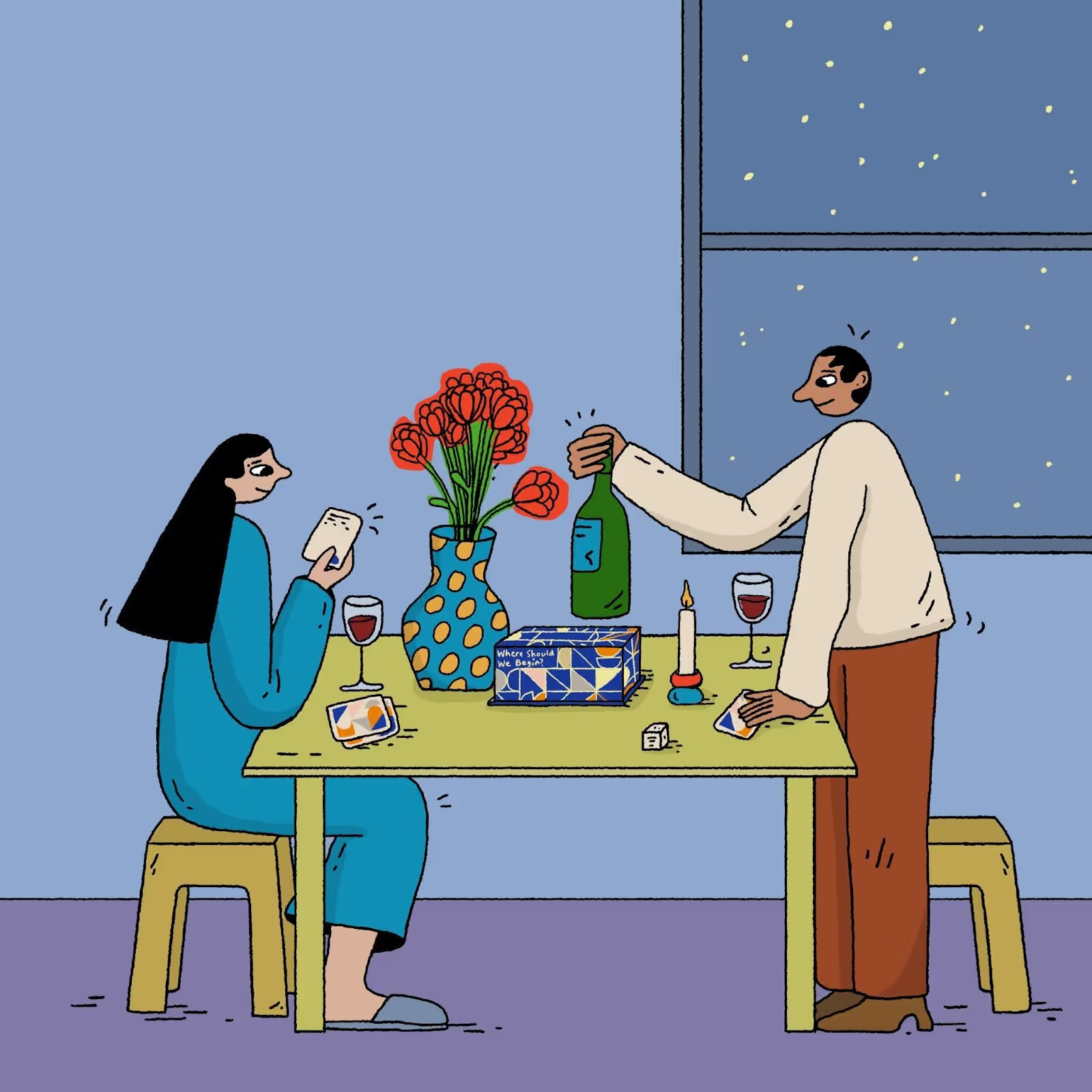
My card game is designed to bring out the storyteller in you, your friends, family, partner, dates, and more. Stories are the building blocks of relationships, and these conversation cards are a great way to spark meaningful discussions and go deeper together.

It’s with great pleasure that I invite you to join me on my first-ever live U.S. tour as I shine a light on the complex cultural shifts transforming relationships today, inspiring the audience to rethink how we connect, how we desire, and even how we love.

‍A good question disrupts a pattern. It goes deeper. Sometimes, it goes sideways. It enables us to travel to a new place without ever leaving one another’s side.

Conversation Starters

A compendium of highly recommended sources of inspiration and information

I’m Reading:

I’m Listening To:

Each year, my son, Noam Saul, makes me a curated playlist of music from around the world. You can listen here.

Read More
Communication & Connection
Letters from Esther #52: A Good Question Changes the Story
My monthly newsletter is meant to inspire you to reflect, act, and develop greater confidence and relational intelligence in all of your relationships.

Shall We Begin?

“What’s on your unofficial résume?”

For years, this has been one of my favorite questions to ask at parties. I’ve been known to hijack a dinner conversation in which people are splitting off into small conversations in favor of unifying the table with a single prompt. I have lots of such prompts but “the unofficial résume” is the one that immediately gets us away from the dreaded “What do you do?”

I was reminded of this recently by an essay by my dear friend, Suleika Jaouad, whom I met years ago in this exact circumstance. As the subject of the new documentary, American Symphony, Suleika has had many interviews recently, leading her to reflect on what makes a good question. I’ve been reflecting on that a lot myself.

At that dinner party, had we simply talked about what we do, I still think she and I would have quickly gotten to the juicy parts of our conversation, but this question of the unofficial résume reframed the gathering and took us to places that, I think, surprised all of us.

A good question does that. It disrupts a pattern. It goes deeper. Sometimes, it goes sideways. It enables us to travel to a new place without ever leaving one another’s side. That night, I told Suleika and the rest of our dining companions that busking and hitchhiking are on my unofficial résume. I did both throughout my twenties with my then-boyfriend. It’s how I got my first introduction to America, state by state, as a passenger in the cars of kind strangers. (It was a much more common way of traveling at that time.)

Every day, we’d spend hours getting to know a new person, couple, family, or group of friends. No two conversations were the same. No two drivers were the same. We met activists, wanderers, tradespeople, hippies from California, and conservatives from the deep south. Having good questions on hand enabled us to find all that we had in common and to delight in what made us each unique. There were a few times when a good, well-timed question defused a tense moment. My favorite for staying in the thick of it: “How did you come to think that way?” A good one for changing the subject: “What’s a piece of advice you’d give to your younger self?”

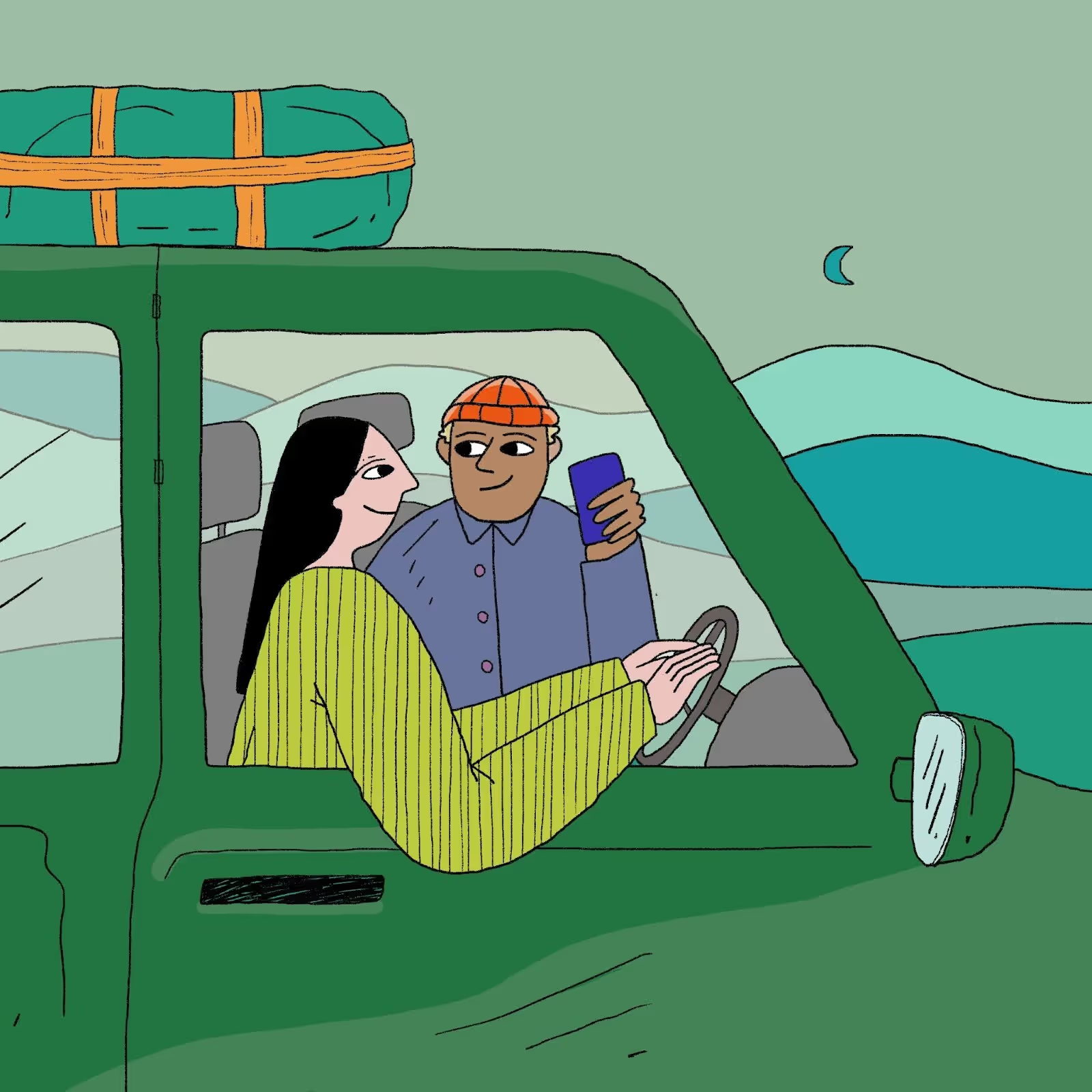
Not long after I released my card game, Where Should We Begin—A Game of Stories, I started getting all sorts of messages from people who were using prompts from the game on long road trips. It’s not something I ever suggested, at least not that I remember, but I like to think that there’s some cosmic link between the road trips of my youth and the road trips people are writing to me about now.

The first letter was from a middle-aged left-leaning woman who had recently played the game on a road trip with her elderly, very conservative, parents. She had been dreading the trip for weeks due to their acrimonious political conversations and she thought the game might provide a good distraction. “Both of my parents shared stories from their childhoods that I had never heard, things about my grandparents that were totally new to me. I wished the road trip could have been twice as long.”

Another favorite letter: “After 17 years, my husband and I were stuck. We decided to take a road trip and spend a month working remotely. We packed the game and everyday, we each picked a card and we walked and talked our way past our impasse. It was incredible to learn so much about someone I thought I already knew so well.”

If you have a story like these, I’d love to hear from you by replying to this letter. In the meantime, I wanted to share a few more questions with you in case you’d like to try them out this holiday season with loved ones or kind strangers. You can find those below. My hope is that, as you gather, whether you feel excitement or trepidation, you can find new stories to share, new questions to ask, and new places to travel together without ever leaving each other’s side.

Let’s Turn the Lens on You

  • What’s an encounter with a stranger you will never forget?
  • What is something you’d like to let go of or release?
  • What is something you’d like to invite into your life, to cultivate, to harness?
  • What is something you’d whisper in the ear of your younger self?
  • What is a risk you took that changed your life?
  • What was your form of play as a child and how has that influenced you?
  • What is a story of friendship, lost or found (or re-found), that changed your criteria for friendship?
  • What is a taboo you grew up with in your family?
  • What is a dream you’ve never said aloud?
  • What’s an experience you’ve had with mortality?
  • What music would you like people to play at your funeral and why?
  • What does hope look like for you?
  • If you had another career, what would it be?
  • If cities were people, who would be your lover, your boyfriend/girlfriend, and your lifelong partner? (I love this one. For me: My lover is Paris or Rio. My boyfriend is Berlin. My lifelong partner is New York.)

More From Esther

My card game is designed to bring out the storyteller in you, your friends, family, partner, dates, and more. Stories are the building blocks of relationships, and these conversation cards are a great way to spark meaningful discussions and go deeper together.

Correspondence with friends has been the most important reading I’ve done all year. In writing, on the phone, and during long walks, we are processing this war and its tragedies together. Despite all that may be splitting us, we are trying to really see each other and connect through our humanity. We are trying to root ourselves in our relationships.

Whether you're facing challenges in love, wanting to reconnect with your partner, or curious about the nuances of human connection, my conversation with Steven Bartlett is full of tools to better your connections and cultivate your relational intelligence.

Conversation Starters

A compendium of highly recommended sources of inspiration and information

I’m Reading:

I’m Watching:

I’m Listening To:

Read More
Conflict
Communication & Connection
Letters from Esther #50: Could it really be that easy to resolve conflict?
My monthly newsletter and workshop is meant to inspire you to reflect, act, and develop greater confidence and relational intelligence in all of your relationships. This month's theme is "Conflict."

Shall We Begin?

A dear friend texted me last week to let me know he was upset with me. We had made plans to talk the previous Sunday morning. When he called that day, I said I was still sleepy and asked if we could reschedule. What I didn’t know was that he had woken up early on the last day of his vacation to have this call. And it wasn’t the first time he had felt disregarded by me in this way. So he wrote me a letter.

It wasn’t only to get his feelings off his chest. He was sounding an alarm. Our relationship needs attention. By addressing the conflict head-on, he was showing how much our friendship matters to him. As I drafted my reply, I felt gratitude for his honesty, care, and communication. I told him so. I acknowledged my poor behavior and how it could come off as careless. I apologized and made a point of telling him that I, too, care about our friendship.

I sent off my reply and prepared for my next session (with a couple deep in a cycle of escalating fights). My friend sent back a loving, understanding message. We were once again aligned. Furthermore, our friendship was better for having gone through this. As the work day unfolded, however, I found myself stuck on a nagging thought: Could it really be that easy to resolve conflict?

No, of course not. My friend and I have an advantage: we’ve both been therapists for many decades and, in that time, we’ve seen every kind of fight you can imagine: the tension, the explosions, the ice-outs, the anger, the tears, the divorces, and the reconciliations. While neither of us has a magic formula for repair, we know the difference between conflict that is productive, useful, and restorative and conflict that is destructive, useless, and harmful.

Everywhere these days, it seems that people are having a harder time finding that difference for themselves. I often hear about situations in which one person, unable to air their grievances, has let a minor crack in a relationship metastasize into a web of fractures. The other person, inevitably, seems to be unaware of the impact of their behavior. Both are left flummoxed at how a misunderstanding or disagreement became a full-blown breakup or breakdown. But, for the life of them, neither really knows how it got so bad.

And it’s not just those with particularly close relationships. My single clients and friends tell me all the time how rare it is to address something they don’t like with a date. Rather than communicate, it’s become all too common to just say nothing at all and let whatever connection could have been fizzle out.

Over the last six months, I have been deeply focused on conflict—and how conflict-avoidant so many of us have become. Is it the social atrophy from pandemic life? Is it the polarization we are dealing with as a society? Is it our over-reliance on increasingly predictive technologies? Has having all the answers in the palm of our hands made us less able to deal with life’s uncertainty and friction?

Are we scared of hurting each other’s feelings?

Are we terrified to let someone we love know that we feel hurt by them?

Do we dread how bad the conversation might get…that something might be said that can’t be taken back?

To all of these questions, I ask: what’s worse—addressing the problem and its potential consequences or losing the relationship altogether because we were afraid of what might happen?

It is possible to turn conflict into connection. It takes empathy and grace, hard work and learning new skills. And it takes a bit of bravery. Trust me, just because I’m a relationship therapist does not mean that I don’t have conflict in my life. In my personal life, I fight with my family and, yes, occasionally my friends. In my professional life, I help people parse out what they are fighting about versus what they are fighting for.

Conflict is intrinsic to all relationships. The presence of bickering or disagreements doesn’t mean the relationship isn’t good, or that it isn’t worth it. Often, it’s an alarm. Your relationship needs attention. Sometimes the best fight you can have is the fight for each other.

Let’s Turn the Lens on You

  • How would you describe your style of fighting?
  • What did you learn about fighting in your family of origin?
  • What are some of the recurring conflicts you experience?
  • How do you know the difference between a good fight and a bad fight?
  • What is your process of repair?
  • If you could learn to fight better, what might it look like?

More From Esther

  • Would you like to learn more about how to turn conflict into connection in your relationship? Click here to receive a free email series starting 10/10.

    Each email will invite you to understand conflicts from a new perspective. Whether you blow up, shut down, or avoid conflict entirely, you'll find something for you. You'll also be the first to learn more about my newest course, opening its doors on 10/17.
  • Are you a therapist, coach, or someone who helps people navigate conflicts? If you've ever felt uncertain about intervention techniques or noticed the toll these sessions might take on your own well-being, I'd like to extend an invitation. Join me for my annual virtual event, Sessions Live, on November 4th. We’ll be focusing entirely on working with conflict. Early bird pricing ends soon. Click here to register and get the special rate.

Conversation Starters

A compendium of highly recommended sources of inspiration and information

As you know, I usually carve out time each month to read, watch, and listen to articles, books, podcasts, films, and television, and I love to share them here. This month, however, all of my reading and watching capabilities are going toward my new conflict course and prepping for my annual clinical conference. I hope you’ll join me in one or both of those places.

Read More
Communication & Connection
Eroticism
Letters from Esther #5 - Trauma, Poetry, and Elephants in South Africa
Letters from Esther is my monthly newsletter to stay in touch and inspire reflection and action in areas that are important for your relational intelligence. This month's theme is: Trauma, Poetry, and Elephants in South Africa.

Shall We Begin?

When the poet David Whyte invited me on a two week poetry safari in South Africa, I didn’t jump at the idea. No disrespect to animals, or animal lovers, but people are my thing. I can tell you now that, sitting in the bush and reciting poetry twice a day followed by group reflections is a combo I completely underestimated. Each day brought a synesthesia of poetry, contemplation, physicality, and social connection. Nature opened itself up to our group, almost like an erotic experience. In awe, we watched elephants in their most intimate bathroom, washing each other and sucking.

We were honored by a visit from the chief and women of Makuleke, a village that underwent forced relocation in the 1960s. I initiated a separate conversation with the women. We discussed everything from sexual education, polygamy, depression, and single-motherhood, to intergenerational transmission of trauma and what it’s like to have young children while they themselves are still in school. I asked them if they would share a favorite lullaby—that universal intimate bonding practice between parent and child—and was amazed when each of the fifteen women stood, one by one, and performed an original lullaby she had created for her child. I sang my lullaby. My friend sang hers. And then conversation continued: domestic abuse, condoms, the problem of diaper disposal. We laughed over the perennial female paradox of celebrating freedom from dependence on men while wishing to find the man who will take care of us and makes us feel complete.

In Johannesburg, I learned about three separate museums which commemorate tragedies committed by humans. Constitution Hill, the Apartheid Museum, and the Holocaust & Genocide Centre form a web of reminders to never forget human atrocity. At Constitution Hill, the former jail-turned-museum, I learned about its most prominent prisoners—such as Nelson Mandela, Mahatma Gandhi, and Fatima Meer—as well as the hundreds of thousands of ordinary people who were once confined within its walls. The curator, Lauren Segal, and her partner, Lwanda Xaso, patiently laid it out for me—how so much political upheaval, history, heartbreak, and survival can happen in one place. 

We visited Ububele, a community mental health clinic in Alexandra township where therapists visit medical waiting rooms and offer educational outreach with mothers, fathers, and their newborns. Gender-based violence is rampant and they tackle it with young and old. In Cape Town, David Whyte and I gave a talk about the complexities of love and fielded questions from the crowded room about betrayal, forgiveness, and loss. “The part of you that was hurt might not be the part of you that forgives,” David advised, poetically. “That’s the part of you that makes it an act of compassion.”

As a psychotherapist, I spend so much time navigating the problems of my patients. But poetry doesn’t solve problems. David’s words often reminded me that it doesn’t need to. Poetry just states the problems beautifully and lets us see the dilemma and the complexity of life, but it doesn't offer a solution. I feel a small relief in knowing that sometimes there is no solution; there’s just holding space for the hurt. 

I think of the museums and memorials. They, too, are not solutions to the traumas they commemorate, but they educate. In saying never forget, they declare never again. I consider the lullabies. They don’t undo the dislocation of the Makuleke women. They don’t bring the fathers of their children back. But they soothe the next generation. Certain pains—the unjust or inhumane treatment of our ancestors; the loss of home or loved ones; the abandonment we feel when we’re left to raise our children alone—live within us forever, mounting memorials. But we can learn from these irrevocable pains. We can self-soothe as we hold space for our traumas. We can remember if only to not repeat. And if all else fails, there is nature. And there is poetry.

Let’s Turn the Lens on You

When recovering from trauma, what helps most is usually acknowledgment on the part of the person or people who hurt us. Recognition of the facts and validation of the experience grounds us in reality. But, more often than not, we won’t get this. Most of the time, it’s up to us to learn how to live with it.

  • Gather your history. What are the stories of adversity and resilience that have been passed on in your family? 
  • Commit to coping rituals. Burning, burying, letting things float away. I once asked a struggling couple to rake all the leaves in their garden together as a representation of ridding themselves of the dead pages of their life together. 
  • Give your trauma and loss a purpose. Loss becomes easier to bear when our grief takes on a meaning bigger than our personal story. Mothers Against Drunk Driving and March for our Lives are organizations which sprung from personal tragedies and turned into movements.
  • Turn to your community. None of the big events in life were ever meant to be experienced alone: not birth, not death, not loss. Gather with family and friends. Go to a support group. When you can’t hold yourself up, let the others hold you so that you can collapse safely. 

More From Esther

Private Drama to Public Healing / a talk with Esther Perel and Jack Saul

Too often our personal dramas are shrouded in secrecy, shame, and guilt. At The National Museum of Art of Romania, Jack and I spoke about the need for bringing trauma and healing into the public square. Our talk accompanied Jack’s multi-channel listening and sharing art installation, Moral Injuries of War, which gives voice to veterans and war correspondents who often carry their moral distress alone. 

Bringing Home the Erotic / A Recent Article 
My most recent article contains five ways to create meaningful connections with your partner, explains the difference between sexuality and eroticism, and encourages you to explore your erotic blueprints with each other. 

Upcoming events
A list of talks, workshops, and trainings around the globe. Join me if an event is near you!

Conversation Starters

A compendium of highly recommended sources of inspiration and information

I’m Reading: 

I’m Watching: 

Read More
Discover more from Esther on Substack.
Explore articles and resources to help you find aliveness and vitality in your relationships.
Subscribe on Substack
Where Should We Begin Podcast COver

Where Should We Begin? with Esther Perel

Join Esther in her office every Monday to listen in as real couples in search of help bare the raw, intimate, and profound details of their stories.
Listen to the Podcast
Recent Episodes
View All Episodes

Where Should We Begin?

A Game of Stories

where should we begin at work product image
New
Where Should We Begin?
At Work
New
Where Should We Begin?
At Work
Improve team dynamics with Esther Perel’s renowned card game—now available for the workplace.
A live event with Esther

Sessions Live 2026

An unforgettable two-day event on relationships, love, and desire
May 15-16, 2026 | Online & In-Person in New York City
Get Your Early Bird Tickets

Courses Taught by Esther

Turning Conflict Into Connection
Uncover why you keep having the same fights over and over again. Learn how to break free from habitual patterns and responses. Find peace and reconciliation even when you disagree.
Gain new insights in just one hour
Downloadable workbook filled with guided exercises
Improve conflicts with or without a partner
View Course
Playing with Desire
Uncover and learn how to speak about your desires. Bring more aliveness into your sex life. Create rich, erotic rituals. Cultivate a more vibrant and fulfilling erotic relationship.
Perfect for date night
Playful exercises and prompts to tap into new erotic possibilities
Based on the same processes Esther has used to help real couples for 40+ years
View Course
Bringing Desire Back
Uncover what blocks desire. Learn how to tap back into pleasure and get unstuck. Discover a new sense of hope and possibility.
Perfect for date night
Guided exercises to turn insights into action and understanding
Based on the same processes Esther has used to help real couples for 40+ years
View Course
The Desire Bundle
Two courses designed to help you and your partner break out of sexual ruts, explore new possibilities, and build deeper connection.
Understand, communicate, and explore your sexual needs
Spark honest and constructive conversations about sex and desire
Designed to reignite curiosity, intimacy, and deeper connection in your sex life
View Course