All Articles
Thank you! Your submission has been received!
Oops! Something went wrong while submitting the form.
Security vs Freedom
Crisis
Letters From Esther: The Great Adaptation
My monthly newsletter and workshop are meant to inspire you to reflect, act, and develop greater confidence and relational intelligence in all of your relationships. This month's theme is: The Great Adaptation.

Shall We Begin?

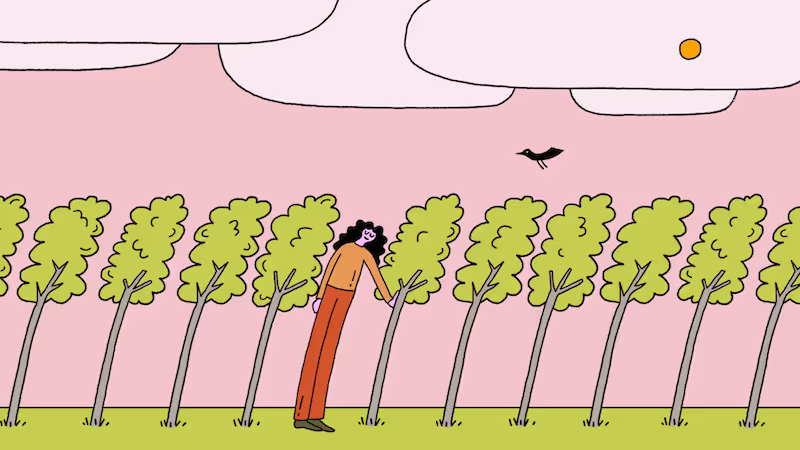
The tallest skyscraper in the world, the Burj Khalifa, was designed to sway in the wind. Its 206th story, at the very top, bends back and forth up to two meters to “confuse the wind,” as chief structural engineer Bill Baker once said. Most tall buildings are designed to adapt to the sky’s push and pull, perhaps taking a cue from trees, which bend and come back to center again and again. Whether concrete and steel or wood and leaves, these structures bend so that they don’t break. And it is what we humans must do now, too. 

Bending is deeply important to me. Physically, it’s a stretch that awakens the body and expands our edges. It improves our flexibility, agility, and nimbleness. Psychologically, bending is what we’re called to do when we can’t change our circumstances, when we can only change how we react to them. It’s what businesses call “pivoting.” It’s what immigrants have done forever. It’s what I and many others call “adaptability.” And it’s an essential part of resilience. 

How much has our world changed in the last few years? How much have we changed? And of those changes we’ve all had to make to varying degrees, what has been reactive versus proactive? How many of us have felt that standing tall and strong—holding on to our routines and beliefs—were the only ways to have some semblance of normalcy? Did your life stay the same? How many of us felt the exact opposite: a call to change everything all at once—to quit the job, move somewhere else, change the status of our relationships, dissolve into a more malleable form to become someone entirely new? Did you change too much?

Adaptability does not prioritize drastic change over fierce rigidity. Adaptability is the conversation within us between stability and change, between continuity and innovation. It is the marriage of our fundamental needs for security and adventure. Adaptability is our ability to bend and come back to center over and over again, increasing our flexibility each time, whether we’re in our daily stretch or the fight of our lives. And the more we practice becoming adaptable, the more we can tolerate change and harness its power.

I’d like to say that I know the perfect ratio of fluidity and steadfastness to achieve the type of adaptability required to meet this moment. I don’t. It’s easy for me to tell you how much I value Zygmunt Bauman’s concept of “liquid life”—an ability to continuously uproot but still find a sense of belonging that he described as an essential part of survival in our rapidly changing world. I deeply identify with that side of the equation. It’s much harder for me to admit how challenging I find rigidity to be, because I equate it with being stuck.

What has helped me find balance—that special posture of absorbing our wobbles to hold strong—has been re-designing the strongest structures in my life so that they can sway when the wind picks up. I adapted my therapy practice and company for remote work. My supervision group began meeting every week to adapt to the increased need for collaboration and support among therapists. I adapted my kitchen into a stage for a free virtual workshop series. My team and I adapted the prompts I had long used in my office, on my podcasts, and in my talks and turned them into a card game—because play is crucial in learning how to adapt. 

It is for all of these reasons that my 5th annual Sessions Live conference this coming November is titled “The Great Adaptation: How Can We Stay Grounded When the Ground is Moving?” Along with my guests, we will explore Adaptability and its best outcomes. If you are a therapist or work in the wellness space, I hope you will join us.

Let’s Turn the Lens on You 

  • When was the last time you changed your mind?
  • What is the best piece of advice you’ve ever received?
  • When was the last time you took a big risk?
  • What is a part of yourself you need to break up with?
  • What experience of adversity made you stronger?
  • What resources do you draw from family and community in hard times?

More From Esther

The Great Adaptation / A multidisciplinary training event

Let's continue the conversation. Join Esther this November for a three-part digital training event as we explore together how adaptability, mass mutual reliance, and collective resilience are crucial to meeting this moment.

“Eroticism in Hard Times” / a newsletter

When times are good, Eroticism is what converts the mundane into magic. When times are tough, Eroticism is what inspires us to survive—and even to thrive—despite all odds. 

“Intimacy and Your 5 Senses” / a blog article

When we’re feeling depleted, Eroticism can help. Engaging in our five senses with our partner is the best entry point.

“Stories shape our reality.” / a newsletter

We all have our go-to stories, but have you ever wondered what role they play in our lives? How might the internal logic of these stories shape our new experiences?

Conversation Starters

A compendium of highly recommended sources of inspiration and information       

On My To Read List:

I’m Watching/Listening: 

Read More
Eroticism
Crisis
Letters from Esther #25: Eroticism in Hard Times
My monthly newsletter and workshop are meant to inspire you to reflect, act, and develop greater confidence and relational intelligence in all of your relationships. This month's theme is: Eroticism in Hard Times.

My monthly newsletter and workshop is meant to inspire you to reflect, act, and develop greater confidence and relational intelligence in all of your relationships. This month's theme is: Eroticism in Hard Times.

Shall We Begin?

From the pandemic to climate crisis to crimes against humanity, severe burnout, and more, we are living through collective trauma. Our impulse may be to shut down, numb ourselves with substances, disconnect, sleep forever, wallow in the 24 hour news cycle, or stuff every free moment with social media to avoid difficult thoughts and feelings. But today, I invite you to try something different. I want to you embrace your Erotic self. You may think that talking about Eroticism at a time like this is hubris. But I think it is essential.

Eroticism. I speak of it often—not through the narrow definition of sex that modernity has assigned to it—but in the mystical sense. “Eroticism reveals to us another world, inside this world,” Octavio Paz wrote. “The senses become servants to our imagination, letting us see the invisible and hear the inaudible.” Eroticism is an elixir of vibrancy, curiosity, and spontaneity that makes us feel alive. It is the counterforce of deadness, a radiance that reminds us that, despite any darkness we may endure, we are here on this planet right now. And, at all times, we are on the edge of all that is possible, straddling hope and anxiety. 

Eroticism isn’t just the life force that makes sex great. Eroticism is what makes life itself worth living. When times are good, Eroticism is what converts the mundane into magic. When times are tough, Eroticism is what inspires us to survive—and even to thrive—despite all odds. It is why we make art and music and go into nature when we are in pain. It is the orchestras in the concentration camps, the choirs in the cotton fields, the dark humor shared by refugees all around the globe. Eroticism is the blues. It is both the letters of longing and the poetry of heartbreak. It’s the playlist we make for a friend working graveyard shifts at the hospital. Eroticism is every “pandemic baby” conceived at the height of prolonged uncertainty, isolation, and grief. It is the spirit that creates new life when death is ever-present. Eroticism is having faith that the world will exist for our grandchildren and finding real ways to contribute to that outcome—even as apocalyptic scenarios seem to play out around us. 

I was raised by a mother and father who were each the sole survivors of families who had been killed in the holocaust. I grew up on stories of resilience in the face of extreme adversity and I have spent my life studying what helps people to come back to life rather than just “not be dead.” I believe it is Eroticism—as has been described in the Zohar, by Audre Lorde, and by many others. Growing up, I played with friends—fellow children of survivors—whose homes seemed defined by suffering, distrust, and vigilance. Their parents sheathed the furniture in plastic, felt safer inside, and kept their circles small. In my house, sadness was designated for rituals on religious holidays. At all other times, there was a ban on sad feelings in a nearly oppressive way, probably because my parents feared sinking into depression due to the insurmountable grief they had suffered. I longed for permission to feel both pleasure and pain, to allow hope to balance my anxiety rather than repress it. In embracing the study of Eroticism twenty years ago, I found that permission. 

Don’t think of Eroticism as a hedonistic distraction from the state of the world. Eroticism is the life force that keeps us connected to our sense of humanity, hope, and pleasure—especially when we are in pain. It confirms: I exist. I’m alive. I have a family. I have a name. Someone knows me. I have a capacity to create, to entertain, to help, to connect with others. This, too, is the reality of our world. 

Let’s Turn the Lens on You 

In times of despair and grief, where have you found hope?

  • Move away from the screen. 
  • Put your feet in the grass and uncurl your toes. 
  • Hum, sing, write, cry. 
  • Explore the love poetry that has been written during war, famine, and plague.
  • Play with children. 
  • Play with animals.
  • Grow plants and observe what they like.
  • Turn yourself on by noticing the warmth of your skin, the cycle of your breath, the steady beat of your heart.

Let's continue the conversation.
Watch the replay of the Letters From Esther Workshop: The Importance of Eroticism in Hard Times.

More From Esther

“How Erotic Thinking Helps Emotional Connection” / a blog article

Eroticism is a state of being, but it’s also a state of mind. In this blog article, we explore how to embrace Erotic Thinking and make it part of our daily lives.

“Why Eroticism Should Be Part of Your Self-Care Plan” / a blog article

We tend to think of eroticism as a sexual state shared by two or more people, but it’s so much more than sex—and it starts with the individual.

“A Romantic Revival” / a podcast episode

In this episode of “Where Should We Begin?,” a couple whose marriage has been colored by loss, grief, and sadness longs to transition from surviving to thriving. 

Conversation Starters

A compendium of highly recommended sources of inspiration and information       

On My To Read List:

I’m Watching/Listening: 

Read More
Communication & Connection
Letters from Esther #22: Small Talk
My monthly newsletter and workshop is meant to inspire you to reflect, act, and develop greater confidence and relational intelligence in all of your relationships. This month's theme is: Small Talk.

Shall We Begin?

I am a person who likes big, deep conversations. I like when dinner parties move to the couch and floor after dessert, and when running into a friend turns into going out for a meal. I like small talk as well, but always saw it as superficial and sometimes tedious. But in the last month, little conversations with cab drivers, baristas, and fellow diners have shown me otherwise.

Recently, I was sitting at a cafe in Tribeca with my dear friend John who I hadn’t seen in fourteen months. We caught up over food and drinks, occasionally fumbling our words and noticing how our socializing muscles had atrophied over the last year. When I decided we needed a bit of mustard to go with our meal, I had to remind myself of how to ask the waiter. Do I gesture for him to come over with that expression that says “when you have a moment…”? Do I wait for him to stop by? Does John want mustard or is it only me? If I wait to eat until I get the mustard, will John feel that he needs to wait on my behalf? 

I don’t think I’d ever been so aware of the tiny social calculations of interacting with people you don’t know (the waiter) or the people you know quite well but haven’t seen in awhile (John). I took the plunge and waved the waiter over. Soon, he returned with a basket of bread in one hand and our mustard in the other. But he put the bread on our table and the mustard on our neighbor’s table before disappearing to his next task. Perhaps he, too, had suffered his share of social atrophy—haven’t we all? 

John and I looked down at the perfectly golden, crusty-edged, steaming hot bread and then at one another. Then we heard an unfamiliar voice say “I’m so sorry, but I think…” We looked up at our neighbors, and though we didn’t know them, I instantly recognized the familiar expression of someone trying to figure out how to navigate a social interaction with a stranger after more than a year without small talk. 

“I think you have our bread and we have your mustard,” she said. 
“But it looks so good!” I joked. 
“Have some!” she said. “We’re vaccinated!” 
“Us too!” we exclaimed. 

She made a little gesture with her hand that said “go ahead, take a piece of bread,” and so we did. She passed us our mustard. We laughed together and chatted a little before returning to our respective meals and conversations. As they were leaving, she waved to us and gestured again to her bread basket. They had left us the last slice. 

There was something about our interaction that reminded me of when my parents, at eighty years old, would visit me in New York. They’d go to Washington Square Park and sit on a bench until they heard someone speaking a language they understood, usually French. They could get lost for hours asking New Yorkers who had emigrated from Paris or Quebec or Haiti or Senegal about what they liked to do in the neighborhood. My parents would tell them about their daughter who immigrated to the states and ask why they had moved, and if they had kids. They’d come home ready to test out their new restaurant recommendations and I’d wonder how they had any energy left after that much small talk in one day.

Even when small talk is inconsequential, there’s something nice about two very different strangers passing time together, engaging in a dance of trying to find some small thing in common. And when done well, small talk is a kind of platonic flirting. It becomes a part of eroticism—that elixir of aliveness and spontaneity that makes life so rich. My parents were living proof that small talk is a bridge to others. But, until I had to live without it, I didn’t realize it’s the first step to breaking bread. 

Let’s Turn the Lens on You

When it comes to small talk, start small. A few questions to get you started:

  • Ask your server, “when you’re not working, what’s your favorite restaurant around here?” 
  • If you stop into a local shop, ask “how’s business been?” 
  • In a cab, ask your driver “where’s the most surprising place you’ve driven to?” 
  • Ask the people at the table next to you, “what did you order? It looks so good.”
  • Ask someone on the street, “Where did you get your outfit? I love it!”

Let's continue the conversation.
Watch the replay of the Letters From Esther Workshop: How to Stretch Your Social Muscles.

More From Esther

Questions That Meet People Where They Are: a newsletter
The questions we ask each other now must make room for peoples’ grief and for their growth.

Anti-Small Talk / a workshop
In this workshop, we talk about how to turn small talk into deep, meaningful conversation.

“He Gets the Respect. She Gets the Toilet Paper” /  a “How’s Work?” podcast episode • Spotify
Married for ten years and co-owners of a gym for seven, this couple is struggling with how their team communicates. The staff talks to him about the big questions. They make small talk with her about domestic needs.

“How the Growing Identity Economy is Reshaping the Future of Work” / an Op-Ed
Leaders who treat employees as whole people—not just workers—can create workplaces that actually work (Fast Company).

Conversation Starters

A compendium of highly recommended sources of inspiration and information.       
On My To Read List:

I’m Watching: 

Read More
Communication & Connection
Letters From Esther: What Does “Single” Mean For You?
My monthly newsletter and workshop is meant to inspire you to reflect, act, and develop greater confidence and relational intelligence in all of your relationships. This month's theme is: What Does “Single” Mean For You?

Shall We Begin?

When I was growing up, “single” meant “not married.” It was a narrow definition that came with rules and rumors. A single woman, it was thought, couldn’t take care of herself or have children. She couldn’t be invited to parties, lest her sex appeal cause another woman’s man to stray. She was too sexy to have around, and yet, sexless enough to be told by society that she belonged in a convent. Single men had their own rules and rumors, but they still had the economic freedom to survive in society on their own. My own mother whole-heartedly believed that a woman without a partner was incomplete. She was ready to marry me off at eighteen. By the time I was twenty, she was burning with impatience and tried to set me up on a blind date. He came with his parents for dinner. I was so mad that I left after dessert to go be with my friends. Poor guy, he must have been as mortified as me.

We know that things are different now, at least in the West. You can have a full life as a single person, with economic independence, your own home, a job outside of the house, kids or no kids, multiple partners or no partners, and so on. And yet, we’re all still confronted with the same narrow definitions of “married” or “single” at the doctor’s office and on the census. It doesn’t matter if you’re in a long term domestic partnership, in a poly relationship, dating, widowed, or happily on your own. If you’re not married, check the box that says “single.” Likewise, if you’re separated or in the process of divorce, even if you feel single, you better check the box that says “married.” It’s a legal binary that reflects outdated options and a one-size-fits-all idea. 

The myth of romantic love in which two halves meet each other to become one whole carries the belief that we need to be married to be complete and to be happy. Marriage can be rich and fulfilling, of course, but it is not a privilege above all others, and it isn’t as clear cut as it used to be. 

These days, we live with a multiplicity of relational identifiers: committed but non-monogamous, polyamorous, single and co-parenting, married, divorced, dating for fun, looking for a soul mate, making space to heal, or simply prioritizing ourself. And within each label, there is a story about where we’ve been, who we’ve loved, what we’re looking for now, or what we’re looking to avoid. 

Talking about our relationship status conveys a complex set of priorities, beliefs, hopes, and dreams. The concept of singledom has expanded. We tend to think of being single as a matter of being alone rather than a matter of choosing the types of relationships we want to be in—including the relationship we have with ourselves. The relational world is no longer divided between “who is in a relationship” and “who is not.” The better question now is “What is your state of relatedness?” It may feel like an awkward phrase to ask, but the answers are much richer, depthful, and informative than any box we could check on a form. 

Let’s Turn the Lens on You 

  • What do you associate with the word single? 
  • How might you like to change that definition? 
  • What are your own biases about being single in regard to yourself or others? 
  • Have you ever been treated differently by friends or family based on your relationship status? How so?
  • How does gender and sexuality influence our concept of relatedness?
  • What’s the best part of being single?

More From Esther

“Why Eroticism Should Be Part of Your Self-Care Plan” / an article

Tune into your body and let it teach you what you like, don’t like, and what you don’t know yet.

“The Myth of Self-Love” / a newsletter

It can be wonderful to be alone, to give our body a massage, to cook ourselves a delicious meal for one, but this isn’t self-love; it’s self-reliance and self-sufficiency. Learn more about Self-Love here.

“How Our Sense of Touch Keeps Us Radically Connected to Ourselves” / an article

We can live without sex, but we can't live without touch.

Conversation Starters

A compendium of highly recommended sources of inspiration and information       

On My To Read List:

I’m Watching/Listening: 

Read More
Communication & Connection
Letters from Esther #23: Stories
My monthly newsletter and workshop are meant to inspire you to reflect, act, and develop greater confidence and relational intelligence in all of your relationships. This month's theme is: Stories.

Shall We Begin?

Stories shape our reality. They help us make sense of our pasts, what we’ve been through, who we were then, who we are now, and who we would like to be going forward. We tell stories to introduce ourselves to new people. We tell stories to explain our behavior (even to people who’ve known us for a long time). Our stories help us relate to others who have similar life experiences and they help us connect with people who are vastly different from us. We cherish these narratives, sometimes too much. We all have our go-to stories, but have you ever wondered what role they play in your life? How might the internal logic of these stories shape your new experiences?

  • Has a childhood of neglect has made you question whether you are worthy of attention? 
  • Have one too many bad dates made you give up on dating altogether? 
  • Do you often find yourself explaining why you are the way that you are to someone who interprets your story as an excuse?
  • Have you ever caught yourself making unfair assumptions about somebody else? 
  • Where do your expectations of yourself and others come from? Are they too high? Too low?

If you answered yes to any of these, it’s time to ask: what if you’re actually trapped in your own story? It doesn’t mean that it didn’t happen the way you think it did, or that your story doesn’t matter. It may all be true, but how does it serve you? 

We use our stories as reminders, as protection and prevention. Our core stories, such as “I can’t depend on anybody but myself,” were once adaptive storylines. They banished our helplessness and made us able and strong. But while they fit the past, they don’t necessarily fit the present—and they may be blocking the future. Holding on to them with tenacity can make us so hypervigilant that we see the past everywhere. What we insist on, persists. It can stop us from seeing and trying new things and, yes, writing new stories. 

If a date shows up late and we have a history of being left waiting or feeling invisible, we might race immediately to the foregone conclusion of our go-to story: that either they are selfish or that we are unworthy—or both. When we hold on to the deep beliefs about who we are or how we think others view us, it can prevent us from creating new beliefs about who we can be. Don’t worry: writing new stories isn’t about letting go of the hero’s journey that has led us to where we are—it’s about allowing ourself to write new chapters, to develop the plot, characters, themes, settings, and lessons. 

I was asked recently how I know when someone is stuck in a self-defeating story. Whether in my psychotherapy office or on my podcasts, there’s always one dead giveaway. If the person repeats the exact same story—word for word—with the same examples and conclusions every time, I know that they are trapped in a narrative cycle. I’ve made it a mission to have people come into my office with one story and leave with another. The goal is to transform from stasis to movement, from repetition to possibility, from constriction to openness. This month, across all of my channels, we’re exploring how to do just that.

In “Trapped in Their Own Story,” season 4, episode 9 of my podcast Where Should We Begin?, we meet a couple stuck in the many competing stories that have formed over their three decade relationship (linked below). We challenge mythologies about how they lost their connection and we rewrite the story they’ve been living with—that their only solution exists outside of their marriage. It’s an episode that reminds listeners that healthy relationships require us to write often and edit well. 

When I tell people to “write often and edit well,” what I mean is this: we are not in control of how life unfolds, but we have agency over how we structure and interpret it. And those new interpretations can help us get unstuck and give us the freedom to make adult choices that we couldn’t as children. New stories can liberate us from defeating narratives, predetermined thinking, and forgone conclusions. They create hope and possibilities for change. So, what new stories are you ready to live?

Let’s Turn the Lens on You 

  • How does your anxiety talk to you?
  • What do you say to yourself when you want permission to try something new? 
  • What is the dialogue between the part of you that fears the worst and the part of you that dreams about more?
  • What do you want to say to the person who still looks at you with the eyes of the past and doesn’t see all the changes you’ve made? 
  • If you wrote the story of your life up to this point, what would the chapters be named? 
  • If you wrote the story of your future, what would the chapters be named? 

Let's continue the conversation.
Watch the replay of the Letters From Esther Workshop: How The Stories We Tell Ourselves Can Make or Break Us.

More From Esther

“Trapped in Their Own Story” / s.4 ep.9 of Where Should We Begin?

Their histories of rejection have left this long-term couple craving connection and acceptance from one another while they grapple with the story that what they want can only be found outside of their marriage. 

“Small Talk” / a recent newsletter

Even when small talk is inconsequential, there’s something nice about two very different strangers passing time together, engaging in a dance of trying to find some small thing in common. And when done well, small talk is a kind of platonic flirting.

“5 Ways to Start Conversations with Confidence” / a recent article

If you’re experiencing anxiety at the very idea of talking to a stranger—or an acquaintance or colleague that you haven’t seen in awhile—this guide is for you. 

Conversation Starters

A compendium of highly recommended sources of inspiration and information       

On My To Read List:

I’m Watching/Listening: 

Read More
Communication & Connection
Eroticism
Letters from Esther #2 - Security and Freedom
Letters from Esther is my monthly newsletter to stay in touch and inspire reflection and action in areas that are important for our relational intelligence. This month's theme is Security and Freedom.

Shall We Begin?

Recently, I landed at the Tel Aviv airport and went directly to the most integrated newsroom I have ever seen, the i24News station. Arabic, English, French, Spanish. In my interviews, I switched from French to English to Spanish, moving from one cultural norm to the next in a matter of minutes. Whereas some might feel overwhelmed in this kind of setting, in these moments, I felt all the parts of me come to life. This is me, I thought, and this is the world I would like to live in: a world of integration, diversity, and fluidity. A world in which we can soften our ideas of what should be, and allow ourselves to experience what is, and what can be.

The sociologist and philosopher Zygmunt Bauman’s major 20th-century book, “Liquid Life,” describes this fluid way of being as an essential part of survival in our rapidly changing modern world. When I re-read Bauman’s book, I wonder: what could life be like if we relied less on social codification—the meaning of a lunch date versus a dinner date; what it means to introduce a romantic prospect to your friends—and allowed ourselves to let the narrative unfold. Nothing in life has any meaning except the meaning you give it. My question to you is: what if we resisted our impulse to prematurely assign meaning onto every little thing and allowed ourselves to go with the flow? 

This isn’t just a suggestion for a new mindset; I see it as a way to survive the times we’re living in, in which social and cultural norms are evolving so quickly that we can’t help but question the indemnity of relationships. 

From the moment we are born, we straddle two sets of contradicting needs: the need for security and the need for freedom. They spring from different sources and pull us in different directions. And the issue today is that we want to reconcile this tension in our romantic relationships and in many other facets of our lives. Maybe your lifestyle requires a 9-5 paycheck but corporate life feels restrictive to your creativity. Sometimes, you like to be nomadic; other times you just want to be home. Big groups of different types of people buzzing about can make us feel alive; other times it can make us feel out of control. 

Control, for many, means choosing one or the other: security or freedom. The fact is we need both. Because we desire the security of belonging—whether to a person, a job, or a community—and the freedom to explore other options, we often find ourselves acting out of our internal contradictions. Some of us come out of our childhood needing more protection; some of us come out needing more space. And these needs continue to fluctuate throughout our lives. Cultivating fluidity helps us navigate this tension. What I’ve observed is this: people want partnership and a deep lasting love, but they also want relationships that should also be revocable at any time. Are there areas in your life in which you are preserving a little exit door?

This topic of communities versus networks has me occupied. In the past, as Bauman explains, we lived with structures. We tied deep knots with people and the goal was to make it difficult to dismantle them. Today, we want fluid networks in which we can enter and exit with ease. The point is not which one is better. Both have costs and benefits. Some people can’t extricate themselves even if something feels wrong for them. Others complain about difficulty finding roots. And you may even identify with both of those feelings at the same time. 

Let’s Turn the Lens on You

So, let me ask you: at this very moment, do you crave a foundation or wings? Do your own checkup. Have you been hopping jobs, relationships, or residences? Do you have stuff in six different places? Maybe it’s time to regroup. Have you been in the same job for ten years, five of which you’ve been complaining you need to get out? Do you trail lackluster friendships that have become obligatory and devoid of joy and interest? Maybe it’s time to take action. 

  • If you desire freedom, go explore. Dare yourself. Take risks. Push yourself where you haven't allowed yourself to go. Take someone new with you into the places that you love. Ditch drinks and the stitled face-to-face interview, and go rock-climbing, if that’s your thing, or biking, or live music. Open your world to them and be open to exploring theirs.
  • If you're in need of stability, look for structure. Stand still and begin building vertically rather than horizontally. Create new rituals: a walk in the park, journaling, or meditation. Every weekend, try to call one long-distance friend.
  • In either case, remember that the goal is fluidity between the two.When we find that balance, our lives open up to new possibilities: new stories, relationships, cultures, people, and ways of life. 

More From Esther

5 Reasons Why Comprehensive Sex Education Makes a Difference/ A Recent Blog Article

In celebration of World Sexual Health Day, we’re looking at 5 ways comprehensive sexuality and relationship education lifts us as a society. 

The Sex Recession / YouTube Moments 

I interviewed Christina Pierpaoli Parker, PhD student and author of Psychology Today’s “Eng(aging)” column about what’s really happening—and not happening—in the bedrooms of millennials and boomers, and why. 

The Erotic as an Antidote to Death / “On Being”

A conversation with Krista Tippett on her podcast “On Being” about how people connect to their sense of aliveness, vibrancy, vitality, and renewal through eroticism.

Conversation Starters

A compendium of highly recommended sources of inspiration and information.

I’m Reading: 

I’m Watching: 

I’m Listening To: 

I hope these recommendations will inspire conversations with friends old and new.

Read More
No items found.
Letters From Esther: Routines and Rituals
My monthly newsletter and workshop is meant to inspire you to reflect, act, and develop greater confidence and relational intelligence in all of your relationships. This month's theme is: Routine and Rituals.

Shall We Begin? 

It’s officially been a year in this strange reality. For one whole year, we’ve been pivoting, spiraling, extending uncertainty, grieving, coping, trying to get grounded while simultaneously craving spontaneity.

What do we do with such anniversaries? We know how to celebrate the anniversaries of birth, weddings, back to school, or joining a company. But what happens to our wedding date after we’ve divorced or the birthday of someone we’ve lost? What are we meant to do with this first anniversary of pandemic lockdown, and as we pass 500,000 Covid deaths here in America—as many as were killed in World War II, the Korean War, and the Vietnam War combined?

Hard anniversaries are helped by looking at the routines which have helped us create structure and predictability and the rituals that have helped us process what the occasion signifies. Routines are concrete repetitive actions that help us develop skills while creating continuity and order. Rituals are routines elevated by creativity, driven by intention, and imbued with meaning. Rituals ease us through transitions—birth, first day of school, graduation, marriage, death—and create a code for handling them. If setting the table every night is a routine, pulling out the special china for the anniversary of grandma’s death, making her favorite recipe from the old country, and looking at pictures of her is a ritual that helps us remember her and process how much time has passed since we could hold her. 

Rituals and routines are both about delineating between space and time and creating a grounding rhythm, a predictable structure with a reassuring, calming, and stabilizing effect. They can also overlap. Reading every night to our children is a routine that helps them develop literacy skills; but symbolically, it’s a ritual of creating special time between parent and child. When you bring mindfulness into your routines, they can become rituals.

In the last year, I have depended on daily routines and rituals to help me function through my day like never before. Every morning, I cut a juicy pink grapefruit in half to eat. I make a cup of coffee just how I like it. I cut up fresh strawberries, mango, grapes for one plate and carrots and cucumbers with sea salt and olive oil for another. After a year of this, I find certainty knowing that, by the end of the day, my husband and I will finish it all, snacking away in our little kitchen cafeteria where we work, call friends, and catch up with our sons on video calls. These are some routines that have sustained and nourished me for one whole year now.

But on this hard anniversary, it is my rituals, both old and new, for which I find myself most grateful. I’ve spent the last year trying to figure out what information, advice, and exercises can be most helpful to the readers of this newsletter, attendees of our workshops, our community, and so on. So much of that information has come directly from daily scheduled conversations with family, friends, colleagues, and my team—an old ritual recast for the Zoom era. For a year, the old ritual of Friday night shabbat—that ancient weekly transition between work and rest where we sit around the table, light candles, drink wine, and sing and talk for hours knowing we can sleep in—has created continuity from pre-pandemic life to now. For a year, my new rituals—a Zoom yoga group with friends where we catch up after savasana; the weekly big batch of hearty soup I make and deliver to friends’ doorsteps which reminds me of my good girl Belgian roots and the warmth of sharing food even when we’re apart—have helped imbue my routines of physical exercise and cooking with new meaning. 

As we process this anniversary together, taking stock of our deep losses and perhaps surprising gains, it’s worth looking back at the rituals and routines which have helped us day after day, month after month—and the ones that will continue to create continuity, structure, and joy as we move ahead.

Let’s Turn the Lens on You

Ask yourself, then ask your loved ones.

  • What old routines and rituals have created continuity for you this year?
  • What new routines and rituals have created structure and joy for you this year? 
  • Are there any that have been passed on in your family? If so, what?
  • Do you follow any religious or spiritual rituals? 
  • What are some special routines or rituals you’ve made with friends this year? 
  • What new routines and rituals would you like to try now?

Let's continue the conversation.

Watch the replay of the Letters From Esther Workshop: Rituals For Your Relationships.

More From Esther

The 3 Types of Relationship Fights You Keep Having—And What To Do About Them / a blog
Your relationship arguments aren't always about what you think they are. Read more to learn about the three hidden dimensions under most relationship fights and how to break the loop.

Bringing Home the Erotic: 5 Ways to Create Meaningful Connections with Your Partner
 / a blog
Couples who are plagued by sexual boredom would be well to explore the hidden fantasies and desires that turn them on. In this blog, we look at how to do that.

How Erotic Thinking Helps Emotional Connection a blog
No matter how effective our routines have been in helping us through the last year, if they’re not filled with creativity, they inevitably leave us numb. 

Conversation Starters

A compendium of highly recommended sources of inspiration and information.       

I’m Reading:

I’m Listening To: 
Down to 100 carefully selected songs, spanning 18 countries in 7 languages from 1965-2021, this playlist is from my son Noam Saul. I so enjoy having my sons keep me up to date on music as well as sharing my old favorites with them. For me, this playlist is not only a way to discover music but also to discover my son.

Read More
Eroticism
Letters From Esther - Eroticism Suffered in 2020; Fantasy Thrived
My monthly newsletter is meant to inspire you to reflect, act, and develop greater confidence and relational intelligence in all of your relationships. This month's theme is: Eroticism Suffered in 2020; Fantasy Thrived.

Shall We Begin?

Eroticism suffered in 2020. Fantasy thrived. I don’t mean sexually, per se, though that may also be the case. I define Eroticism as those qualities of vitality, curiosity, and spontaneity that makes us feel alive. It’s the unexpected yet welcomed touch on a great first date; running into a dear old friend and absconding together for a drink; traveling to a brand new place and experiencing it unfold before you. This type of Eroticism went into lockdown with us nearly ten months ago, when life’s delectable little mysteries were suddenly replaced by the great unknown. 

Ever since, we’ve found ourselves missing those moments of happenstance that knock our routines—a laugh shared with a stranger in line, a waiter’s recommendation, even the lengthy office commute which once provided perfect circumstance for falling deeply into a new podcast. For me, it’s the dinner parties. Before March 2020, I attended or hosted dinner parties weekly, reveling in the chance encounters a great dinner party brings. While I like to mix flavors in a dish, I especially delight in the concoction of people around the table. You never know whom you’ll sit next to, what great questions will be asked, what delicious meal will be served, or how long the evening will last. 

Now, my greatest source of mystery—aside from the pandemic itself—comes from throwing rocks into a nearby frozen lake. I’m never sure how each one will sound when it cracks the surface or what shapes the bubbles underneath the ice will make. Sometimes, I’ll video record it and send it to friends, wishing they were standing next to me. I think about how we’d run through the snow laughing, how we’d make a hot meal together and sit by a fire. I imagine what it will be like to hug them and what life will be like on the other side of all this. What will we do first? Where will we go?

This is what I mean when I say that where Eroticism has suffered, Fantasy has thrived. Over the last year, our imaginations have gone into overdrive—both good and bad. Unable to see our friends, we’ve had to get extremely creative. But that creativity has also extended to the scary things, too. How much time have we spent hypothesizing how bad it will get? We’ve fantasized a roller coaster of apocalyptic outcomes. If we pop our bubble, we’ll surely get sick and die. The economy is forever in smithers. New York City is never coming back. The housing market can’t recover. I’ll be unemployed forever. The kids will never return to school. We’re going to lose grandma. We’re going to lose everything. For so many, some of our deepest fears have come true. And so we wonder, what if they all do? 

I, myself, am prone to this kind of thinking. I don’t regret the time I spent fantasizing about what could go wrong. It kept me safe. But I’m enjoying fantasizing about what can go right in 2021. In this new year, I plan to use my overactive imagination for good, inspired by the children in my life. My niece recently sent me a video of her children in lockdown hopping from pillow to pillow, pretending they are rocks in a river. In another video, they pile those same pillows up to make their “cabin in the woods.” I envy their free range imagination and I want a little of it. They know the trick: freedom in confinement comes from our imaginations. We’re not out of the woods yet, but fantasy can take us anywhere. So what would you like to imagine?

Let’s Turn the Lens on You

  • Think back on the last year. 
  • Write down 3 things you have lost. 
  • Write down 3 things you have gained. 
  • What did you imagine when you were in your darkest place?
  • What did you survive?
  • What are 3 challenges you have mastered? 
  • What have been the consequences—good and bad? 
  • What was the kindest thing someone else did for you? 
  • What were some of your contributions to your community? 
  • Think about the year ahead. 
  • Write down 1 thing you need to release.
  • Write down 1 thing you’d like to develop.
  • What are you excited about?
  • What are you afraid of?
  • Revisit these answers every few months and record your progress.

Let's continue the conversation.

Watch the replay of the Letters From Esther Workshop: How Eroticism and Fantasy Can Help You Embrace a New Year.

More From Esther

Why Eroticism Should Be Part of your Self-Care Plan / a blog article
Tune into your body and let it teach you what you like, don’t like, and what you don’t know yet.

Where Should We Begin? Pod Club / on Instagram
Producer Jesse Baker and I discuss show notes from episode 4 of season 3: “A Romantic Revival”

Loneliness Around the Holidays / a blog and community resource list
We asked our community to share their strategies for coping with loneliness around the holidays and shared some of our own. The holidays may be over, but these strategies are still helpful in the new year.

Conversation Starters

A compendium of highly recommended sources of inspiration and information       
I’m Reading:

I’m Watching:

Read More
Taboo
Letters from Esther #16: Who Was There For You?
My monthly newsletter and workshop series meant to inspire you to reflect, act, and develop greater confidence and relational intelligence in all of your relationships. This month's theme is: Who Was There For You?

Shall We Begin?

“Tell stories, not theories. Talk about people, not cases.” 
These were some of the key messages I learned from my mentor, Rich Simon, who died last month. [Content warning: mental illness, suicide] Rich, editor of Psychotherapy Networker and host of the publication’s eponymous conference, was my friend, colleague, and teacher. I wouldn’t be where I am without him. I wouldn’t have believed I could write without him. He encouraged me to put my ideas about love and desire on paper. He made me write eleven versions of the original article that eventually led to my first book, Mating in Captivity. 

He wasn’t well-known in other circles, but in the world of psychotherapy, Rich was a giant—an innovator who wrote about mental health and the field with a journalist’s sensibility. He was a bon vivant, a showman. He began every conference with a cabaret. He was social and loved to connect people to one another. And he also struggled with bipolar disorder for much of his life. His suicide is a testament to the tenacious nature of mental illness. And it’s a reminder of the limitations of the mental health field.

I, along with many other of Rich’s mentees, are grieving for the man who made us. After hearing the news, we coalesced for the first time ever—on Zoom, of course—and I quickly learned something new about my friend Rich. With his undivided attention, encouragement, and big heart, he made each and every one of us feel like his favorite child. It’s the kind of posthumous revelation that cracks the sadness open, makes me smile. We all thought we were special because that’s how he made people feel. That’s true charisma. 

Rooted in the master-apprentice relationship, mentorship is often thought of as a wholly professional experience. A great mentor delights in seeing the mentee flourish. They’re not competitive. They bear witness to your transformation and growth. Rich saw things in me that I did not yet see in myself. He believed in me and inspired confidence when I had none. He helped counteract the ever-present critical voice (my mother’s) that lived in my head and permeated my sense of self and well-being. He reflected a kinder and more capable version of myself than I could produce on my own. It made all the difference in my life. 

When people tell me about major difficulties earlier in their lives—violence, abandonment, neglect, and more—I always ask: who was there for you? Did anybody step in? Was there a person who saw and affirmed you? Did they use their position of power to lift you rather than to exploit you? What effect did this have on your life? Do they know? 

The strongest protective factors against hardship are our relationships. Whether we are able to turn our adverse experiences into a resource rather than a bane often depends on how much our relationships have become resources. Accessing these resources fosters our resilience. We are lost without the presence of truly benevolent, caring people—the teacher, coach, neighbor, or family friend who didn’t put us down, who shined a spotlight on us that revealed parts of us that we didn’t know existed or didn’t value. Rich was one of those people for me. And though he had beautiful strong relationships, and major resilience, I will always wish I could have done more for him. 

For Rich’s community, the hole that he leaves is not just inside each of us but in the threads between us. Will we find a way to stay connected to each other without him? The answer, of course, is that we must. He was the master networker who never allowed us to forget that it is our relationships that keep us tethered to ourselves and to each other. As we move into winter time, still navigating this ongoing pandemic, many of us are feeling depressed, burned out, unmoored, lonely, and uncertain. We are continuing to face massive change and loss. These are circumstances that even the most resilient, well-resourced people find difficult. I can’t repeat it often enough: Reach out. Don’t wait for tomorrow what you can do today.

It can be as simple as a phone call or a letter. Or a question—as Rich used to say every time he called to check in, which he did often: “so what’s going on in your world?”

Let’s Turn the Lens on You

Who’s your mentor? 

  • Think of yourself in the year 2022. You are successful, accomplished, happy, excited, and continuing to grow in surprising ways.
  • What does your life look like?
  • Who helped you get there? 
  • What did that person do to help you on your path?
  • Describe one instance in which they redirected you down a better path.
  • Do they know you feel this way?
  • If you were toasting this person at a party, what would you say?
  • Use your answers to these prompts to write them a letter. Keep the first draft for yourself. Send the second. 

Let's continue the conversation.

Watch the replay of the Letters From Esther Workshop: How A Great Mentor Makes All The Difference.

More From Esther

What Death Can Teach Us About Life / a recent newsletter and workshop
In October’s newsletter and workshop, we explored how talking about death is really talking about life—hopes, fears, uncertainty, imagination, legacy, connection, responsibility, love. 

Helping is Making Me Feel Helpless / a blog article 
In this article, we take a hard look at how constantly coming to the rescue for our loved ones can deplete us and what to do about it.

How’s Work? Podcast Season 2 / request for applications
If you have a workplace dilemma you’d like to explore with Esther in Season 2 of How’s Work?, consider applying with a business partner, former boss, colleague, employee, mentor, or whomever you need to start the conversation with. (Please do not apply with your romantic partner—that space we cover on another podcast!) Often, our applicants don’t come into Esther’s office because they’re ready—they come in because they’ve tried everything else. If you feel this way at work, fill out an application today

Conversation Starters

A compendium of highly recommended sources of inspiration and information       

On Rich Simon: 

I’m Reading:

Read More
Discover more from Esther on Substack.
Explore articles and resources to help you find aliveness and vitality in your relationships.
Subscribe on Substack
Where Should We Begin Podcast COver

Where Should We Begin? with Esther Perel

Join Esther in her office every Monday to listen in as real couples in search of help bare the raw, intimate, and profound details of their stories.
Listen to the Podcast
Recent Episodes
View All Episodes

Where Should We Begin?

A Game of Stories

where should we begin at work product image
New
Where Should We Begin?
At Work
New
Where Should We Begin?
At Work
Improve team dynamics with Esther Perel’s renowned card game—now available for the workplace.
A live event with Esther

Sessions Live 2026

An unforgettable two-day event on relationships, love, and desire
May 15-16, 2026 | Online & In-Person in New York City
Get Your Early Bird Tickets

Courses Taught by Esther

Turning Conflict Into Connection
Uncover why you keep having the same fights over and over again. Learn how to break free from habitual patterns and responses. Find peace and reconciliation even when you disagree.
Gain new insights in just one hour
Downloadable workbook filled with guided exercises
Improve conflicts with or without a partner
View Course
Playing with Desire
Uncover and learn how to speak about your desires. Bring more aliveness into your sex life. Create rich, erotic rituals. Cultivate a more vibrant and fulfilling erotic relationship.
Perfect for date night
Playful exercises and prompts to tap into new erotic possibilities
Based on the same processes Esther has used to help real couples for 40+ years
View Course
Bringing Desire Back
Uncover what blocks desire. Learn how to tap back into pleasure and get unstuck. Discover a new sense of hope and possibility.
Perfect for date night
Guided exercises to turn insights into action and understanding
Based on the same processes Esther has used to help real couples for 40+ years
View Course
The Desire Bundle
Two courses designed to help you and your partner break out of sexual ruts, explore new possibilities, and build deeper connection.
Understand, communicate, and explore your sexual needs
Spark honest and constructive conversations about sex and desire
Designed to reignite curiosity, intimacy, and deeper connection in your sex life
View Course