All Articles
Thank you! Your submission has been received!
Oops! Something went wrong while submitting the form.
Play
Eroticism
Letters from Esther #49: What do you want to focus on more?
My monthly newsletter and workshop is meant to inspire you to reflect, act, and develop greater confidence and relational intelligence in all of your relationships. This month's theme is "Focus."

Shall We Begin?

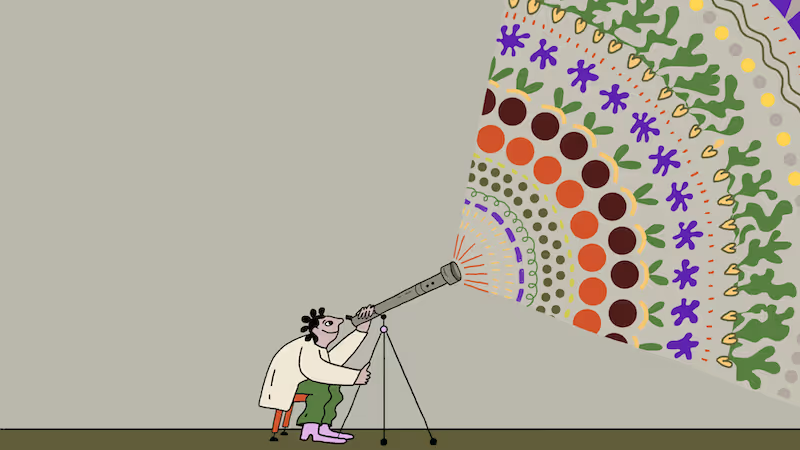
An old memory keeps resurfacing. My son (at three years old), standing in front of our apartment. He’s inching ever closer to a giant hole in the street. It’s safely blocked off but he can get close enough to see people inside of it, working on the gas lines. He leans in and then—for two whole hours—stares and points into the hole while asking the workers question after question about what they are doing. 

I remember that the workers seemed to enjoy teaching my son about the pipes and wires and processes, a veritable city under the city. This was a relief to me because my son was unrelenting in his pursuit of answers. I was totally in awe of this little insatiably inquisitive being: his curiosity and intense focus on this particular thing he wanted to learn. But, in retrospect, it’s the time span that stands out—two whole hours. 

Two whole hours to do nothing but ask questions, listen, learn, observe, engage, peer into the vast emptiness of a hole in the street. No distractions. And my dominant feeling as I remember this day? 

Pure unadulterated envy. The unbounded freedom to learn new things, the unstructured time, the ability to simply focus. And that’s just the envy I feel of my son. I’m envious of the hole, too. What I’d give to have some empty space and do a little inner work. 

But I am full up. I’m full of stories, sessions, calendar notifications, emails, texts, and other pings. Every time I finally get to a temporary stopping point on my to-do list, I find that I unconsciously pick up my phone and immediately suffer the fracturing of attention so many of us have come to accept as a normal part of everyday life. It’s ironic how we have apps to make life simpler, to help us meditate, and to measure our health, when we’d likely make significant strides on all three fronts if we were to simply bury our phones in the yard for a few hours a day. 

Which brings me back to those two hours. I’ve decided that I’m taking them back. I’m harnessing the “back to school” energy of September in pursuit of three things: focus, curiosity, and learning. 

I know it’s easier said than done. I start with the question: what conditions do you need in order to find your focus? For me, first, it’s doing something with my hands that prevents me from holding a phone. Second, it’s doing it consistently. And third, it’s going deep into just that one thing. This fall, it’s guitar. I’ve wanted to pick it back up for years. I want to get that focus back—string by string—and finally calm my wandering mind. So, I’m doing it. I’ve committed to learning four songs from the old days: “Pas L'Indifférence” by Jean-Jacques Goldman; “You've Got a Friend” by Carole King; “Quelqu'un m'a dit” by Carla Bruni; and “Tomara” by Vinicius de Moraes. 

Last week, I told a colleague over Zoom I couldn’t go into “meeting overtime” because my guitar teacher was coming. And, with that, I immediately saw how committing specific time to learning also creates a helpful boundary between work and home. When my teacher arrived, that memory came up again: my son at the edge of the hole, asking question after question. I no longer felt envy; I felt inspired. 

Let’s Turn the Lens on You 

  • What conditions do you need in order to find your focus? 
  • Do you focus better in silence or with the noisy background of a café? 
  • What prevents you from focusing?
  • What would you like to focus more on in your life? 
  • What would you like to focus less on in your life? 
  • What do you want to learn this fall?
  • What investment would you need to make to bring that goal to life? 

More From Esther

"Why is it so hard to take a break?" / last month's letter

No matter where you go, vacation always comes with a choice: do you want to stay connected to the world and its realities or do you want to disconnect and simply be present where you are?

“Am I being gaslit by my partner?” / a recent article

This summer, we relaunched “Where Should We Begin?” as “always on” with the Vox Media Podcast Network. That means more episodes, more relational journeys to listen in on, and bonus content for those who subscribe for a small monthly fee—including conversations with luminaries from the arts, entertainment, psychotherapy, and beyond. Read on for the behind-the-scenes story of the episode “Am I being gaslit by my partner?”

Six Essential Practices to Improve Listening Skills in Relationships / an article

If you, too, are diving into learning new skills this Fall, consider brushing up on your listening skills first by reading our article. 

Conversation Starters

A compendium of highly recommended sources of inspiration and information

I’m Watching: 

To help me reconnect with my own musical pursuits, I’m listening to: 

I’m Reading: 

Read More
Conflict
Communication & Connection
Letters From Esther: “Am I being gaslit by my partner?”
My monthly newsletter and workshop is meant to inspire you to reflect, act, and develop greater confidence and relational intelligence in all of your relationships. This month's theme focuses on the term "gaslighting."

Shall We Begin?

She called me for a reality check. “I’m wondering if I’m being gaslit by my partner or if I’m just being overly sensitive,” she said in a shaky Irish brogue. The content of her examples told me her side of the story: he hounded her when she was sick. He picked fights right before seeing friends (and then welcomed said friends as if nothing was wrong). He berated her constantly about how mean she was, all whilst yelling at her. Her tone, unsure and exhausted, told me more. 

“I just have no idea if I’m basically a bad person.” 

We hear the term “gaslighting” all the time now, often applied to a whole range of behaviors, some of which apply and some of which do not. I didn’t know if she was being gaslit. But it was clear to me that she was in a bad situation. Her sense of self had eroded. Her ability to trust her instinct and perspective had evaporated. Her doubt had calcified, turning her into a hard shell of herself, and she didn’t get there alone. Whenever she mustered the courage to speak up to him, she’d find that the exact words she was saying—you’re being really unkind right now—would be thrown right back at her ten times harder. What are you talking about? YOU’RE being unkind! You don’t even realize how mean you’re being. You don’t care about my feelings at all!

If you relate to this dynamic, don’t immediately fret. We’ve all had some version of this fight. As always, however, there’s a line. She was wondering if they had crossed it. She was so profoundly questioning reality that she needed something solid and sure. She wanted to know, definitively, if she was being gaslit. But without witnessing their dynamic together, I couldn’t answer that. 

She was feeling many of the things people who are gaslit experience: confusion, self-doubt, and that she could no longer trust her sanity. In her relationship, she felt that her thoughts and feelings did not have validity. She was questioning her mental health because, as she shared, her partner often blamed her mental health as the root cause of their issues. Maybe he was right, she thought. After all, she had struggled before. Maybe this was her fault. Plus, he was really trying to be better. 

She was sure she was complaining too much to me and wanted me to know that he had many good qualities. He loves her. He’s her best friend. She can’t imagine losing him. He introduced her to the arts. He’s a generous friend. He’d have moments of lucidity in which he could see his part in their dynamic but it was never long before they’d be back in the spin cycle. Round and round they’d go. She was so dizzy with doubt, she couldn’t see straight. She asked me again, “am I being gaslit or am I too sensitive?” 

While I couldn’t answer her question, the question itself revealed so much. If you are constantly questioning and doubting yourself in a state of confusion then you know something’s not right. I think many of us try to grab these words—gaslighting, narcissist, red flag, and other therapy-speak—not because these are not very real and important psychological terms, but because giving it a name tells us what we’re going through is real. If we can name the problem, perhaps we can find the solution. 

I’ve said it so many times: most relationship challenges are not problems to solve. They are paradoxes to manage. And sometimes, as was the case for this woman, you can love someone and still decide to leave them.

I spoke to this woman for an episode of my podcast, Where Should We Begin?, which I’m so glad to share is relaunching next week in partnership with Vox Media. And, this time, I’m trying a lot of new things. 

When I was thinking about what I wanted to do differently, I thought about this woman. I wanted to know what happened after we spoke. Since none of the people on my podcast are my patients, I am always curious about what they do with the things we discuss. How did the conversation motivate them or help them make sense of what they were going through? How did it contribute to a process of change? 

Six months after our initial conversation, this woman left me a long voicemail. The Irish brogue was there, of course, but the shakiness was gone. She had made a choice that would forever change her life. I could feel the confidence, joy, and maturity in her voice. She had the answer to her question and she was sure. Later this month, with her permission, you'll get to hear it for yourself.

Let’s Turn the Lens on You 

  • You may recognize yourself in the story above. 
  • Have you ever been caught in a dynamic of gaslighting? 
  • If you felt you were being gaslit, how did it lead you to question your sense of reality?
  • Did you come in with one perception of yourself and develop another? 
  • Did you act completely out of character?
  • Did it feel like a never-ending competition for whose feelings matter more?
  • What did it take for things to change? 
  • If you stayed, were you able to turn the lens on you or only focus on the shortcomings of your partner? Or vice versa? 
  • How were you able to turn around the cycle of blame, attack, and defensiveness? 
  • If you left, what did it finally take for you to leave? 
  • How did the experience inform your future relationships? 

More From Esther

Feeling Alone in a Relationship? You’re not alone. / an article

Over the last decade, we’ve experienced a new type of loneliness—the loss of connection, trust, and capital while we are next to the person with whom we’re not supposed to be lonely. Read more about feeling alone in a relationship, how it's intensified in the midst of crisis, and what you can do to reconnect.

Stop Bickering. It’s Killing Your Relationship / an article

Ongoing criticism can lead to the demise of the relationship. And if we criticize as a way of asking to be loved, we will often produce precisely the opposite effect of what we seek: to be loved and to feel good about ourselves. Here’s how to reset the negative pattern.

In a Relationship Standoff? Here’s How to Get Out. / a workshop

This workshop gets tactical about how to break the rhythm of escalation and examine our own rigidity. This link takes you right to the exercises. 

Conversation Starters

A compendium of highly recommended sources of inspiration and information.

I’m Watching: 

I’m Reading:

I’m Listening To:

Read More
Communication & Connection
Friendship
Letters From Esther: The Question that Comes Up in All New Adult Friendships
My monthly newsletter and workshop is meant to inspire you to reflect, act, and develop greater confidence and relational intelligence in all of your relationships. This month's theme focuses on the question that comes up in all new adult friendships.

Shall We Begin?

“Raise your hand if you’re experiencing some anxiety being here. Keep it low if it’s just a little anxiety. Raise it to a height that corresponds with the intensity. So, if you’re having a panic attack right now, your hand should be as high in the air as possible.”

Two weeks ago, I said these words to hundreds of first-time attendees of TED’s annual conference in Vancouver. The organizers had invited me to speak to newcomers about forming connections, grappling with imposter syndrome, and reconciling our home lives with the adventures to come in the week ahead.

“Find someone whose hand is at the same height as yours and give each other a little high five. Can you two be anchors for each other while you’re here?”

Five years had passed since my last TED conference. I was very moved to be back. I kept thinking about my first mainstage talk, in 2015, and how it felt to be there. I was riddled with anxiety, not only because I was preparing my talk but because I wasn’t sure what authenticity looked like in this space. Everyone around me seemed so confident and successful. Could I admit that I didn’t feel the same way? What was appropriate to share about myself, my feelings, my inner world, my life back home? It wasn’t until after I’d delivered my talk that I found out: I was not alone in these feelings — not at all. 

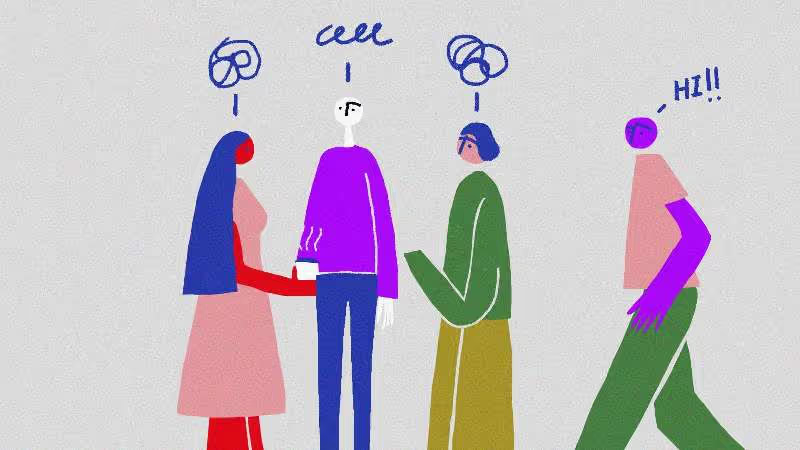
Perhaps it’s the nature of being a therapist. Perhaps it’s because my talk struck a chord. As soon as I exited the stage, in 2015, I became a walking confessional booth. Strangers approached me to discuss their relational challenges in deeply personal detail. Occasionally, multiple people would approach, and I’d suggest they talk to each other. You three are going through something similar. Why don’t you get coffee and discuss? They almost always did. 

At every conference, there is what’s happening on the stage, but there’s also what’s happening in the hallways, in the bathrooms, and on the group chats. People are eager to connect on a personal level. They likely have deep connections at home, but there is something unique about connecting in a new space with new people in real time. You can walk in alone, but you won’t be lonely for very long. But there is always the question: how much of myself should I share? 

This is a question that comes up in all new adult friendships. And it’s a topic that has fascinated me my entire adult life. When I moved from my tight-knit Belgium community to Israel for university, I was perplexed by how one makes friends without having grown up with each other—without knowing each others’ parents and seeing inside each others’ homes. When I moved to America, the question evolved: how do you make friends with people who know nothing about where you come from? 

These relational queries directly impacted my mental health. And, as I figured out how to make new friends—asking an Israeli student for help; meeting other foreigners in America; seeking out locals who could show me around—that directly impacted my mental health, too, for the better. And while, presently, I have lots of friends all over the globe, I still sometimes find myself asking…how much sharing is too much sharing? When is it appropriate to tell people that I’m struggling? 

Candidly, my family is currently navigating a major health crisis. It’s taken me months to say this to you, my community. But I told my closest friends, old and new, right away. Friendship has been on my mind more than ever because I know I would be lost right now if not for the friends in my family’s orbit who don’t flinch when I am freaking out, who pick me up when I feel like collapsing. In the midst of all this, speaking publicly about relational health has taken on a renewed fervor for me. 

At TED this year, I wanted to highlight that relational and mental health are inseparable. It’s a part of this thing. Not just the conference, but the act of convening. Not just the organization’s “ideas worth spreading,” but the social support that enables us to do so. As scores of speakers took the stage to talk about the most-pressing issues of the day—engendering both hope and terror—hundreds of attendees shared their inspirations and anxieties with their new friends. People turned toward each other, not away. Two weeks later and the group chats are still activated by that ethos. It shows no signs of slowing. 

Let’s Turn the Lens on You 

  • When making new friends, go beyond “what do you do?” 
  • A question I love to ask new people is: “what would you do if you had the chance to do things differently?” It’s open to interpretation and people can choose their comfort level.
  • Practice active listening. 
  • Ask follow up questions, but pay attention to boundaries—and respect them.
  • Practice mutuality. Don’t be afraid to share things about yourself but find the line. You don’t have to go all the way in the very first interaction. Like any relationship, friendships build over time.

More From Esther

Letters From Esther #27: Friendship / a newsletter

Different from romantic or filial love, friendship is its own unique love story. Making friends is the first free choice relationship we have as kids. Our friends provide community and continuity in an ever-changing world. 

Letters from Esther #1: The Friendship Workout Plan / a newsletter

Connection creates positive by-products; it is an antidote to loneliness. Friends are a lifeline, an oxygen mask. No matter how deep the connection, however, friendships require emotional maintenance. Here’s how.

The Power of Apologizing: Relearn How to Say I’m Sorry / a recent article

A strong, meaningful apology goes a long way in repairing major and minor rifts in any relationship. Intellectually, we know this. Apologizing is one of the first relationship skills we learn as young children. But it’s a skill that needs to grow with us. 

Conversation Starters

A compendium of highly recommended sources of inspiration and information       

I’m Reading:

I’m Going To: 

I’m Watching: 

Read More
Communication & Connection
Conflict
Letters from Esther #43: “Would you rather be right or be married?”
My monthly newsletter and workshop is meant to inspire you to reflect, act, and develop greater confidence and relational intelligence in all of your relationships. This month's theme offers a look inside my office as I help a couple navigate a common couple argument.

Shall We Begin?

“Would you rather be right or would you rather be married?” 

I don’t often use clichés in couples therapy, but this one is a go-to. It is often the most direct question I can ask a feuding couple who is stuck in a standoff. A few years ago, after I welcomed a young couple into my office, they sat down on the couch a foot apart and immediately looked in opposite directions. I waited to see who would speak first. She looked over at him and raised her eyebrows. He gestured with his hand, wordlessly conveying “no, you start, honey.” And so she began. 

“His parents hate me.” 

“They don’t hate you. They don’t know you. They live on the other side of the world. They’ve never met you.” 

“What am I supposed to do? They don’t want to get to know me.” 

“I’ve told you, you should call them, write to them.” 

“We don’t speak the same language.”

“We can arrange a trip to go see them.”

“You know we can’t take off work for that long.”

It went on like this for a while: her stating her case, him butting in, her shutting him down. And then, I fell into the trap, too. “What if you used a translation app?” Soon came a deluge of reasons from her as to why that wouldn’t work. “I see,” I said. “You ask him what do I do? He gives you an option and, no matter what that option is, you come up with a reason why it is not possible. And I also see that you are getting frustrated he has not yet been able to solve this problem. I am curious: Do you want a solution or sympathy? Both are valid. Do you want help or do you want to be right? Less valid. You seem to want help but when he offers it, you are quick to reject it. So, what is he missing?”

Discomfort rippled across the room. It was silent and awkward and then, out of nowhere, she laughed. “This is so stupid,” she said. Was she talking about the therapy? His frustration? My advice? “I have no idea why I do that.” She turned to her partner. “I’m sorry.” 

I invited him to suggest another solution and her to try responding with curiosity. He offered to translate between her and his parents. She opened her mouth and laughed again. “It’s hard to not immediately go to the negative. All of his suggestions give me anxiety.”

“Is he giving you anxiety or are you experiencing the discomfort of recognizing your own pattern?” She went to speak, stopped herself, and smiled. “I was about to do it again.”

These days, we work really hard to eliminate discomfort in every area of our lives. I have found, however, that discomfort is a remarkably effective tool. When we heighten the discomfort we feel around how stuck we are, we urgently start to reconnect with our sense of agency. “I don’t want to feel this way; what can I do to change this?” That agency becomes a pipeline to relationship accountability. “I didn’t realize I was doing that; I’m sorry I kept shutting you down.” 

Not every couple’s session goes this way, of course, and we spent much of the session on the aspects of their dynamic he needed to own. He had been offering surface-level solutions instead of listening to what she was experiencing underneath. He had been discounting the very real challenges that can arise with cross-cultural family ties. In one hour, two clear patterns had emerged: her reluctance to put herself in a situation in which she could be rejected and the back and forth between her expressions of distress and his failed attempts at redress. Eventually they both went silent. And then he said “you keep saying that my parents don’t like you…but, by avoiding meeting them at all, you’re turning your fear into our reality.” 

It was the most uncomfortable moment of the whole session but clarity was finally seeping in. Gears were clicking forward. She went to respond and stopped herself. Once she could see her automatic no creeping up, she couldn’t help but laugh and neither could we. Discomfort is a great tool, but so is laughter. Both bring perspective. 

Let’s Turn the Lens on You 

  • What are some of the common ruts you get into with your loved ones? 
  • Identify one element of that rut for which you are perennially responsible. 
  • What kind of triggers make you defensive in this situation? 
  • What do you think might happen if you were to own your part?
  • What’s one quality you could bring to the dynamic that could change it for the better?

More From Esther

“The 3 Types of Relationship Fights You Keep Having” / an article

The deeper issues that drive escalation are rarely about the content of our fights—dirty dishes, too much time on our phone, politics, the kids—they’re about the needs, vulnerabilities, and biases that get triggered over and over. 

“The Myth of Unconditional Love in Romantic Relationships” / an article

It might actually be a necessity to allow ourselves to really, really not like the person we love sometimes. Perhaps the highest form of love isn’t unconditional. Maybe it’s closer to Terry Real’s description of self-esteem: our ability to see ourselves as flawed and still hold ourselves in high regard. Can we do that for our relationships, too?

“Stuck in a Relationship Standoff? Here’s How to Get Out” / a free workshop

In this free workshop, Esther explains how to break the rhythm of escalation and examine our own rigidity.

Conversation Starters

A compendium of highly recommended sources of inspiration and information       

I’m Reading:

I’m Listening to: 

I’m Watching: 

Read More
Communication & Connection
Letters From Esther: My Worst Valentine’s Day
My monthly newsletter and workshop is meant to inspire you to reflect, act, and develop greater confidence and relational intelligence in all of your relationships. This month's focus is on using the month of love as a step in nurturing your relationship.

Shall We Begin?

“Don’t even think about going out on Valentine’s Day.” 

I still remember practically hissing those words at my husband one year at the beginning of February. We were going through a tough period, running our psychotherapy practices, raising two kids, and coordinating care for aging parents across the Atlantic. We also virtually disagreed on how to handle each of these herculean responsibilities. 

We weren’t at war, but we were more AT each other than WITH each other. And then suddenly, it was the second week of February and he asked me “what do you want to do for Valentine’s Day?”  To me, this wasn’t really a question. What I heard was “I don’t want to do anything for Valentine’s Day. Do you?”

Let’s just say we weren’t feeling romantic. We were so stuck in the trenches, a détente for Valentine’s Day seemed ludicrous. And yet, deep down, it’s all we wanted. In good years, celebrating Valentine’s Day had been a welcome ritual. Now, the holiday felt designed to shame us. Celebrating ourselves felt like a farce and a fraud. It was hard then to see what would eventually come: we’d repair. We’d figure it all out. We’d laugh again. We’d have fun for decades to come. 

We worked hard to pull ourselves out of the pit. I can credit my skills as a relationship therapist, but I really have his flirty sense of humor to thank. Nothing thaws icy relations like a masterful diffuser who can finally bring some much needed lightness. When I need a reminder as to why this occasionally frustrating man is the great love of my life, I pull out the “book proposal” he gifted me one year: “Making Your Marriage Work: A Guide for Men with Dynamic, Attractive, Passionate, and Insanely Demanding Wives.”

In reflecting on this, I’m reminded of a quote from my dear friend and colleague, Terry Real, with whom I’ve been spending a lot of time lately. He says “relationships are our biospheres. We’re not above them; we’re in them. You can choose to pollute your biosphere by having a temper tantrum over here, but you’ll breathe in that pollution by your partner’s withdrawal, resentment, or lack of generosity over there. You and they are connected in an ecosystem.”

There is no better advice for those of us warring with a partner. And, believe it or not, Terry’s words apply to Valentine’s Day, too. It’s not just a day in February when card companies and chocolatiers make their annual windfall. Take an ecological approach and a once a year holiday to prove your love becomes a big red reminder to nourish your biosphere. Have I been unkind? Unfair? Downright mean? Holding onto a grudge? What do I need to do for the health of this ecosystem? 

Surprise your lover by being more thoughtful than they thought you could be. And then…don’t stop there. Try it again the next day and the day after that. Be kind, more playful. Invite your partner into a new routine, a nightly walk after dinner, lighting a candle while you get ready for bed, coffee together in the morning. 

Recently, Terry and I conducted a workshop together. Midway through, we began screaming at each other—all the things couples say to each other during a blow out fight. I’m sure anyone outside the room without context was horrified. But inside the room, one hundred people were laughing at how ridiculous we sounded. We all recognized ourselves in that dialogue, the terrible things we say to the people we love when we’re hurting…and how unproductive it is toward what we really want. We’re all guilty of it. 

When you’re so deep in that dynamic, one day in February isn’t going to change anything. But it can be a start, if you let it. 

Let’s Turn the Lens on You 

  • Whether you’re angry, exhausted, or just not feeling it, Valentine’s Day can be stressful.
  • The impulse to skip Valentine’s Day altogether is valid. But that can be hurtful to your partner.
  • Even doing something small can nourish your relational biosphere.
  • Notes go a long way. “I am so grateful for our life together. Thank you today and everyday for your love, care, thoughtfulness, and kindness.”
  • Set a goal together. “What is one thing we could do every month this year for the health of our relationship?” Offer your own ideas, too.
  • Agree to let go of something. “I’ve been holding on to this grudge/fear/disappointment for too long. I’m ready to let go of this for us.”
  • Read a great book or take a class together that will nourish your relationship.

More From Esther

“Looking for the Perfect Fit? Pros & Cons of Relationship Checklists” / a recent article

It’s fantastic to know what you want. It’s important to communicate your desires and values. But there are major downsides to being overly reliant on your relationship checklist. By the time you get to the bottom of it, you may have put yourself in a box and boxed the other person out. 

“Our Comfort with Intimacy Has A Lot to do with These 7 Verbs” / an article

It’s been said that we need fifty words in a foreign language in order to speak it. In the language of intimacy, basic fluency comes down to just seven verbs. And behind each one are questions about how we learned to love and be loved. 

“The Myth of Unconditional Love in Romantic Relationships” / an article

It might actually be a necessity to allow ourselves to really, really not like the person we love sometimes. Perhaps the highest form of love isn’t unconditional. Maybe it’s closer to Terry Real’s description of self-esteem: our ability to see ourselves as flawed and still hold ourselves in high regard. Can we do that for our relationships, too.

Conversation Starters

A compendium of highly recommended sources of inspiration and information       

I’m Reading:

I’m Listening to: 

  • Every year, my son Noam Saul makes a playlist for me of timeless music from around the globe. It’s not only a great way to discover new music; it keeps me connected to my son. You may listen to that playlist here. 
Read More
No items found.
Letters From Esther: A Practical New Year’s Resolution? Find Balance.
Looking for a more practical new year’s resolution? Find a balance between structures that ground and motivate us and guilt-free spontaneity which allows us to take risks, explore, and yes, occasionally overindulge in life’s pleasures. Read more on the importance of balancing structure and spontaneity in the new year.

Shall We Begin?

The new year brings a desire for structure. A fresh calendar, a clean grid ready to be populated with plans and promises. In this first month, we aim to wrangle all eleven months that will follow. This year, we will plan more trips. We will keep a cleaner house. We will work on our minds, bodies, and spirits. We will get in shape. We won’t make the same mistakes. We will spend more quality time with loved ones. We will manage our money better. We will be happier, healthier, better.

Just last week, were we not kicking ourselves for overindulging on holiday food? Were we not lamenting how little we got done at the end of the year or, conversely, how little we allowed ourselves to do nothing? Every year we engage in this swing from December self-flagellation to January hyper-motivation. And I can’t be the only one whose best laid plans wither by February. Are our outsized expectations—and our sharp left turn to kick them off when the clock strikes midnight—preventing the sustainability required to make lasting change?

A more practical new year’s resolution? Find balance between structures that ground and motivate us and guilt-free spontaneity which allows us to take risks, explore, and yes, occasionally overindulge in life’s pleasures. I often speak of our dualistic needs for security and freedom, safety and adventure. But even I have to remind myself of what that looks like in practice when every article and ad is pushing “new year, new you” gym memberships, to-do list apps, and courses which promise life-changing results in eight perfectly-organized modules.

It’s not just the new year that makes it hard to remember the importance of balancing structure and spontaneity. Any time the pressure’s on, we are so quick to forget the fundamentals. We all know, for instance, that balancing predictability and newness is essential for children. It’s how they learn, grow, and make connections. But when adults come to my office or on my podcasts to discuss relational challenges, work problems, friendship fallouts, and more, inevitably they either have no clue where to start or think they already have all the answers. To them, I introduce a loose equation: 

  • too little structure = high chaos
  • too much structure = rigidity
  • too much spontaneity = dysregulation
  • too little spontaneity = fossilization and deadness 

I observe these imbalances in so many contexts. Think of your romantic relationships. Relationships that are all structure and no spontaneity leave little room for mystery or happenstance, erotic qualities that are essential to aliveness and energy between partners. All spontaneity and no structure, on the other hand—no titles or concrete plans—can leave us anxious. Think of your friendships. Old friends remind us of who we’ve been. New friends remind us of who we can be. Think of a company. Businesses need structure and spontaneity, too. They need legacy, accountability, and boundaries, as much as they need flexibility, creativity, and innovation. 

Now think of this new year. You don’t have to throw everything old away. You don’t have to focus entirely on the new. The uncertainty of the year ahead doesn’t have to unravel you. Trying to constantly control the unknown won’t make it better. Resolve instead to ground into what is real for you now and to uplift yourself by the still unclear possibilities for your future. Yes, you need some discipline, but you also need to let go a bit. And if a little extra control is what you really want this new year—if you find yourself entirely unable to stop planning every detail—at least promise me that you will plan to have some fun. 

Let’s Turn the Lens on You 

  • What are your associations with the “new year”? 
  • Does the promise of new beginnings motivate you? 
  • Does the conclusion of the previous year stress you out? 
  • Do you prefer to bring in the new year dancing with others or in quiet contemplation with yourself? Why?
  • What area of your life could use more structure? 
  • What area of your life could use more spontaneity? 

More From Esther

“4 Practices for Hopefulness in the New Year” / a recent article

“Hope is the alchemy that turns a life around,” says psychotherapist and grief expert Julia Samuel. “It isn’t just a feeling; it is a realistic plan—and a plan B supported by the belief that you can make it happen.” The challenge, of course, is actually doing the plan. Read more to learn how.

“Rituals & Routines” / a newsletter

Routines are concrete repetitive actions that help us develop skills while creating continuity and order. Rituals are routines elevated by creativity, driven by intention, and imbued with meaning. Together, routines and rituals help us through life’s big changes, including the transition from one year into the next.

“The Last Time I Felt Free…” / a newsletter

How do you define freedom? When do you experience it? How has the pursuit of freedom informed your decisions? In this exploration of freedom, we look at what the answers to these questions all seem to have in common. 

Conversation Starters

A compendium of highly recommended sources of inspiration and information.

I’m Reading & Listening to:

I’m Watching: 

Read More
No items found.
Letters From Esther: Contemplating Hope
My monthly newsletter and workshop is meant to inspire you to reflect, act, and develop greater confidence and relational intelligence in all of your relationships. This month's theme: Contemplating Hope.

Shall We Begin?

The modern definition of the word “hope” is synonymous with “wish” or “want.” The ancient definition is closer to “trust.” Consult scripture and you’ll find “hope” as part of “faith.” It’s the aspect of faith focused specifically on the future. Hope is the prayer that things will change, that our loved ones will be healthy, that this year will be better than the last, that we will finally be happy.

Contemplating hope is my annual ritual at the end of each year. Resolutions don’t do much for me, but hope does. Hope is a balm for those of us who regularly experience anxiety. It counters negative anticipation, instantly making us feel a bit better. The only problem with hope, as I see it, is that it can be flimsy. For an anxious person, catastrophic thinking is more reliable (and at least comes with a pleasant surprise when we’re wrong). If you’re like me, you know that “wishing” and “wanting” are often immediately followed by a deeper layer of fear: what if what I wish for doesn’t come true? 

What are us anxious mortals to do? Perhaps we can try tapping into those older definitions of hope—putting wishing and wanting aside to instead cultivate trust and faith. I like this shift, in part, because trust is a very important subject in my work and faith comes up a lot in my personal life. People ask me all the time: “how do you build trust after betrayal, when hope has made a fool of you?” For these people, hope has become dangerous. It can feel much safer to keep a negative outlook, to wrap ourselves in it like protective armor. If I anticipate what will go wrong, I’ll see it coming. If I see it coming, I won’t get hurt. 

Closing ourselves off to the possibility that things will get better doesn’t protect us from getting hurt. Unfortunately, it only ensures that nothing will change. This doesn’t only apply to our relationships, but to our world view. It’s been a tough few years. I know I’m not the only one questioning what good hope is when war rages on, when Iranian protestors are murdered, when extreme weather is now the norm. For these reasons, I’ve been studying hope in the context of broader challenges as well as hope's overall connection to our mental wellbeing.

Psychotherapist and stress researcher, Elissa Epel, takes “the long view of hope,” a balanced view of cultivating daily joy, social connection, and purpose, while maintaining the dialectic of accepting and acknowledging the loss, pain, and disappointments of the world in which we’re living. Primatologist Jane Goodall has said hope is a survival skill that “enables us to keep going in the face of adversity.” Psychotherapist and grief expert Julia Samuel has said “hope is a feeling, but it’s also a plan.” The Austrian psychiatrist and Holocaust survivor, Viktor Frankl, recognized that hope is directly tied to meaning. Meaning, as I see it, is not only what keeps us going; it’s how we can help. 

So how do we do it? How do we be hopeful? The rules of hope may be similar to those of happiness, as described to me recently by Gretchen Rubin. Both require action, one small step at a time, with no guarantee that we’ll get our desired outcome. Like happiness, hope is not logical, but nothing about trust and faith is logical. It doesn’t make it any less important. There is a saying in Judaism, “na’aseh v’nishma” — “we will do and then we will understand.” Lately, when I’ve been rapt with anxiety, I’ve been trying to reorient toward hope. Even if I don’t know exactly what I’m hoping for, I tell myself it’s okay to take the leap of faith and trust the landing. I’ll let you know how it goes. 

Let’s Turn the Lens on You 

  • Do you straddle hope and hopelessness? What strategies are helpful for you?
  • What has made you feel hopeful in moments of darkness, loss, or grief?
  • Is there a person in your life who gives you hope? Do they know?
  • What’s a song that lifts your spirit?
  • What’s a quote that has inspired you? 
  • Do you seek out good news?
  • What is your hope for the new year?

More From Esther

“My Own Chosen Family” / a recent newsletter

Co-creating a sense of belonging is one of the most satisfying aspects of having relationships. For 30 years, I’ve been doing just that with a group of friends during the holiday season.

“Promises & Resolutions” / a newsletter

There are plenty of articles that will encourage you to make new year’s resolutions. This year, I invite you to think about the promises you need to break instead. What would the new year be like if our resolutions—that mental state of activation—was informed by the promises we’re finally ready to break?

“Want to Build Trust in Your Relationship? Take Risks.” / a blog article 

Issues pile up in every relationship. Even small mistakes can be corrosive when they happen again and again. It’s hard to open back up to the possibility of being hurt or disappointed again, but taking that risk is the only way to build trust in a possible alternative: that things can be better. 

Conversation Starters

A compendium of highly recommended sources of inspiration and information       

I’m Reading & Listening to:

Read More
Work
Letters from Esther #4 - Relationship Dynamics in the Workplace
My monthly newsletter to stay in touch and inspire reflection and action in areas that are important for your relational intelligence. In celebration of the release of my new podcast, How’s Work, this month's theme is: Relationship Dynamics in the Workplace

Shall We Begin?

I created a new podcast about what couples therapy can teach about relationship dynamics in the workplace. It’s made me think about my own professional trajectory. I’d like to share some of those reflections with you today.

This is how it all began. At least, the version of me you have come to know. 

For thirty years, I was a therapist in private practice which meant I worked alone. I still see patients weekly, but back then, I did my own scheduling and accounting, and booked my own lectures and flights. As I’ve said before, we all need both security and freedom. But I figured out early on that I tolerate a lack of security better than a lack of freedom. It’s why I’ve always been self-employed. As any entrepreneur knows, self-employment is a double-edged sword. I had independence, but the office could be isolating. I created a reliable stream of income to support my family, but I was losing some of my enthusiasm and energy. I had built a foundation and achieved stability, but I was longing for creativity and community. 

So I took stock of what I had built up, and decided it was time to build out. The first person I hired never showed up. The person who did show up that day—to interview me about work—decided to stay and help while she was between jobs. Well, now she had one. Together, we began to translate the analog, solitary experience of therapy for the digital, community-based landscapes of webinars and social media. Everything was new in those early days. And luckily, I had a list of people who had told me over the years “the day you scale, call me.” And so we picked up the phone. 

There was a new dynamic emerging, too: for the first time in my life, I had a business partner, a “co-founder.” For a person whose work primarily concerns relationships, this was a brand new kind of relationship to explore. And in our modern world—in which many of us have severed ties to the geographies, communities, institutions, and family obligations that gave previous generations their sense of belonging and identity—there’s never been more pressure on our interpersonal relationships and work lives. We used to go to work to “make a living.” Now we go to work to “make meaning.” I had wanted more creativity and community in my work and I was getting it. 
As we learned, we grew. It soon became clear: it was time to go from two to three and more. At the end of this summer, at our second company retreat, as I sat surrounded by my team of twelve—most of whom are entrepreneurs in their own right—I saw for the first time the map of what we have built and the potential for where we have yet to go. On this map are business milestones, yes, but also discoveries about the importance of working together to raise our relational index. 

People want to feel seen, valued, and included. As Dr. Howard Markman has said, there are three main hidden dimensions under most relationship impasses: power and control (who has influence and decision-making power); care and closeness (do you have my back?); and respect and recognition (integrity and value). When issues come up, we have to ask ourselves which dimension is at play. It may feel safer to gossip about a meeting than say “when I’m not listened to in a meeting, it makes me feel unimportant,” but calling it like it is fosters relational accountability. 

Calling it like it is may mean grabbing coffee with a colleague and talking out your issues. Listening to each other, not just waiting for your turn to talk. Apologizing without having to agree. Acknowledging that we may have offended the other person even if it wasn’t the intention. These are the ways in which we avoid what I call “kitchen sinking,” our tendency to let issues compound. We can’t wash one dish if we pile it all up. 

Building my business hasn’t always felt the way I thought it would. I set out to take psychotherapeutic ideas and practices out of the office and into the public square, and hopefully expand the scope of my usefulness. My goal was never to build a brand. It was to counter the ever-growing privatization of problems that we all experience.

Maybe that’s where you are now: reflecting on your own professional development or perhaps building something that feels bigger than yourself. Maybe you, too, are eager to raise the relational index of your work life. After all, we spend a lot of time there. 

Let’s Turn the Lens on You

Raising the relational index of your work life starts with communication.

  • If you’re building your team, surround yourself with people who know what you don’t. I can help someone navigate their relationship, but I need help navigating SEO and sales. My team is made up of experts who complement my gaps. 
  • As you develop these relationships, ask “how are we doing?” Not just “how is the product doing?” 
  • In fact, add a relationship check-in to your weekly agenda. Ask “what is the status and quality of the relational dimensions of our team?” It’s something I’m trying to remind myself to do more, too.
  • Talk aloud. Email and slack are convenient, but insufficient for interpersonal communication and productivity. 
  • Role play. At a certain level, colleagues are not entirely unlike couples. I often make partners switch seats and talk to me from the point of view of the other person.
  • Start with what you agree with; then tackle the disagreements. 
  • Ask “what am I not asking?” Instead of pretending you have it all figured out, invite others to help you better define your goals, values, and identity.
  • Stay humble. Whether you’re investing in building a career, a business, or a project, it demands focus; sometimes this focus can turn into self-absorption—whether it’s arrogance or anxiety. Remain curious about others.

More From Esther

How’s Work? / Season 1

All the relational habits you built in life don’t immediately disappear the moment you walk in the office door. My new podcast, “How’s Work?,” brings new perspective to the invisible forces that shape workplace connections. Available November 5 on Spotify.

On Security and Freedom / A Recent Article

As our social landscapes evolve, we are trying, more and more, to reconcile the tension between our need for security and our need for freedom by putting too much pressure on our external relationships when we should be looking within ourselves. 

Anticipation for "How's Work?" / Quartz 

Lila MacLellan tees up what’s to come on “How’s Work?,” and reacts to my recent interview with The Cut on Tuesday’s podcast about our shifting professional needs. 

Conversation Starters

A compendium of highly recommended sources of inspiration and information

I’m Reading: 

I’m Watching: 

  • Prune Nourry’s new documentary “Serendipity,” a chronicle of the treatment she underwent for breast cancer and its effect on her art. 
  • Baratunde Thurston’s TED Talk
  • Anna Ginsburg’s explanation of her approach to animation 
  • The Century of the Self, a docu-series about “psychoanalysis as a powerful means of persuasion for both governments and corporations.”
  • ANTHROPOCENE: The Human Epoch,” a documentary about humanity’s massive reengineering of the planet. 
  • The Family,” a documentary about one group’s insidious influence in Washington, D.C.
  • Where’s My Roy Cohn?,” Matt Tyrnauer’s documentary about the ruthless lawyer and mentor to Donald Trump. 

 I’m Listening To: 

Read More
Communication & Connection
Friendship
Letters From Esther: Thanksgiving & Belonging
My monthly newsletter and workshop is meant to inspire you to reflect, act, and develop greater confidence and relational intelligence in all of your relationships. This month's theme is: Thanksgiving and Belonging.

Shall We Begin?

Who matters in your life today and how has it changed? Every year, as the leaves pile up on the ground here in New York, these questions begin to peak for me. To whom do I want to reach out for a holiday check in? Whom do I want to dance with on New Year’s Eve? Where do I want to focus my relational energy? As lives change, so do the answers, but what stays the same for me is what I seek in all my relationships: belonging, connection, honesty, loyalty, support, adventure, (and sometimes commiseration).

Belonging has long been at the heart of my work. Belonging is that sense of safety, comfort, and happiness that we feel when we are part of a group, place, tradition, relationship, or friendship. Our identities are intertwined with our experiences of belonging. Have you noticed how different parts of yourself become activated with different people and places? At home, I’m a mother and a partner. At work, I’m a therapist. In New York, I’m an immigrant. In my native Belgium, I’m an expat coming home for a visit. I speak nine languages and in every one a different part of me is expressed. Whenever my American and Belgian friends meet, they often compare notes. Long lasting friendships bring the many parts of us into alignment, grounding us in continuity. Old friends remind each other of who we were then and how much we’ve grown. We’ve been there for each other in excitement and boredom, in celebration and tragedy.

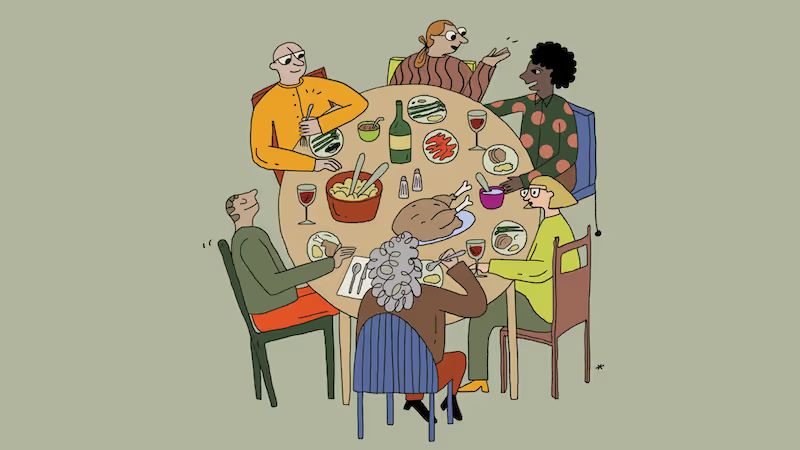
Decades ago now, after living in America for seven years, it seemed as if all my friends were leaving. I socialized then mostly with other foreigners and many were going back—to Amsterdam, Paris, Tel Aviv, to where they were from or to the next place they would call home. I suddenly felt like I was the only one who didn’t know where they belonged. When a friend of mine generously lent me his house for Thanksgiving, I wasn’t sure whom to invite. So I thought of the people whom I wanted to get to know better. Along with a few close friends, ten new ones came. None had ever met but they were all game to spend five days together. Thirty years later, that same group still meets every year for Thanksgiving. 

We’ve seen partners come and go. There are now fourteen children amongst us, many of whom join each year. I didn’t know what “chosen family” meant before this group. Having my own has created a whole new definition of what “family” can mean. Recently, I asked one of my friends in the group to reflect on this. She focused less on the Thanksgivings we’ve shared and more on how the group has been there for each other when our families of origin could not. She lost her mother during the social-distancing era of the pandemic. Members of the Thanksgiving group gathered outside her apartment, apart but together, for a small service. When she could finally travel to clean out her mother’s home in Florida, two members of the group came with her. 

We all weren’t always this close. Thirty years of Thanksgivings together made us fixtures in each others’ lives. In our secular and transient modern world, the holidays have become for many the only time in which gathering is ritualized. So make it a ritual. Come together with intention. Come prepared to participate—to prep, to cook, to clean together. You never know how these relationships might evolve. It’s never too late to start your own Thanksgiving group. Any combination of family, friends, and strangers will do, as long as you remember why you’re doing it. Co-creating a sense of belonging is one of the most satisfying aspects of having relationships at all. 

Let’s Turn the Lens on You 

  • Think about the people in your life. 
  • Whom would you like to have at your Thanksgiving table? Why?
  • What would it mean for you to open your home to them? Or to ask one of them to host a group in their home?
  • Find a collaborator to share the organizational load.
  • Both of you can invite 5 people who’d be fun to bring together. They can know each other or not. 
  • Invite everyone to bring one dish that is traditional for them. 
  • Invite everyone to join early to prep. Make sure they know everyone will be cleaning up together too. 
  • Consider having a few prompts for dinner conversation, perhaps about the year behind and the new year ahead.

More From Esther

“Coping With Loneliness Around The Holidays” / a blog article

There are many resources for turning holiday loneliness into strong relational health. When we’re experiencing loneliness, it can be difficult to reach out for help. With that in mind, we reached out to our community to pull together resources for coping with holiday loneliness.

“Friendship” / a newsletter

Different from romantic or filial love, friendship is its own unique love story. Making friends is the first free choice relationship we have as kids. While some friendships are tight knots, others are loose threads. How do we know which is which?

“Relationship Stress at a High? Try Spending Time With Friends” / a blog article 

We spend our young lives building an entire relational infrastructure. As soon as we partner up, that network tends to shrink, often putting pressure on our romantic relationship to fill all of the relational roles in our life. Spending time with friends can help restore the balance.

Conversation Starters

A compendium of highly recommended sources of inspiration and information       

I’m Reading & Watching:

Read More
Discover more from Esther on Substack.
Explore articles and resources to help you find aliveness and vitality in your relationships.
Subscribe on Substack
Where Should We Begin Podcast COver

Where Should We Begin? with Esther Perel

Join Esther in her office every Monday to listen in as real couples in search of help bare the raw, intimate, and profound details of their stories.
Listen to the Podcast
Recent Episodes
View All Episodes

Where Should We Begin?

A Game of Stories

where should we begin at work product image
New
Where Should We Begin?
At Work
New
Where Should We Begin?
At Work
Improve team dynamics with Esther Perel’s renowned card game—now available for the workplace.
A live event with Esther

Sessions Live 2026

An unforgettable two-day event on relationships, love, and desire
May 15-16, 2026 | Online & In-Person in New York City
Get Your Early Bird Tickets

Courses Taught by Esther

Turning Conflict Into Connection
Uncover why you keep having the same fights over and over again. Learn how to break free from habitual patterns and responses. Find peace and reconciliation even when you disagree.
Gain new insights in just one hour
Downloadable workbook filled with guided exercises
Improve conflicts with or without a partner
View Course
Playing with Desire
Uncover and learn how to speak about your desires. Bring more aliveness into your sex life. Create rich, erotic rituals. Cultivate a more vibrant and fulfilling erotic relationship.
Perfect for date night
Playful exercises and prompts to tap into new erotic possibilities
Based on the same processes Esther has used to help real couples for 40+ years
View Course
Bringing Desire Back
Uncover what blocks desire. Learn how to tap back into pleasure and get unstuck. Discover a new sense of hope and possibility.
Perfect for date night
Guided exercises to turn insights into action and understanding
Based on the same processes Esther has used to help real couples for 40+ years
View Course
The Desire Bundle
Two courses designed to help you and your partner break out of sexual ruts, explore new possibilities, and build deeper connection.
Understand, communicate, and explore your sexual needs
Spark honest and constructive conversations about sex and desire
Designed to reignite curiosity, intimacy, and deeper connection in your sex life
View Course