All Articles
Thank you! Your submission has been received!
Oops! Something went wrong while submitting the form.
No items found.
Stop Bickering. It's Killing Your Relationship
In this video and article, Esther looks at the phenomenon of bickering, and the impact it has on our relationships.

“We bicker all the time, she’s so critical of me and I don’t feel like I am doing anything right. What should I do?” – Anthony, Boston

The artist Louise Bourgeois once described her tumultuous experience as a child at the dining table listening to her parents fight in this way: “To escape the bickering, I started modeling the soft bread with my fingers…. this was really my first sculpture.” And while conflict may have lead to great art for this artist, in most cases, it can be the constantly replaying soundtrack of a distressed relationship.

Anthony’s question is powerful because it is so common. I think of bickering as low-intensity chronic warfare. Ongoing criticism can lead to the demise of the relationship. And if we criticize as a way of asking to be loved, well then we will often produce precisely the opposite effect of what we seek: to be loved and to feel good about ourselves. If we spend much of our time feeling lousy, unloved, devalued, inadequate and inept, we are on the wrong side of the tracks. So what can we do to reset this negative pattern?

Pay Attention to What’s Working

When I went to school in Belgium, the teacher would mark our mistakes in red pen. Our mistakes were highlighted; our achievements rarely noted. When our relationship is in distress, we tend to overlook the good and overemphasize the bad.
To counter this, try keeping a daily list of everything that your partner does that is positive, everything that you appreciate, everything that you can be thankful for. Do this for ten days in a row.

Each note can be as simple as: “Made me a cup of tea” or “Locked door on the way out”. Instead of elevating the annoying, elevate the minute details of your partner’s generosity and thoughtfulness.

Focus on what is working. Pay attention.

The ratio of appreciation is crucial to a good relationship. Take the log one step further and make a big deal every time the other person does something positive. This will kick you out of a defeating cycle of negativity. And will motivate your partner towards acts of kindness.

Let Yourself Be Vulnerable

What’s important to understand about criticism is that it sits on top of a mountain of disappointments of unmet needs and unfulfilled longings.
Every criticism often holds a veiled wish. When your partner says to you, “You’re never around”, what they may actually mean is “I’m lonely, I miss you when you’re not here.”

When Anthony’s partner tells him he never brings her along when he goes hiking, what she is also trying to tell him is “I wish we would go hiking together”.
I recommend that Anthony and his partner both say what they want and not what the other did not do. 

Often I suggest this to couples and they complain, “But I already did exactly that and I got nothing”. Try again.

It is tempting to launch into anger instead of experiencing the vulnerability of putting yourself out there, asking for something and waiting for the possibility that you won’t get it.

For many, anger is easier to express than hurt. Anger can feel like a confidence booster and an analgesic. Yet the more we communicate through anger, the more anger we get in return, creating a negative cycle of escalations.

Reflect & Take Responsibility

If you have ever done any breathing exercises or yoga classes, you may have noticed that there is a space at the end of each inhale and exhale. A moment to pause. Similarly, economists and psychologists often encourage this moment of pause before making a large purchase.

Instead of shifting into instantaneous blame, take a moment to shift from reaction to reflection.

Why are you angry? What do you want? Instead of going for the jugular. Take responsibility for what you feel and state it.

When couples come to therapy and they are in escalating cycles – things change when each person begins to take responsibility. This is true for both Anthony and his partner. 

How do you experience chronic criticism in your relationship? I would love to hear your personal stories – be sure to leave a comment under the YouTube video. And next week we will take relationship conflict one step further and explore how confirmation bias can affect our partnerships.

Read More
No items found.
Relationship Accountability
Rejection has always been a part of the relationship landscape. But are the new trends of ghosting, icing and simmering increasing our acceptance of ambiguous ends?

Relationship Accountability and the Rise of Ghosting

“I’ve been dating a woman for three weeks, but after we had sex for the first time, she’s stopped texting me back. WTF?” – Edward, 36
Rejection has always been a part of the relationship landscape. But are the new trends of ghosting, icing and simmering increasing our acceptance of ambiguous ends?
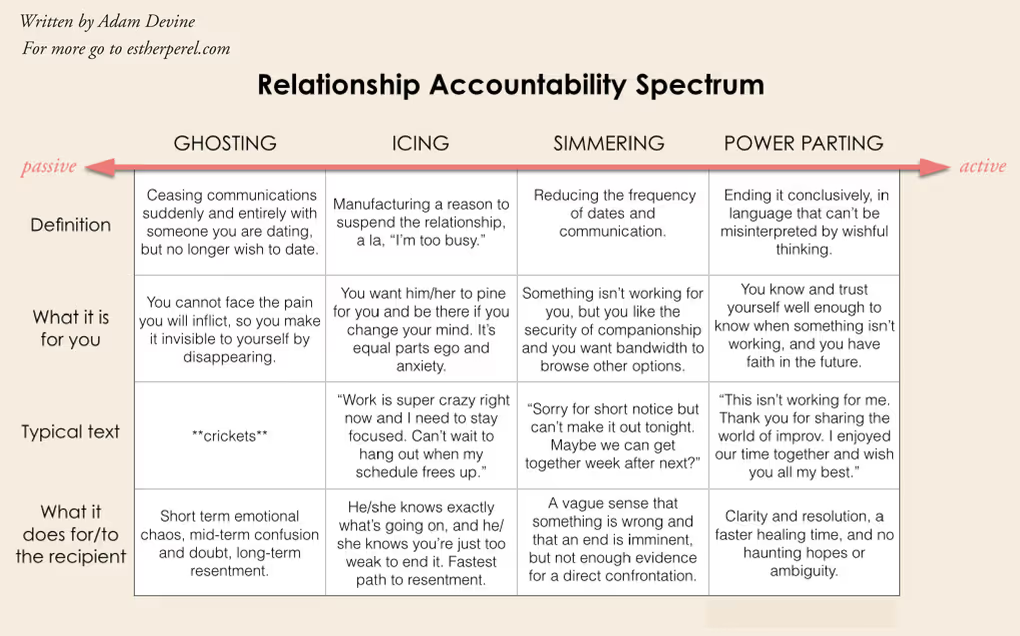
Last month, I spoke about modern love at a conference with 2,500 millennials. There, I was introduced to these new norms of intimate relationships and the corresponding vocabulary (we made you a chart, written by my friend Adam Devine).

These tactics of maintaining unclear relationships and prolonging break-ups all produce what I call stable ambiguity; too afraid to be alone, but unwilling to fully engage in intimacy building — a holding pattern that affirms the undefined nature of the relationship, which has a mix of comforting consistency AND the freedom of blurred lines.

We want to have our cake and eat it too. We want to have someone available to cozy-up with when it’s snowing, but if something better comes along, we want the freedom to explore.

In this relationship culture, expectations and trust are in constant question. The state of stable ambiguity inevitably creates an atmosphere where at least one person feels lingering uncertainty, and neither person feels truly appreciated or nurtured. We do this at the expense of our emotional health, and the emotional health of others.

It’s time to bring back relationship accountability.

In situations like Edward’s, the ghostee hopes the ghosted will just “get the hint,” as opposed to having to communicate that he/she is no longer interested. However, inaction has causality. At first, Edward runs the gamut of reasons he hasn’t heard back: She must have a really busy work week. She lost her phone. She doesn’t want to seem too eager. At first, relaxed and patient, Edward tries to be understanding, but his attempts at insight soon morph into uncertainty and self-doubt. Am I bad in bed? Did I say something to offend her? Am I unlovable? In the absence of information, he will fill the gaps, and what he imagines is most likely worse than reality.

Ghosting, icing, and simmering are manifestations of the decline of empathy in our society — the promoting of one’s selfishness, without regard for the consequences of others. There is a person on the other end of our text messages (or lack thereof), and the ability to communicate virtually doesn’t give us the right to treat others poorly.

I encourage you to end relationships respectfully and conclusively, however brief they may be. Act with kindness and integrity. This allows both people to enter into his/her next relationship with more experience and a clear head, rather than filled with disappointment and insecurity.

Ideas to incorporate into a final conversation:

  • Thank you for what I’ve experienced with you.
  • This is what I take with me, from you.
  • This is what I want you to take with you, from me.
  • This is what I wish for you, henceforward.
    Of course, duos dancing in the stable ambiguity zone don’t always end in a breakup. Sometimes this state is the training wheels period needed for one or both parties to realize he/she wants something more. This is normal for a brief, beginning phase, but not as the defining mode of a relationship.
Read More
Crisis
Communication & Connection
Play
How to Engage in Social Connection While Socially Distancing
How do our communities remain emotionally and socially connected when we must be physically apart? Read more on how to stay connected in a time of uncertainty.

How do our communities remain emotionally and socially connected when we must be physically apart?

It’s very hard to separate our bodies from our hearts. Last week, seven hundred people in New Rochelle—the quarantined epicenter of the Covid-19 outbreak in New York—held a town meeting online. While each of them were confined to their homes, alone or with family, the community was together in this virtual space. Decisions were made. Students with computers and iPads at home would be able to continue school classes via conference calls. They would need to source devices for children who did not have their own. A local caterer who had already prepared food for a Bar Mitzvah offered to divide the group meal into 152 boxes and deliver them to anyone in need. Parents wondered if they could touch their children. A husband and wife on the verge of separation would have to find a way to work from home together. “Even a big house becomes small when you're locked in it together,” the wife told me.

In the age of Covid-19, a new normal has arrived. As we isolate as individuals and families, we must activate the resilience of our communities virtually in order to gather information, plan interventions at schools and hospitals, and strategize about how to continue working, learning, socializing, loving, and desiring through screens. This is uncharted territory for many of us, and it’s the first time in our lifetimes that the mandate to do social distancing has been the norm at the global level.

China and Europe, as well as American cities such as Seattle and New Rochelle, embarked on this journey a few weeks before the rest of the world. As of this writing, it is estimated that the U.S., England, France, Spain and Germany are approximately 9-10 days behind Italy in the COVID-19 progression. Listen to what Italians wish they would have known ten days ago. Their advice follows guidelines from the World Health Organization, which emphasizes the need to socially distance as early as possible to slow the spread of the virus and flatten the curve. Even if an infected person has a mild case, they could have a significant impact if they accidentally infect someone else who is more vulnerable to this disease. So we must ask: when the most socially responsible thing we can do is avoid other people, how can we maintain social connection?

We Are All In This Together

We must acknowledge that we are entering a time of prolonged acute stress and uncertainty and that it is a shared reality—with our families, communities, colleagues, and all of humanity. We must be physically apart, but we are emotionally and psychologically in this together. Though the circumstances are different, this situation has induced a rapidly mounting psychological panic not dissimilar to what has historically occurred in response to terror attacks, natural disasters, and life in warzones, especially when there is a lack of resources, information is ambiguous, and instructions are unclear. It’s easy to feel helpless. Activating the collective healing capabilities of our communities—by sharing stories and accurate information, helping each other, and lifting one anothers’ spirits—is the most powerful antidote to fear, loneliness, and isolation. 

In the eighties, I, along with my husband Jack Saul—a psychologist who specializes in large-scale psychosocial trauma and collective resilience—taught together at the Psychosocial Center for Refugees, in Oslo, about family life in war and exile. We shared how extreme conditions affect communication and closeness between couples, parents, children, and neighbors. I drew from my work with Jewish people who had been “hidden” during World War II and what I had learned about how their situations affected their emotional, sexual and intellectual intimacy. Jack, for his part, taught that these situations were not only the trauma of the individual, but of entire communities. Much of his work surrounds the reality that collective trauma necessitates collective healing, a process dependent on the activation of our communities, not just ourselves. It lifts everyone and takes certain pressures off our partners and families to do it all ourselves, a crushing and near-impossible feat. 

After 9/11, Jack and I held workshops for residents, teachers, students, and parents in our downtown Manhattan community. Rather than screening individuals for PTSD, we recognized that collective trauma was setting in. He emphasized the need to mine the strengths and resources of the community to address our shared fears about breathing burnt plastic and to help the children feel safe(r). We were all addressing together how to live with the uncertainty of prolonged environmental stress, dislocation, and loss—of people, homes, schools, income, and innocence. It was a time of great uncertainty and unprecedented communal cohesion. Something similar is happening here and now. Many of the lessons we learned then are applicable, but there’s a twist: instead of needing to leave our homes, we must stay confined within them. 

Social Connection in a Virtual World

To make social distancing bearable rather than a major source of strain, we must insist on maintaining our social and emotional support. Never has social media been more important for providing connection and context, as many of our communities go entirely online. On Friday night, I attended Shabbat services with 900 people on Facebook Live. We sang together and practiced the shared rituals our ancestors had also held onto in situations of crisis, injustice, poverty, and dread. We were drawn together by our Rabbi, Amichai Lau Lavie, who invited us with the message: “Know that we're all in this together, that we've got ways to communicate, and that our ancestors left us tales and tools to help us handle even these most dramatic realities.” 

Every one of us, in every part of the world, carries these types of stories of vulnerability and triumph. The stories are our guidelines for how to adapt in the present. As Jack Saul wrote in his book “Collective Trauma, Collective Healing,” resilience is only as effective as it is diverse. It must draw from the perspective of all races, creeds, and classes, as well as multiple indigenous traditions, both secular and religious. The more stories we share, the better off we are.

Social Connection Without Breaking CDC guidance 

  • Start a group chat with your extended family for updates and encouragement. Discuss best practices for caring for elderly and very young family members. Share plans, but have phone calls, even conference calls, if you need to come up with a plan together.
  • Jack Saul advises creating an ecomap of your resources. Who do you know? Where are they? Who can help you with what? And who can you help? 
  • Join your local community’s group on Facebook or NextDoor for insight about your surroundings and to engage in group conversations with neighbors. (In one Facebook group for Long Island mothers, a member advised the group that many local stores had run out of toilet paper and included a link to where more could be bought on Amazon.)
  • Suggest a digital sunday supper with friends via conference video call. Start a book or film club. Share music. It’s important to continue to culturally connect in ways that aren’t defined by sharing updates about Coronavirus. 
  • Important event canceled? See if it can be held virtually via group chat or livestream, like this birthday party and these operas. (It’s more fun than it sounds.)
  • If you have school-aged children, create structure and routine to help support their learning (examples here). Check in with other parents to troubleshoot challenges, share creative ideas, and commiserate. Don't be hard on yourself if you need to break the structures you’ve put in place; it’s a learning experience for all of us.
  • If you are able, volunteer to help teachers, administrators, and students with the transition to virtual learning. 
  • If you are able to volunteer virtually to help your local senior centers, home care facilities, hospitals, and/or Urgent Care centers, call or email to find out how you can do so. 
  • Find virtual forums addressing similar situations, i.e. this Sub-Reddit for people under quarantine.
  • Commune with nature. 
  • Check the facts to avoid spreading misinformation.

Economic stress and loneliness are two of the most important social determinants of health. If you are in a position to be able to financially contribute, consider donating to Safe Horizon, which provides resources for victims of crime including domestic and sexual violence, and/or CityMeals on Wheels, which provides meals to more than 18,000 homebound elderly New Yorkers. 

If you are in a position to donate your energy and time, check in with elderly neighbors to see if you can drop supplies or food outside their door. Consider starting a virtual fundraiser among your friends and family to raise money for organizations like Feeding America. Stay up-to-date with social media accounts that will share ways to support those in difficult situations. @Serviceworkerscoalition has mobilized to assist those working in the service industry who have lost wages and hours due to the pandemic. @Nokidhungry is committed to helping ensure that school children from low-income families have access to meals while schools are closed. 

In the western world, our tendency is to see resilience as a set of individualistic traits rather than the combined and diverse capacities and resources of a community. It’s time to change that. Despite the necessity of staying physically apart, we have an opportunity to activate the specific type of collective resilience that can emerge when faced with communal prolonged uncertainty and potential widespread trauma. A powerful antidote to loneliness and fear is purpose. Say it again, a mantra for these strange times: we are all in this together.

Read More
No items found.
Sex? After Kids? - A Podcast with Dr. Becky
What happens when two become three, or four, or five? Who is responsible for the needs and wants of a couple when days are filled with playdates, pick-ups, and meal preps? Nights lack the erotic energy that couples need not only to survive but to thrive. Dr. Becky and Esther Perel come together to talk about what parents can do to rekindle their desires.

What happens when two become three, or four, or five? Who is responsible for the needs and wants of a couple when days are filled with playdates, pick-ups, and meal preps? Nights lack the erotic energy that couples need not only to survive but to thrive. Dr. Becky and Esther Perel come together to talk about what parents can do to rekindle their desires.

Read the excerpt from The Good Inside podcast and listen to the full episode here.

Esther: When I wrote Mating in Captivity, I tried to really understand what happens to this, what I call the erotic energy, right? The creative energy that makes us feel alive, vibrant, vital. That’s what you call to play, to roll on the floor, to love, to create, to tickle, to look at each other, to love together, etc.

Dr. Becky: That’s erotic energy. You’re not just talking about like sexy time.

Esther: No, no, no. I’m talking about that creative outburst, that energy that makes you feel alive.

When you have kids, it’s a revolution in the couple. It completely shifts all the resources, the time, the attention, the intimacy, the money, it all shifts. Why? Because when you are in a relationship, you negotiate continuously two poles. You negotiate your need for stability and predictability and reliability. You also negotiate your need for novelty and exploration and risk and change and movement. But when you have a child, you prioritize stability. You become security so that the child can become adventure. The child itself is an adventure that you are going on and that you are accompanying, and so you try to stabilize yourself.

That erotic energy — playfulness, imagination, aliveness, curiosity, engagement — is alive and well, but it is eros redirected. It all goes to the children with the idea that the adults will kind of survive like a cactus. That you not don’t even need to water. Then one person says “What is going on here? Where are we at? We haven’t gone hiking. We haven’t been alone. We haven’t gone on a date. When is the last time we went dancing? When’s the last time we touched each other and looked at each other the way that we are constantly adoring each other’s kids? And when’s the last time that when you say “how are you?” the answer was not about what you did and what you got done and what is off the list? How are you, what’s happening to this person right here next to me, who is go going through a lot of things?” That is the loss that takes place.

Read More
No items found.
Sexless Relationship? Take the First Step Toward Reconnection.
From physical challenges to breaches of trust to parenting exhaustion and beyond, there are so many reasons couples fall into a sexless relationship. Read more on how to shift your focus and take the first step toward intimate reconnection. A hint: it has nothing to do with frequency.

From physical challenges to breaches of trust to parenting exhaustion and beyond, there are so many reasons for a lack of sex in a relationships. Some couples are perfectly happy without sex and that’s fine, as long as everyone’s on the same page. More often, however, sexlessness is shrouded in hurt feelings and confusion, particularly when the love is there but the lust is not. 

If you ever want to know if your sex life is normal, a quick Internet search will deliver you more results than your mind (or ego or heart) can possibly comprehend. Type “sexless marriage” into a search engine and over two million results will appear in under a second. The phrase even has its own Wikipedia entry. So, you can find some relief in knowing: you are clearly not the first person to wonder if the amount of sex you are—or are not—having is “normal.” 

So, What is Normal?

Many of us have found ourselves reading studies that cite “once a week” as the norm or seek to provide qualitative data around involuntary celibacy. Most couples go through sexless phases. Reading in TIME magazine that “from 2010 to 2014, the average American adult had sex nine fewer times per year than Americans did from 2000 to 2004,” may lead to what we’ll call a “Sexistential Crisis”—particularly the bit about how nine jumps to sixteen fewer times per year for married couples who live together. Whether these stats make you feel better or worse about your own situation, please know: when it comes to sex, numbers miss the bigger picture. 

The more diffuse and uncrunchable aspects of sexual expression—love, intimacy, power, surrender, sensuality, and excitement—rarely become a headline. These facets of Eroticism don’t lend themselves easily to statistics. Eroticism as an immeasurable quality of aliveness and imagination is too often reduced to what the French author Jean-Claude Guillebaud calls une arithmétique physiologique—a physiological arithmetic. But it’s precisely those unquantifiable aspects of sex and sensuality that help revive a dead bed.

Bringing Desire Back to a Sexless Relationship

It may feel counterintuitive, but the first step out of a sexless cycle is to commit—together—to giving up the numbers game. Our obsession with frequency of sex and orgasm neglects the vast realm of Eroticism as well the issue of Desire. We can force ourselves to have sex but we cannot force ourselves to want it. And we certainly can’t force our partners to want it. Nothing kills Desire like overemphasizing how much sex you’re not having in your relationship. Let go of the calculus and try shifting your focus to Desire. 

Talking with your partner about Desire may be intimidating at first. It can feel so mysterious, particularly when it feels out of reach. How do we define it? Why is it so difficult to sustain it? Why do we lose it? How do we reclaim it? Once it’s gone, can it be rekindled? 

You don’t need to answer these questions with your partner. Remind each other that we all grapple with the subject of Desire—even if we’re satisfied in every other area of the relationship. Straight, gay, young, old, married, coupled or polyamorous, we want to want. And we want to be wanted. This is a great place to start an Erotic conversation with your partner. 

Put it Into Practice

Invite your partner to join you for a glass of wine or a cup of tea. Resist the urge to over rationalize or “solve” a problem. Let go of the goal to have sex and instead try to fully embrace just having a deep conversation together. Engage in your sense of curiosity when you ask them 3 of the following Erotic questions: 

  • What's your favorite temperature of water? 
  • What's your favorite temperature generally outside? 
  • How do you respond to sun, wind, air?
  • Are you aware of what touches your skin, of what hovers around you? 
  • When you wash yourself, what’s your relationship to the body that you’re washing?
  • Do you enjoy touching yourself? And I’m not talking about genitals only, but pleasing and soothing yourself. 
  • When you drink coffee or tea, do you find yourself gobbling or savoring? 
  • What non-sexual thing feels sexual to you? 
  • Which is the sense with which you make love the most? 
  • Which sense do you barely notice or use?
  • What does it feel like to want something really intensely? 
  • What does it feel like to be wanted by another person? 
  • What is one of your favorite sensual memories of us together?
Read More
Eroticism
Play
Finding Freedom in What Feels Good: 3 Reasons to Embrace Foreplay
Contrary to popular assumptions, foreplay is so much more than just the physical suggestion that kick-starts sex. Let’s adjust the lens. Read more on three reasons to embrace foreplay as the freedom to experience what feels good, for no other goal than pure pleasure—from a quick warmup to lasting erotic energy.

Foreplay is often talked about as the ramp up to the “real thing.” Yet, for many of us, foreplay is the “real thing.” 

It’s a common misconception that foreplay is just checking off the boxes and putting parts in motion to get us ready for sex and orgasms. Through this lens, foreplay is just not that interesting—at best—and full of pressure at worst.

Let’s adjust the lens and embrace foreplay as the freedom to experience what feels good, for no other goal than pure pleasure—from a quick warmup to lasting erotic energy.

What is foreplay?

Foreplay is so much more than just the physical suggestion that kick-starts a sexual encounter. 

Foreplay is the energy that runs through an entire relationship. It begins at the end of the previous orgasm and it lives as an ever-present suggestion that a small look, touch, text, or banter might lead to a little more. Foreplay is a mood we live in, a way we look at ourselves, how we feel about ourselves in the presence of a lover—or even in the presence of just our own reflection. At its core, great foreplay is made of the same things that make play, in general, so fun—freedom of exploring, creating, bonding, and trying new things.‍

Foreplay is a flirtatious tease.

There’s a reason why it’s been suggested that the etymology of the word “flirt” has to do with “the tip of the sword.” It’s a double entendre that playfully illustrates the verbal poking we engage in with someone we like—as well as the physical suggestion that the tip of the sword may eventually lead to the whole shaft. 

The word “tease” accomplishes something similar. Teasing is what we do from the earliest age when we like someone; it’s a way of building a rapport without exposing our true feelings. We continue to tease this way as we grow up, but the word takes on a second meaning as we explore our sexuality. Physical teasing is what we do with ourselves or another to build tension for the sake of pleasure rather than climax. 

Foreplay is more than just a quick warm up.

Yes, foreplay includes the physical acts that prime our bodies for the big event, but it’s not a road map to an exact destination (sex) or a math equation that outputs a neat answer (orgasm). Foreplay is the art of anticipation. It’s the feeling of being simultaneously present and transported. This is why foreplay is created by a mix of planning and spontaneity. We love to meticulously get ready for a date, anticipating the events to come, and we love to be surprised by the delightfully unexpected gesture that detours from the evening’s plans.

It’s the same for social foreplay. How many of us prepare our taste buds for dinner with friends by looking up the restaurant’s menu in advance, salivating over which delicacy we might choose in the moment? How many of us enjoy packing for a vacation, imagining how the linen outfit we’re tucking into our suitcase will feel on our skin in the balmy breeze of a faraway place? In this way, and contrary to popular assumptions, foreplay isn’t just about sex in the same way that sex isn’t just about sex. It’s about all the other feelings, associations, memories, dreams, wishes, and connections. Foreplay isn’t a thing we do; it’s a place we go. 

Foreplay is the playful energy of possibility.

Maintaining an atmosphere of foreplay isn’t just about constantly being “in the mood” so that we’re ready to be sexual at any moment. It’s about creating an energetic field that vibrates with the playful energy of possibility rather than dullness or contempt. When a small disagreement takes place in a consistently playful environment, it’s easier to handle it and move on. Hurtful digs become less frequent, replaced instead with humorous jabs back and forth. Bad tension fades. Good tension builds. In a playful environment, the trust that we have each others’ backs grows deeper. When things are tough, the consistent understanding that we want to feel good and make the other feel good indicates that we’re coming from a good place—and that’s a pretty good place to come, if and when we get there. 

We’ve always thought of foreplay as mostly physical and verbal. But it’s also emotional and psychological. It’s humor. It’s holding. It’s inquisitiveness. And the way to encourage it, to sustain it, to help it grow is to return to what we’ve known since we were kids: flirting, teasing, cultivating playfulness that creates complicity. Foreplay doesn’t need to be something that diminishes as we get older, it’s an energy that deepens as we grow. Foreplay is for play.

Read More
No items found.
Rituals For Healthy Relationships At Every Stage
Routines and rituals have a lot in common, but what makes them different is the key to elevating our relationships. Read more about the importance of rituals for healthy relationships at every stage.

Routines get us through the day. Rituals guide us through life.

Routines are concrete repetitive actions that help us develop skills while creating continuity and order. They ground us and create familiarity. Rituals, on the other hand, are routines that are elevated by creativity, driven by intention, and imbued with meaning. They lift us up and create excitement. They also help us say goodbye and process loss. Through repetition, routines and rituals both help us to delineate space and time. They create predictable structures, grounding rhythms, and a calming, stabilizing effect. Routines and rituals have a lot in common, but what makes them different is the key to elevating our relationships.

Rituals function like maps, helping us navigate transitions and major life events such as first dates, weddings, births, anniversaries, heartbreaks, and loss. There isn't a culture that doesn't have rituals to transmit the protocols and meanings of those special events. But we don’t need a special occasion to engage in ceremoniousness. Inviting the concept of ritual into our daily lives converts the mundane into the significant. Jogging every morning is an exercise routine. Walking in the woods together every Sunday afternoon is a ritual for spending quality time together in nature. Setting the table each night is a routine. Decorating the table with flowers, candles, and a special china is a ritual for a perfect date night. Brushing our teeth with our partner every night is a routine. But leaving our partner with a little bit of toothpaste on their toothbrush after a big fight is a ritual that signifies that we might be ready to make up. The difference is in the details and what they symbolize for us.

The Beginning is About Bonding

In the early stages of dating, creating rituals together is about establishing a shared reality. Morning coffee, dinner out, and stopping by a party together is routine. But picking our favorite coffee spot, planning a weekly date night, and meeting each others’ friends signify that “you and me” are becoming a “we.” Exchanging house keys, offering a drawer, and meeting each others’ families means that “we” are integrating our lives more fully.

When we’re really into each other, these initial steps feel natural. Pulled in by affection and attraction, everything feels new and shiny. With so much to learn about each other, newness itself is practically routine. What elevates newness to the status of ritual is creating special vessels that allow for deeper vulnerability. Sharing a playlist of our favorite music from our teenage years, playing “Truth or Dare,” picking a country we’d like to travel to together some day and making its signature dish—each of these activities give permission to reminisce and fantasize together. In the realm of shared dreams, we find new parts of our connection. Affirming and growing that bond as time goes on and as challenges arise is supported by creating rituals that acknowledge, affirm, and grow that bond. 

Rituals for Long-Term Healthy Relationships

In long-term partnerships, rituals create continuity and affirmation while highlighting the specialness of the bond. Making rituals a part of our daily lives ensures that we don’t only celebrate our love and closeness on anniversaries—though celebrating anniversaries is one of the most important long-term partnership rituals of them all. 
When our lives are woven together, intentionally breaking our routines can become a ritual. Instead of eating cereal at home every morning, go out for a breakfast date. Skip date night, which can be exhausting after a long day, and take a bath together with candles. Make a private email address—a virtual destination separate from the realities of the world—and send each other love letters.

Rituals are a major part of long distance relationships or when we work opposite schedules. Always leaving something for or with the other person is a gesture that helps us feel each other’s presence even when we’re apart. 

Rituals are also especially helpful in the transition from parent to partner. Changing clothes, location, light, trading the nursery rhymes for our favorite album, opening a bottle of wine together—these are rituals that signify it’s our time. We've put the kids down; we can focus on ourselves. We can switch from responsibility to play.

On social media, when we asked what rituals people have established in their relationships, you replied with great answers from building pillow forts together to having no phone date nights. You shared that you like to go through pictures together and talk about all the memories associated with each one. The constant theme was unification between two people around a shared story of specialness and meaning. All relationships are stories. Rituals help us tell them. 

Rituals Help Us Have A Healthy Relationship With Ourselves

Just as there are ritualized behaviors and practices around engagement, marriage, and all important beginnings, there are rituals around endings. And oh, how well we know them: exchanging the items we once kept at each others’ places, giving the keys back, canceling the trip, unfriending, distributing loyalty among friends, untangling the web that once provided warmth and softness before it felt like a trap. How many of us have hesitated to get rid of an object that felt like the last piece of a former lover? Grief drives home the metaphorical quality of rituals—it’s not about the thing itself; it’s about what it represents.

On social media, you also shared with us rituals that have helped you through breakups. So many of those answers were about self-care and connection with friends and family who remind us that we are still lovable and worthy. Friends who come over to sage the house, take out the ex's belongings, and put new sheets on the bed help with those mourning rituals. Engaging with our closest community is an antidote to the isolation and shame we inevitably can feel after such loss. Coming together with those people and asking them to share their stories of heartbreak and resilience is a ritual that makes the experience slightly more common and normal. It provides evidence that everyone experiences love’s agonies and that love is not a scarcity.

Letting go of a past relationship is a process full of rituals, first with the former partner, then with our communities and perhaps a therapist, and finally with ourselves. Through self-love rituals—like daily journaling, trying something new each week, intentionally taking care of our mental, physical, and emotional health—the intrusive feelings of heartbreak eventually become less frequent. As time goes on, so does life, and so does love. We can never go back in time, but we can always love again—till the day we drop dead. Love matures with age, but love itself is ageless. Once we accept that, we open a door to a new beginning. And life’s most important rituals will be there, providing continuity from chapter to chapter and helping us write the next one.

Read More
No items found.
Relationship Stress at a High? Try Spending Time With Friends
Our expectations of our partners have never been so high. When our primary relationship is experiencing high stress one of the best things we can do for ourselves and our partners is to take some of the pressure off. Read more on the importance of spending time with friends and how it serves as a reminder that we don’t live or love in a vacuum.

“Today, we turn to one person to provide what an entire village once did: a sense of grounding, meaning, and continuity. At the same time, we expect our committed relationships to be romantic as well as emotionally and sexually fulfilling. Is it any wonder that so many relationships crumble under the weight of it all?” - Mating in Captivity

Our expectations of our partners have never been so high. We still want everything the traditional family was meant to provide—security, children, property, and respectability—but now we also want our partner to love us, to desire us, to be interested in us. We want to “marry our best friend,” our confidant on all matters, someone to whom we should be able to tell everything. And, for that matter, they should not only be a stellar co-parent, they should also be a savvy co-decorator, a skilled sous chef, a financial whiz, a motivated jogging partner, and a devilishly funny gossip—depending on what we need that day. 

Where did we get this idea that one person is supposed to provide every facet of emotional connection available to man? It didn’t start when we went into lockdown in 2020 (though that certainly intensified the contemporary over-reliance on our primary relationships). For decades now, the self-imposed isolation that can come with modern love has begun as soon as we think we’ve found “the one.” Who among us isn’t a little guilty of having deprioritized our friendships shortly after feeling a mutual click with someone we’ve just met? The desire to lay in bed all day with a new love can make it feel like the world outside has disappeared. But when we open the door, we have to ask, did the world disappear or did we? 

Diversifying Our Relationship Portfolio

Ambrose Pierce said love is a temporary insanity cured by marriage. Anyone who’s been married can confirm that it comes with its own insanity. For instance, it’s insane to think that our partner can provide for us the same level of support and connection that once we got from our networks of friends, family, acquaintances, colleagues, teammates, (and even the occasional nemesis). We spend our young lives building an entire relational infrastructure. Some friends come and go, but the latter tends to accelerate once we partner up. There’s a lot of major lessons partnered folk can learn from our single friends. One of the biggest? We don’t need to be in a relationship to have relationships. We’ve had them the whole time.

We have to remember this especially when our primary relationship is experiencing high stress. One of the best things we can do for ourselves and our partners is take some of the pressure off. Remind ourselves we don’t live or love in a vacuum. Sure, it helps to diversify our expectations of our partner, but if we really want to make a meaningful and long lasting improvement, we have to diversify our relationship portfolio, as social psychologist Elaine Cheung has explained. Expanding our intimate connections does not automatically mean we’re siphoning the emotional energy out of our primary relationship. Let’s do a little assessment:

  • Do you bring all of your challenges to your partner, or do you seek out advice from the person in your life who has the most knowledge or experience with the problem?
  • Do you have a tendency to reach out to friends with only the things you feel you can’t talk to your partner about? If so, why? 
  • Who in your life knows the most about decorating? Cooking? Breast-feeding? Grieving after the loss of a parent? 
  • What are the skills, traditions, or wisdom that you would like a friend to come to you for—have you offered?

Spending Time with Friends is a Balancing Act

Eli Finkel, author of The All-or-Nothing Marriage, has said that “on average, people who have a specialized social network—seeking out Tim to celebrate our achievements, Donna to cheer up our sadness, Kyoko to soothe our anxiety—tend to feel more fulfilled in their life than people who look to one person to do it all. They also tend to be happier in their romantic relationship over time.” As is usually the case, it’s not a one-size fits all model. “This winnowing of our intimate social network will be fine for some people,” says Finkel. “If we’re lucky enough to have a spouse who is compatible with us across a vast range—fun to celebrate with, supportive when we’re sad, understanding when we’re ashamed—then we can remain fulfilled despite having few ‘other significant others’ (OSOs) in our life. But that’s a high-risk strategy, as most spouses are more compatible in some ways than in others—and, of course, our spouse can’t be available under all circumstances. If our spouse is on a work deadline or sick with the flu, the effects on us are especially rough if we’ve jettisoned most of our OSOs.” 

Given our focus here on the importance of outside friendships for the health of our primary relationships, it’s important to be clear that healthy friendships are never one-sided utilitarian relationships. We all know a friend or two who only calls when they need something…and if we don’t, we have to ask ourselves if we’re that friend to someone else. Ask yourself: 

  • When you’re in a romantic relationship, do you tend to only reach out when you’re  fighting with your partner? 
  • When you’re not in a romantic relationship, do you put added pressure on that same friend to fulfill boyfriend or girlfriend duties so that you don’t have to be alone?
  • Have you ever lost a friend and don’t know why? 
  • Have you ever lost a friend and know exactly why but don’t know how to fix it? 

New Friends Are Great—But So Are Old Ones

When we enter different stages of life, it is sometimes the case that our friendships weaken. Often it’s because of kids or moving away or simply growing apart. Sometimes it’s because we’ve had a big fight or have been harboring resentment that we just don’t know how to address. But that doesn’t mean that friends don’t come back together or that new friends cannot be made. Just like in our primary relationships, our friendships go through phases. And now, with social networks, it’s not uncommon for friends—who fell off after highschool, college, or when one person left their shared workplace or moved away—to rediscover each other decades later. Some friendships pick up where we left off and some begin anew. Having a break in a friendship is sometimes the most important aspect of actually creating growth later on. It can allow us to reintroduce ourselves as the people and friends we’d like to be. We know that, in romantic relationships, desire needs mystery (having friends outside of our partnership to share some aspects of our lives with helps on that front). Is it possible that the platonic version of that is “absence makes the heart grow fonder?” For the many of us who have lost important friendships, sometimes reconnecting can start by simply asking that question. “I’ve really missed you and I’d love to catch up and see where life has taken us. Would you like to spend some time together?”

Read More
No items found.
Owning Your Part: Self-Accountability in Relationships
Relationship dynamics go beyond the binary of perpetrator and victim, powerful and powerless, betrayed and betrayer—the accountant and the accountable. Recognizing that all parties are a piece of the pie does not mean that everyone’s slice is the same size and made up of the same ingredients. But owning your part is essential to breaking through impasses. Read more about the practice of self-accountability in relationships.

Every relationship therapist has seen it. The clients arrive for their first session, settle in, and assume the positions. One partner becomes the storyteller, the one who gives the history: how they met, how it used to be, and how they ended up in this office. The other will sit, reluctantly listening to the balance sheet of their mistakes and shortcomings. 

For this person, therapy can feel like a punishment for their actions and their last shot to fix things. They’ll sit there and take it or occasionally interject to correct the record. But mostly, the therapist will witness the dynamic they’ve seen hundreds of times before. In couples, it’s the sinner and the saint. In polycules, it’s the weak link in the chain and everyone else pulling weight. The deep issues that bring clients into therapy, however, rarely lie at the feet of one person alone. 

Relationship dynamics go beyond the binary of perpetrator and victim, powerful and powerless, betrayed and betrayer—the accountant and the accountable. Recognizing that all parties are a piece of the pie does not mean that everyone’s slice is the same size and made up of the same ingredients. But owning your part is essential to breaking through impasses. 

The other side of that breakthrough begins when each person freely shares what they are doing differently with the intention to improve things, rather than doggedly focusing on the change they need from their partner. This is how therapists know they’re getting somewhere. Their job is not to act as judge, jury, and executioner. It’s to help the clients navigate how people in love can behave in unloving ways—and how they can carve a new path.

Your Partner Will Practice Self-Accountability When You Do

Owning your part is an act of humility, and that gesture opens the door for your partner to reciprocate, to meet you in an honest place. Your apology lessens the shame on the other to do the same. And while you may feel that your missteps pale in comparison to those of your partner’s, they might not feel the same way. 

Taking accountability for yourself does not excuse the other person. It helps them see that apologizing for their mistake doesn’t mean that they are a mistake. If you can do it, perhaps they can, too. 

If you have been wounded by your partner time and time again, accepting any kind of responsibility can feel like losing ground in an endless battle to prove you deserve better. But even the phrase “can’t you see how you’re hurting me?” is likely to trigger a defensive response that throws the responsibility back on you. “Yes, but I never would have slept with them if you had shown any interest in me whatsoever.” 

If you say to your partner “you never thank me,” you are all but ensuring that future thank-yous will become obligatory rather than heartfelt and sincere. Instead, consider saying “I love supporting you and your gratitude is really important to me.”

If you are aghast at how your typically responsible mate lost your shared money, have you asked if they felt financial pressure to take care of you? Did the desire to give the children a successful start empty the bank account? What’s the larger context? And what is your part in it? This is not victim blaming; this is acknowledging the inherent complexities of what it means to be responsible in your relationship. 

Practices for Self-Accountability

Try one or more…

  • Own your experience. You can describe your experience as a consequence of the other’s actions, but pay attention to the language you use. Trade out “you made me feel” for “you did not acknowledge me and then I felt rejected.” 
  • Stop punishing. Do you want to hurt them or do you want both of you to be able to learn from this and move on in your relationship together?
  • Make a choice: if you want to continue the relationship, make that choice. 
  • Prioritize clarity and expectation setting. As the PREP program teaches, be specific about what happened and how you felt using X, Y, Z statements: “when you did X in situation Y, I felt Z.”  ex: “When you thank everybody for helping you with this big project, and you don’t mention me at all, it makes me feel that you don’t recognize my contributions or value—staying home with the kids, taking care of the house, while you did your thing.”
  • Practice differentiation. It involves identifying and clarifying your thoughts, feelings, and desires while being open and curious about your partner’s. It’s the ability to simultaneously experience connection and autonomy and not personalize their autonomy as a rejection of you. 
  • Ask them about their experience. Be curious about the context of their behavior. Demonstrate empathy. 
  • Separate the behavior from the person. “We both know what you did was bad but I don’t view you as a bad person.”
  • Beware of “Fundamental Attribution Error.” In stressed relationships, we tend to see our behavior as circumstantial and their behavior as characterological. We’re black and white about others and nuanced about ourselves. 
  • When we’re in a bad mood, it’s because we had a bad day. 
  • When they’re in a bad mood, it’s because they’re not a nice person. 
  • Use humor. If you find the right tone, humor can be helpful for owning your part and diffusing tension. 
  • Practice grace. You can be so mad at your partner or so mad at yourself. It doesn’t mean the whole house has to come down. Practicing grace is the acknowledgement that you don’t condone what has happened but you keep room for redemption and healing. 
Read More
Discover more from Esther on Substack.
Explore articles and resources to help you find aliveness and vitality in your relationships.
Subscribe on Substack
Where Should We Begin Podcast COver

Where Should We Begin? with Esther Perel

Join Esther in her office every Monday to listen in as real couples in search of help bare the raw, intimate, and profound details of their stories.
Listen to the Podcast
Recent Episodes
View All Episodes

Where Should We Begin?

A Game of Stories

where should we begin at work product image
New
Where Should We Begin?
At Work
New
Where Should We Begin?
At Work
Improve team dynamics with Esther Perel’s renowned card game—now available for the workplace.
A live event with Esther

Sessions Live 2026

An unforgettable two-day event on relationships, love, and desire
May 15-16, 2026 | Online & In-Person in New York City
Get Your Early Bird Tickets

Courses Taught by Esther

Turning Conflict Into Connection
Uncover why you keep having the same fights over and over again. Learn how to break free from habitual patterns and responses. Find peace and reconciliation even when you disagree.
Gain new insights in just one hour
Downloadable workbook filled with guided exercises
Improve conflicts with or without a partner
View Course
Playing with Desire
Uncover and learn how to speak about your desires. Bring more aliveness into your sex life. Create rich, erotic rituals. Cultivate a more vibrant and fulfilling erotic relationship.
Perfect for date night
Playful exercises and prompts to tap into new erotic possibilities
Based on the same processes Esther has used to help real couples for 40+ years
View Course
Bringing Desire Back
Uncover what blocks desire. Learn how to tap back into pleasure and get unstuck. Discover a new sense of hope and possibility.
Perfect for date night
Guided exercises to turn insights into action and understanding
Based on the same processes Esther has used to help real couples for 40+ years
View Course
The Desire Bundle
Two courses designed to help you and your partner break out of sexual ruts, explore new possibilities, and build deeper connection.
Understand, communicate, and explore your sexual needs
Spark honest and constructive conversations about sex and desire
Designed to reignite curiosity, intimacy, and deeper connection in your sex life
View Course