All Articles
Thank you! Your submission has been received!
Oops! Something went wrong while submitting the form.
Communication & Connection
Letters from Esther #7: The Art of Conversation
Letters from Esther is my monthly newsletter to stay in touch and inspire reflection and action in areas that are important for our relational intelligence. This month's theme is: The Art of Communication

Shall We Begin?

All too often, I see the tension between speaking and listening. We expect to hear people drone on about themselves in professional settings, hoping to stand out, get a promotion or investment, or make a life-changing connection. But lately that mentality of pitching oneself is showing up in smaller circles. How many dinner parties have you attended where one person seems to be talking AT everyone, at length, about their business or their back problems? 

From the very beginning, Western parents tell children “use your words.” The current norm emphasizes direct communication and the ability to clearly articulate one’s needs as an essential step to building confidence and self-esteem. It’s interesting, isn’t it? We make of point of encouraging one another to be assertive—speak up! Communicate! Advocate for yourself! Yell it from the mountain tops!—but we don’t quite prioritize listening in the same way. 

The art of conversation is about healthy amounts of both: thoughtful speaking and hardcore listening, asking questions and navigating commonalities and differences. Consider Erich Fromm’s six rules of listening. Or David Bohm’s writings on the paradox of communication in which he says “if we are to live in harmony with ourselves and with nature, we need to be able to communicate freely in a creative movement in which no one permanently holds to or otherwise defends his own ideas.”
In an age of self-surveillance, of measuring oneself’s likeability based on “likes” and one’s network based on how many “connections” they have on LinkedIn, the collapse of simple but depthful conversation was almost bound to happen. Now, at least in cities, we’re more likely to meet a friend at a co-working space—those of the “venture-backed belonging” variety—than in our homes.

The gap between work and life is narrowing. So many of us are putting our whole selves into our work, investing everything we’ve got by betting on ourselves. In this state, transforming dialogues into monologues feels like a survival tactic. We know we need the support of our friends and communities, but we feel as if we must advocate for it. Rather than deep exchanges that are rooted in curiosity, or even superficial conversations floated by fun, our conversations become performances. How many opportunities do we miss because we didn’t ask someone about themselves? 

There are ways of shaking it up. I love to throw dinner parties and unify guests around one question. A new question can make you hear people that you know well in totally new ways. Recently I asked, “what is a relationship question that you have at this moment?” Fifteen people around the table all said completely different things: about sex after having kids, aging, monogomy, and more. One of the more shy guests immediately spoke up: “how long do you continue to try to have a relationship with your adult child?” A simple question allows people to share at the level of intimacy and disclosure they are comfortable with.

When we stop being so focused on having to shine, we can see the shimmering lights of others and engage in a real give and take. Long, deep listening around a dinner table opens up a whole new world of connection. And get this: you won’t need four drinks to get through the night. 

Let’s Turn the Lens on You

Invite friends to come together (dinner or not), and try out some of the below questions.

  • What would you tell your 20 year old self?
  • What is one of the lessons learned from a heartbreak? 
  • What is a conversation that you know that you need to have with yourself? 
  • When did you know that you were no longer a child?
  • What’s the best piece of advice you’ve ever received? 
  • What is the relationship legacy from your own family of origin that you want to keep?
  • What is an aspect from your relationship culture that you're set on changing?
  • What’s a challenge that you have successfully faced and how you have handled it?
  • What would you say makes you not the easiest person to live with?
  • Describe a time when you changed your mind.
  • What would you do if you had a different career?
  • Were you raised for autonomy or raised for loyalty?
  • What is something that you wished you had known or been told as a child?

Watch and Listen

Unsent Love Letters / A Six Part Blog Series

Unsent Love Letters is a six-part series of real unsent love letters from people who wrote to a loved one, but in the end kept their words to themselves. Each article includes the original letter, a playful video discussion, and an exercise for those who resonate.

Letter from Esther / On Connection

A meditation on the importance of building your village and advice about how to maintain it.

“How’s Work?” Podcast / Season 1

Season one of my new podcast about relational dynamics in the workplace is available soon on all podcast apps, including iTunes. Episodes will be released weekly starting February 4, or listen to the full season on Spotify.

Conversation Starters

A compendium of highly recommended sources of inspiration and information       

I’m Reading: 

I’m Listening To: 

Read More
No items found.
Letters from Esther #68: Daters Are the Pioneers of Modern Love
My monthly newsletter is meant to inspire you to reflect, act, and develop greater confidence and relational intelligence in all of your relationships.

Shall We Begin?

Meet Ally, Louis, and Douglas: three strangers, three different life stages, all actively dating and in search of love, pleasure, and passion. I recently had a conversation with all three of them—a blind date, if you will—for my podcast, Where Should We Begin? They each brought their own questions, quiet fears, and hopes they weren’t even sure they were allowed to name.

What unfolded was more vulnerable than a conversation about dating apps and swiping behavior. It was a reflection on longing, loneliness, doubt, curiosity, and culture. They are all searching for real connection in a world that doesn’t feel designed for it. Welcome to modern dating.

THE DATERS

Louis, a gay man in his late twenties, was born in Cameroon and came out after moving to the U.S. He’s gregarious and open-hearted—someone who genuinely enjoys the experience of meeting new people. But he’s noticed a pattern: feelings rise quickly and then disappear just as fast. “It always goes from really high to nothing,” he says. And yet, he keeps showing up. “I still go in with a big smile.”

Douglas, who moved from South Korea to Los Angeles just over a year ago, is dating with serious intention for the first time. He adopted the name “Douglas” because his Korean name is hard for many to pronounce—one of many subtle ways he’s had to translate himself to be understood. He’s thoughtful, sincere, and emotionally observant. But when it comes to dating, he finds it hard to feel that elusive spark. “Sometimes I perform curiosity,” he admits. “I wish I didn’t have to.” Underneath is a quiet ache: Why is it so hard to feel something real?

Ally is a 47-year-old straight woman and divorced mother of two who grew up in Saudi Arabia and now lives outside Boston. After a long marriage, she’s re-entered the dating world with both curiosity and caution. She calls the process tedious, something that competes with the few hours she has to herself after work and parenting. “When I go on a date, it’s taking time away from people I already love, or from being alone, which I actually enjoy.” Still, she holds onto hope.

DON'T BE SO QUICK TO JUDGE

Let’s be clear: these aren’t stories of dysfunction. They’re stories of resilience. And improvisation. Trying and trying again. All three are doing something that wasn’t modeled for any of us: building intimacy outside of kinship networks, without reliable introductions from friends, without shared context—because modern dating takes place in a world that doesn’t look the same as it did when our parents and ancestors were courting. They didn’t know the experience of sitting at home alone, face aglow from a phone screen, looking for love.

Modern daters are pioneers of new rituals and new rules. They must find new answers for age-old questions that have been transformed by technology, globalization, consumerism, and individualism. How will I choose? And will they choose me? How much is too much to share? What happens if I get my heart broken again?

EMOTIONAL MULTITASKING

Dating today is an act of emotional multitasking. It asks us to hold hope and disappointment in the same hand. It asks us to stay open to intimacy while guarding against burnout. It asks us to reveal ourselves just enough to spark interest—but not so much that we seem too eager.

What stayed with me most after our conversation was what didn’t come up: We didn’t talk much about love. Or sex. Or desire. We talked about time. Logistics. Ambivalence. Effort. Not because these three people don’t want love—but because they’ve grown used to organizing their romantic lives around systems that reward patience and performance over presence. And yet, in the middle of all that, there were glimmers.

  • When Louis spoke about his joy in simply meeting people.
  • When Douglas described a second date at a climbing gym, planned with care.
  • When Ally talked about how she can sense real connection—not through words, but through the way someone leans in, or lingers, or asks a real question.

Each of them is reaching for something honest. Not just to be liked. Not just to match. But to be met.

Click here to listen to this episode on Apple Podcasts.

This episode—titled "Terms & Conditions May Apply"— won’t give you dating rules. But it might give you something better: permission—to date at your own pace; to take breaks when your spirit needs rest; to try new things; and above all, to approach dating with curiosity.

Because when connection starts to feel like a transaction, it’s curiosity—the kind that invites and listens and stays—that brings us back to the part of dating that has remained the same throughout time: to meet and to be met, to see what unfolds.

Know someone who’s dating in the deep end? Consider sharing this letter with them now.

Let’s Turn the Lens on You

Every month in this space, we aim to offer not only reflection, but practical exercises you can bring into your relationships, conversations, or next encounter. This month, we’re excited to share something new.

We’ve partnered with the dating app Hinge to co-create a new collection of profile Prompts called “Your World.” These ten Prompts are designed to help daters share more of who they are—by sparking curiosity, inviting storytelling, and breaking free from familiar scripts. The goal is to help online conversations flow more naturally into meaningful in-person connection. Here’s a small sample of what’s now live on the app:

  • In my friend group, I’m the one who . . .
  • An award my family would give me . . .
  • Where I go when I want to feel a little more like myself . . .

Even if you’re not dating, try answering one of these with a friend or partner. Sometimes the right question is all it takes to turn a moment into a story—and a story into something more.

More from Esther

EROTIC INTELLIGENCE: CULTIVATING DESIRE AND ALIVENESS IN YOUR RELATIONSHIPS | reserve your spot

On October 8–13, 2025, amidst the wonders of Paros, Greece, my expert guest facilitators and I will share fresh perspectives and actionable tools to help you go deeper into the work, expand your erotic intelligence, and experience new erotic breakthroughs—with or without a partner.

TRANSFORM YOUR WORK CULTURE | learn more

I believe that the quality of our relationships at work determines the quality of our work. From my new card game to my class on Masterclass to my limited podcast series How’s Work?, my suite of workplace offerings are designed to help business owners, managers, and team leaders elevate workplace connection and improve team dynamics.

SESSIONS LIVE 2025: MATING IN THE METACRISIS | watch the replay

The live event may be over, but you can still be part of this transformative experience. Register today to get on-demand access and discover:

  • A complete archive of recordings
  • Exclusive discounts from event partners, plus 10% off my books, courses, and card game
  • Additional resources to go even deeper
  • Unique networking opportunities

You’ll find all this and more inside the Sessions Live app—but only for a limited time.

Conversation Starters

A compendium of highly recommended sources of inspiration and information

TO READ:

  • The Dry Season by Melissa Febos. With intensity and precision, Febos writes through a year without sex—and emerges with revelations about intimacy, addiction, power, and self-respect. The Dry Season is not a memoir of lack, but of radical clarity.
  • Living Real: Redefining Success, Presence, and Happiness by Camille Preston Ph.D.This book is an invitation to high-performers to exit autopilot and reconnect with what truly matters. With unflinching honesty and practical tools, Preston guides readers to reclaim the parts of themselves they’ve sidelined in the pursuit of external success—and to live and lead with greater presence, authenticity, and meaning.
  • Raising AI: An Essential Guide to Parenting Our Future by De Kai. This new book offers a powerful reframe: A.I. bots are neither gods nor slaves; they’re imitative, neuroatypical, attention-seeking children who want your approval, and have grown into feral tweens who are humanity’s most giant influencers . . . So, as De Kai asks, how’s your parenting?
Read More
Communication & Connection
Eroticism
Conflict
Letters from Esther #66: Meet Me In the Public Square
My monthly newsletter is meant to inspire you to reflect, act, and develop greater confidence and relational intelligence in all of your relationships.

My annual conference, Sessions Live 2025: Mating in the Metacrisis, begins on Friday, April 25, at 9am EST.

Register now to reserve your virtual spot, access the Sessions Live app, connect with fellow attendees, and join the live event—plus, enjoy on-demand access to event recordings for 90 days.

Click here to register for Sessions Live 2025.

Shall We Begin?

For nearly four decades, I’ve worked to bring the insights of the therapy room into the public square. Through books, podcast episodes, and conversations that cut across borders, disciplines, ideologies, and identities, I’ve spent most of my life in dialogue with all of you about what it means to love, to hurt, to fight, to repair, and to live.

What I see, again and again, is that the things we think are private—our anxieties, longings, shame, and questions—are in fact universal. That people crave language for their experience. That when we talk about the hard things, we create the possibility for healing, together.

This is the spirit behind my annual conference, Sessions Live.

JOINING TOGETHER

Sessions Live is my answer to our current era of digital disconnection, deep polarization, and cultural overwhelm. It’s what I can offer at a time when therapists—as well as teachers, coaches, partners, parents, all of us—are holding more than ever.

Sessions Live is a gathering for those who want to explore how we live, love, and connect in an era of rapid change. It’s a place for cultural conversation and professional reflection. It’s an environment in which mental and relational health meet art, technology, embodiment, and the paradoxes of our time.

Together, we’ll explore Mating in the Metacrisis: Connection, Polarization, and Eroticism in a World on Edge—with the voices I turn to for clarity and depth. While every piece of programming is designed to bring relational insights to a wider audience, there is one that I want to highlight today, on the theme of bringing therapeutic insights into the public square.

THE PUBLIC SQUARE

When I started my podcast, Where Should We Begin?, in 2017, it was considered taboo in the West to have the public listen in on therapy sessions, even ones that are one-time, anonymous sessions with people who are not, and will never be, my clients. In 2019, couples therapist Orna Guralnik took the next step by featuring couples sessions on American television. While our projects are different, they are united by a shared idea: When people hear and see others’ relational challenges and their possibilities for healing, it reduces stigma, shame, helplessness, and loneliness.

I am so pleased to share that Orna and I will be in conversation at Sessions Live—our first time coming together this way.

Ours will be one of many conversations taking place over two days. And, to take it a step further, I’ve decided that part of bringing these insights into the public square is making sure that all of the conversations we are having at this year’s event don’t just happen in Brooklyn, New York, where the event is taking place.

This year, the entire event is available virtually, wherever you are in the world and for 90 days after. I’ve had the chance to spend time with our virtual community already and I am touched by the perspectives many of you have already shared with me. When we are together, our screens feel like a portal, a place where we come together, our own public square.

I hope you will join us there.

Register for Sessions Live 2025 now.

Let’s Turn the Lens on You

Sessions Live would not be possible without the generous support of our partners, including our headline sponsor, Dipsea.

Dipsea is a revelation in the world of audio storytelling—a sensual, relationally intelligent platform that redefines erotic content with elegance, depth, and psychological nuance. Their immersive, voice-acted narratives center pleasure, consent, and emotional resonance. What sets Dipsea apart is not just the quality of its production, but its commitment to juicy storytelling that celebrates diverse identities, kinks, and relationships. It’s not just about turning you on—it’s about tuning you in.

I cannot think of a better way to “turn the lens on you” this month than to share Dipsea’s exclusive gift with subscribers of Letters From Esther.

More from Esther

EROTIC INTELLIGENCE: CULTIVATING DESIRE AND ALIVENESS IN YOUR RELATIONSHIPS | learn more

Join me amidst the wonders of Paros, Greece, for my next in-person event on October 8–13, 2025. During this six-day retreat, my expert guest facilitators and I will share fresh perspectives and actionable tools to help you experience new erotic breakthroughs—with or without a partner.

Register today to discover:

  • An exploration into frameworks for greater connection, communication, and understanding
  • Powerful group work and hands-on activities to practice essential skills and practices for fostering deeper intimacy
  • A supportive emotional container in which you can show up as you are and experience a true safe space

Whether you feel stagnant in your long-term relationship, wish to feel more alive in your life, or want to learn to cultivate intimacy without a partner, this retreat is your opportunity to go deeper into the work and expand your erotic intelligence.

Click here to learn more and reserve your spot.

Conversation Starters

A compendium of highly recommended sources of inspiration and information

TO READ:

  • Diana Hill’s Wise Effort: How to Focus Your Genius Energy on What Matters Most is a powerful examination of “life force”—and how your genius can become your problem when not directed with wisdom. Drawing on ACT (Acceptance and Commitment Therapy) and Buddhist psychology, Hill offers a refreshing guide to sustainable growth rooted in presence, courage, and care.
  • Francesca Hogi’s How to Find True Love is a powerful reimagining of modern romance, reminding us that true love isn’t something we find—it’s something we build. With clarity and compassion, Hogi invites us to let go of the myth of the perfect partner and instead cultivate the mindset, heartset, skillset, and soulset to co-create lasting, meaningful relationships.

TO LISTEN:

  • Smart Girl Dumb Questions is a curiosity party in the form of a podcast. Host Nayeema Raza asks Mark Cuban if billionaires can solve our social problems, Cleo Abram if the future is too bleak to have babies, and Neil deGrasse Tyson if horoscopes matter in dating (and other pressing questions about astrophysics). In a recent episode, two 11-year-olds explain why they feel more present on their screens than IRL . . . inspiring even more questions. Tune in on Apple, Spotify, YouTube, or wherever you get your podcasts.
Read More
Eroticism
Letters from Esther #60: Reconnect to Your Erotic Self
My monthly newsletter is meant to inspire you to reflect, act, and develop greater confidence and relational intelligence in all of your relationships.

Shall We Begin?

WE CAN GO A LONG TIME WITHOUT HAVING SEX.

Plenty of people live without sex entirely, whether they are asexual, celibate by choice, grappling with trauma or physical pain, or for many other reasons. Some people prefer to have sex alone or to engage with their erotic self in other ways—through imagination, art, erotic novels, or films. There are so many ways to connect with your erotic self. Sex is just one avenue.

That said, when people come to me to talk about sexlessness, it’s typically because they really want to be having sex. They don’t understand how they fell out of practice or how the chasm between their partner’s desire and theirs grew so large, so seemingly uncrossable. They often tell me they want more sex. They always tell me they want better sex.

WHEN YOU WANT TO WANT . . .

Sex goes on the back burner when we’re not in the mood, have kids around, are exhausted by work, caregiving, or both. You may want to have sex, but it simply isn’t a priority. And the more time that passes, the harder it can be to initiate, let alone address in conversation.

That silence is the perfect habitat for anxiety to grow. The confusing and/or harmful cultural, familial, and societal messaging you may have received about sex while growing up thrives in this space. Many of us are told to hide our sexual selves and our desires. A dry spell can feel like confirmation that we should. When you want it but aren’t having it—or when you want to want it and just don’t—shame will convince you: It’s an individual problem. It’s your fault.

I'm here to tell you: It’s not.

YOU ARE NOT ALONE.

I am headed to Los Angeles, San Francisco, and Seattle this week to pick up the west coast leg of my tour, An Evening with Esther Perel (learn more).

There is an exercise I do during the show that demonstrates how not alone you are. I ask the audience to raise their phone flashlights if, growing up, sexuality was central at home. Very few people turn their lights on. Those who do, I’m told, turn their light on because they received adequate sex ed from their parents or observed their public displays of affection.

I then ask the same question in a different way: “Turn your flashlight on if sexuality in your family was hidden or hinted at.” Many more lights come on and I tell them to keep them on.

Then I say, “Turn your light on if sexuality was violated, misused, or abused.”

And finally, “Turn your light on if there was infidelity.”

Slowly at first and then all at once, we find ourselves in a sea of lights, each one representing what we all usually carry alone in our internal darkness. Sexuality is always more central than we acknowledge, and the messaging we learned about sex growing up tends to show up in our sex lives later on. No wonder sex—and a lack of it—can be so hard to talk about.

RECONNECT TO DESIRE

Inside of your sexual preferences lie your deepest emotional needs. That’s a lot to process by yourself and can be even harder to do with a partner. But I believe if you want to have fulfilling, pleasurable, and satisfying sex, the work of understanding yourself, your desires, and what you bring to the experience is essential.

It’s clear to me that a live in-person show, however visceral, is only available to very few. With that in mind, I’m so pleased to be able to offer something brand new that I can bring to you, wherever you are in the world and on your sexual journey.

That’s why I am launching my new Desire Bundle—two courses that will help you overcome the shame and misconceptions that often block sexual satisfaction and bring more vitality and aliveness into your relationship.

Click here to join the waitlist.

Let’s Turn the Lens on You

A sexual rut can show up in many ways. Which one resonates for you?

  • You haven’t had sex in a long time.
  • Sex has become the elephant in the room that you avoid.
  • You’ve talked about sex many times, but nothing changes.
  • You don’t feel desirable.
  • Whenever you think about sex, it conjures painful memories and negative associations.
  • You have little-to-no sexual interest in your partner, or you feel rejected by them.
  • You’re caught in the dance of distancer and pursuer, where one of you is always seeking sex and the other is always shutting it down.
  • You wonder, “Why even try?” because your attempts to reconnect erotically have failed.

Take a few moments now to reflect on these scenarios. Know that they are both common and impermanent. In my two new courses, you’ll discover how to navigate these sexual dilemmas and reignite desire in your erotic life. Read on to learn more and join the waitlist.

More from Esther

OPENING SOON! THE DESIRE BUNDLE | join the waitlist

Inside my Desire Bundle, you’ll find two courses: Bringing Desire Back and Playing with Desire. The first will help you remove sexual blocks and reignite desire. The second will help you tap into new erotic possibilities and play your way to an erotically charged life.

If you feel stuck in a sexless relationship, frustrated by a lack of desire, or excited by the idea of new erotic possibilities, I invite you to join the waitlist today.

When you do, you’ll receive early access to enroll in the courses on September 17, plus:

  • Access to the best pricing
  • A chance to ask me your questions about desire and eroticism
  • The opportunity to attend a live virtual workshop and Q&A with me when you purchase the courses
  • The opportunity to join a special foreplay challenge when you purchase the courses

Plus, you’ll receive more insights into desire and eroticism from me over the coming weeks.

Join the waitlist to learn more.

Conversation Starters

A COMPENDIUM OF HIGHLY RECOMMENDED SOURCES OF INSPIRATION AND INFORMATION

I’M REMEMBERING:

Helen Fisher was a force of nature—her work on the brain circuitry of love was both scientifically rigorous and poetically profound.

When I was getting ready to publish my first book, Mating in Captivity, I faced resistance over the title. I knew it was the right name—that it captured the essence of the book—so I called Helen to discuss it. But she had no time for discussion. Her response was immediate and fierce: “You must fight for your title. This is your book.”

She gave me the confidence I lacked. Emboldened by her rallying cry, I stood my ground and got my title. Helen boosted me and I’ve never forgotten that moment. Over the years, our paths crossed many times. She was not just a colleague but a guiding light, someone who validated my clinical observations with her empirical research.

Her book, The Anatomy of Love, remains a must-read, and the conversations we had, including the one we had on stage at TED, “Technology hasn’t changed love. Here’s why,” are moments I will always cherish.

Helen, your wisdom, grit, and vitality will continue to inspire me, and so many others, long after your passing. What you did for me I have now done for a few other authors—and each time, I tell them our story. Rest in peace, dear friend.

Read More
Communication & Connection
Eroticism
Letters from Esther #61: The Art of Erotic Communication
My monthly newsletter is meant to inspire you to reflect, act, and develop greater confidence and relational intelligence in all of your relationships.

Shall We Begin?

IMAGINE: YOU AND YOUR PARTNER ARE CURLED UP ON THE COUCH AFTER A LONG DAY.

The glow of the television flickers across your faces. You’re watching a new show together and suddenly, one character gives another that look. Their eyes shift rapidly, their breath gets heavier, they lunge for each other, and then fall into spontaneous, coital bliss.

“YOU HAVEN’T LOOKED AT ME LIKE THAT IN MONTHS.”

As soon as you say it, you realize that what you meant as a lighthearted joke has not landed as intended. Your partner recoils. It’s awkward. The people on the screen are having sex, and you’re sitting there three feet apart with a growing tension in the air—and not the sexy kind.

Your partner picks up his phone and begins to scroll. The tension dissolves but so does any chance of connection. Eventually, you go to bed. Nobody says anything. Nobody does anything. You don’t go to bed angry, per se, but you feel annoyed, disappointed. Every time you give him a hint to initiate, he acts totally aloof.

I HEAR THIS STORY OFTEN.

Whenever I hear this story in my therapy office, I always wish I had a remote that could rewind the situation. I would be like a football coach reviewing a play with the team, pausing at key moments. “There!” I would say. “You said, ‘You haven’t looked at me like that in months.’ Imagine if instead you had said: ‘I love when you look at me like that.’”

WHAT’S THE DIFFERENCE?

One way is a complaint. The other is a desire. Behind many criticisms is a veiled wish. Expressing the wish can feel vulnerable, so we sometimes fall into defeating strategies in which we ask for what we want in a way that almost guarantees that we won’t get it.

Here are some examples of the desires left unsaid. I invite you to practice them:

  • “That look? Did you see it? I’d love to have that look with you.”
  • “I miss your touch.”
  • “I want to come over there and kiss you.”
  • “Will you stroke my hair?”
  • “Do you like when I touch you like that?”
  • “That doesn’t feel good. Try touching me like this.”
  • “Can I show you what I really like?”
  • “Keep doing that. That’s perfect.”

All of this is part of sexual candor. It’s when partners openly and honestly discuss desires, preferences, and concerns, preferably with kindness, as it is more likely than criticism to foster an atmosphere of trust and understanding.

WHY USE SEXUAL CANDOR?

Sexuality is a coded language through which we express our deepest emotional needs, fears, wounds, and longings. Sexual candor goes way beyond likes and dislikes. It helps you disclose core aspects of yourself such as dependency, neediness, vulnerability, and aggression.

In western culture, we’re taught from a young age to speak up, express ourselves, and communicate. Unfortunately, sexuality is a subject about which many learn to remain silent. But to experience pleasure and connection, we must be contributing authors to the plot of our sexuality.

It takes practice to learn how to ask for what you want but, once you do, you both might find that your own story can be more thrilling than the one on television.

Let’s Turn the Lens on You

To further nurture your intimate conversations, consider these exercises:

EXERCISE 1: AFFIRMATION EXCHANGE

The purpose of this exercise is to build connection. Take turns sharing two things you love about your intimate life using “I” statements (e.g., “I love when we kiss goodnight”). These don’t have to be sexual.

EXERCISE 2: SPEAK FROM LONGING

The purpose of this exercise is to foster understanding and create motivation. Take turns asking and answering these questions: “What is a great sexual memory you have of us?” and “What do you miss about our sex life?”

EXERCISE 3: CURIOSITY QUESTIONS

The purpose of this exercise is to explore other aspects of eroticism. Take turns asking each other about your favorite sensory experiences. “What temperature of water do you like?” “Where is a spot on your body that could use a massage?” “What is your favorite food to eat slowly and savor?”

NOTICE WHICH OF THESE EXERCISES YOU FEEL MOST DRAWN TO.

Then, invite your partner to try it with you. This might sound like, “I’ve just read an interesting article about sexual candor. It’s the ability to talk about sex and desire openly. This is something I’d like to be better at. Will you practice with me now?”

Hopefully, your partner will join you without hesitation. It’s possible they will not. In that case, I encourage you to explore these exercises on your own, in a journal, or with a trusted friend.

Inside The Desire Bundle, you’ll find even more exercises and insights into sex and desire. If you’re interested in reigniting desire and enhancing erotic intimacy, I invite you to join me there.

More from Esther

THE DESIRE BUNDLE | learn more

“These courses gave us the script and vocabulary to get through the scary parts of talking about sex and intimacy.”

To experience pleasure and connection, we must be willing to engage in erotic communication. The two courses inside The Desire Bundle will help you and your partner do exactly that.

In Bringing Desire Back, you’ll learn how to:

  • Identify and start removing emotional and erotic blocks to sexual satisfaction through poignant insights and self-reflective prompts
  • Uncover your desires and communicate them to your partner using scripts for sexual candor
  • Tap back into pleasure and create space for erotic possibility with interactive exercises

In Playing with Desire, you’ll learn how to:

  • Create more satisfying erotic experiences with lessons that dive deeper into each of your unique sexual stories, appetites, and preferences
  • Enhance erotic communication and enjoy more pleasure using customizable scripts and playful prompts
  • Break out of mundane routines and build fulfilling erotic rituals through hands-on exercises

Taken together, these courses will help you and your partner overcome sexual shame and stigma, reignite desire, and play your way to a more erotically charged relationship.

Click here to learn more about The Desire Bundle.

Conversation Starters

A COMPENDIUM OF HIGHLY RECOMMENDED SOURCES OF INSPIRATION AND INFORMATION

I’M READING:

Read More
Communication & Connection
Letters from Esther #65: Is love worth it?
My monthly newsletter is meant to inspire you to reflect, act, and develop greater confidence and relational intelligence in all of your relationships.

Shall We Begin?

Another first date. Another attempt to reach out to a lost friend. Another fight with a partner. Another misunderstanding with a sibling. Why do we keep doing this? Why do we still open ourselves up to the unknown, to the potential for heartbreak, misalignment, and disappointment?

The answer is simple: because our well-being depends on it.

The Harvard Study of Adult Development, the longest-running research on happiness, has shown that the quality of our relationships is the single most important predictor of a long and fulfilling life. Not wealth. Not status. Not even the most extensive biohacking. Our ability to cultivate and sustain meaningful connections is essential to our happiness and longevity.

And yet, in a world that offers more ways than ever to avoid intimacy—through endless scrolling, swiping with the illusion of infinite choice, and ghosting—we have to actively choose connection over convenience.

RELATIONSHIPS CONFIRM OUR SENSE OF ALIVENESS

Connection is not just about longevity, however; it is also about aliveness. The act of relating—to a lover, a friend, a stranger—awakens something in us that we cannot experience alone. It is in these moments of exchange, of friction, of discovery, that we remember who we are.

Relationships introduce us to our edges and invite us to grow beyond them. Dating, in particular, is an act of optimism, a refusal to give in to cynicism or resignation. It is a way of saying, “Despite everything, I still believe in possibility. I still believe that I can be surprised. I still believe that love—whether fleeting or lifelong—has the power to transform me.”

IS IT WORTH IT?

So, is it still worth it? Yes. It is worth the effort, the risk, the vulnerability. Because the alternative—a life without connection—is far more dangerous to our well-being. Isolation makes us brittle; connection makes us resilient. I don’t just mean romantic love. I mean the kind you can find in communal and spiritual experiences of all sorts.

In a world that can often feel unstable and uncertain, our relationships—romantic, platonic, communal—become the anchors that ground us. They remind us that even in the midst of upheaval, even when we feel undeniably lonely, anxious, or depressed, we are not alone.

We all go through phases of isolation, whether self-imposed, medically necessary, or because we’ve fallen out of practice putting ourselves out there. But it is relationships, whether meaningful and fulfilling or mundane and fleeting, that sustain us and remind us that life is worth living.

GOING DEEPER

This month, I’ll be talking more about this topic on the Vox stage at SXSW, with Peter Attia, author of Outlive: The Science and Art of Longevity. But I’ll also be diving into this more deeply at Sessions Live, my annual conference taking place on April 25–26. (In-person tickets have sold out, but virtual tickets are still available—and going fast. Get yours here.)

This year’s theme? Mating in the Metacrisis: Connection, Polarization, and Eroticism in a World on Edge. I—along with our incredible lineup of speakers—will be addressing the impact of technology and A.I. on relationships, how to navigate increasing societal divisions, and why the antidote to these challenges lies in the strength of our bonds and the aliveness that we breathe into them.

Let’s Turn the Lens on You

This exercise is designed to rewire you for optimism by recalling past experiences of warmth, presence, and belonging. When we consciously focus on the moments when connection felt good, we become more open to seeking it again.

  1. Recall a moment of connection. Think back to a time when you felt truly connected to someone. It could be a deep conversation, a shared laugh, a spontaneous adventure, or even a simple exchange that made you feel seen. Don’t overanalyze—just let a memory come to you.
  2. Engage your senses. Close your eyes and bring the moment to life: Where were you? Who was with you? What did you hear, see, or feel? What emotions were present? Try to immerse yourself in the memory as if you were reliving it. Let the warmth of that moment fill you.
  3. Write a message to your future self. Imagine you are speaking to the part of you that might feel hesitant, disconnected, or doubtful in the future. Remind yourself of how good connection can feel and why it is worth seeking. Your note might begin: “Dear me, remember that time when…?” Keep it short, personal, and encouraging. Save it somewhere you can revisit when you need a reminder that connection isn’t just possible—it’s part of what makes life meaningful.

And when you’re ready, reach out to someone you’d like to connect with. Not because you have to, but because somewhere in your past, your present, and your future, connection has already been waiting for you.

More From Esther

SESSIONS LIVE 2025: MATING IN THE METACRISIS | learn more

Are you seeking new inspiration and fresh ideas for your own work and relationships?

On April 25–26, relationship professionals and curious minds will gather online and in person for my training conference, Sessions Live 2025: Mating in the Metacrisis. In-person tickets are sold out, but you can still join us and discover insightful perspectives, practical tools, and creative approaches for navigating modern relationships when you purchase a virtual ticket.

Click here to purchase your virtual ticket.

As a virtual attendee, you’ll gain access to interactive talks and workshops by some of Esther’s most trusted colleagues, plus:

  • Connection & Networking: Connect with like-minded professionals, chat before and during the event, participate in dedicated breakout sessions, and more inside the Sessions Live app
  • Interactive Learning & Sharing: Share your thoughts, ask questions, and shape this year’s event with special features like polling, Q&As, a virtual “Wall of Thoughts,” and more
  • Special Virtual-Only Content: Enjoy a pre-event virtual webinar with Esther, dedicated workshops, guided exercises, and more—all specially designed for virtual attendees

This isn’t just another livestream. Sessions Live 2025 is your opportunity to witness leading therapists collaborate in real-time, modeling nuanced problem-solving and reflecting on the complexities of modern therapeutic practice—from the comfort of your home or office.

Space is limited. Register today to reserve your virtual spot before it’s too late.

Conversation Starters

A compendium of highly recommended sources of inspiration and information

ON MY SHELF TO READ:

  • Speaking of overall well-being, we all know that movement is essential, yet so many of us struggle to make it a consistent part of our lives. In I Know I Should Exercise, But…, clinical psychologist Dr. Diana Hill and biomechanist Katy Bowman illuminate the hidden psychological barriers that keep us stuck—offering a compassionate, science-backed approach to rewiring our mindset so that movement becomes not just another obligation, but a natural and joyful part of daily life.
Read More
Communication & Connection
Conflict
Letters from Esther #63: New Year, New Possibilities
My monthly newsletter is meant to inspire you to reflect, act, and develop greater confidence and relational intelligence in all of your relationships.

THIS MONTH ONLY: Get 20% off when you purchase an annual subscription to Where Should We Begin? on Apple Podcasts before January 31, 2025. Discount automatically applied at checkout.

Shall We Begin?

A woman wonders why she keeps getting ghosted.

A couple confronts the possibility that they are sexually incompatible.

Long lost lovers wonder if they missed their chance—and whether they should try again.

These are some of the stories you will hear this month on my podcast, Where Should We Begin?

For the uninitiated, my podcast features one-time anonymous therapeutic conversations with people grappling with a wide range of relational dilemmas. While names have been changed, the voices—and what they say—are real. So, too, is the unique experience you have when you listen in.

NEW YEAR, NEW STORIES

As I reflect on the episodes we have kicking off this new year, several themes emerge: the perils of modern dating; navigating the ebbs and flows of desire in long-term relationships; how repair and reconciliation can bring a brand-new start. But the theme that flows through all of them is possibility.

What becomes possible when we stand up for ourselves?

When we take responsibility for our part in a mess?

When we are able to truly see another person’s side of the story?

When we finally choose to stay?

When we finally decide to leave?

When we dare to try again?

This time of year always carries that feeling of possibility. The trick is to listen to it. Though I could never pick a favorite episode from this month’s slate, there is one that I keep returning to: a special subscriber-only conversation with my friend and colleague, Dr. Paul Browde.

Discover ad-free listening, bonus episodes, behind-the-scenes content, and more when you subscribe to Where Should We Begin? on Apple Podcasts. Click here to get 20% off your subscription this month only. Discount automatically applied.

THE POWER OF LISTENING

Over our many years of collaboration, Paul has taught me so much about the power of listening deeply, especially how the listener shapes the speaker and vice versa. In our episode of Where Should We Begin?, Paul recalls attending a lecture by the founder of narrative therapy, Michael White, in which White explained that there is no singular truth or story.

There are, in fact, as many truths and stories as you can think of—that not only describe our lives, but shape our lives. It was upon hearing this that Paul realized: If you help someone tell a new story of their life, it actually changes their life.

This is what I try to do with my own patients and with every brave person who comes on my podcast.

WHAT POSSIBILITIES STILL LIE AHEAD?

Though most of the people on my podcast are anonymous, it still takes tremendous courage to share their story publicly and to let a stranger (me) work with them to edit that story so that new possibilities emerge.

As we begin the eighth year of Where Should We Begin? and consider what possibilities still lie ahead, my team and I are continuously grateful for those who trust us with their stories and for all who listen in.

Let’s Turn the Lens on You

What possibilities emerge when we listen for new stories?

In this exercise, you’ll retell an old, familiar story in new ways. First, choose a personal story you’ve told many times. Then, try using the following questions to tell a new version of the same old story.

  • What are the dominant colors, scents, and textures you remember from the original experience?
  • What do you think the other person/people involved in the story noticed about the setting that you might not have?
  • If a stranger witnessed the original experience, how would they tell the story?
  • If the experience hadn’t happened, how might the rest of the day have unfolded?
  • What negative aspects of the experience are you grateful for now?
  • How would the experience be different if it happened today?

As you reflect on this exercise, notice what about the new story surprised you or led to a perspective shift. You may want to repeat this exercise using another familiar story or invite a trusted friend, lover, or family member to try it with you.

Conversation Starters

A compendium of highly recommended sources of inspiration and information

TO READ:

TO EXPERIENCE:

  • Mindplay is a mesmerizing off-Broadway exploration of the mind’s hidden landscapes, delivered with precision and artistry by Vinny DePonto. Playing at the Greenwich House Theater in NYC until April 20, Mindplay blends mentalism and storytelling to reveal the beautifully intricate ways we construct memory and meaning. This is not merely a performance—it’s an invitation to sit with the mystery of our own perceptions and question how we connect with others and ourselves.
Read More
Communication & Connection
Conflict
Letters from Esther #62: How do you connect to others?
My monthly newsletter is meant to inspire you to reflect, act, and develop greater confidence and relational intelligence in all of your relationships.

My card game, Where Should We Begin? A Game of Stories, is perfect for connecting with others. Click here to order today and get it in time for the holidays.

Shall We Begin?

CONNECTION IS CHANGING

The world has changed in ways that continue to challenge how we connect with each other. For years, many of us have adapted to virtual spaces, finding surprising intimacy through screens but also feeling the weight of something lost.

Recently, I gathered in-person with my mostly remote team, many of whom live far from each other and in different geopolitical regions. Sharing meals, leaning into conversations, and feeling the rhythm of unspoken gestures reminded me that being together is not just about proximity. It’s about the richness of what happens when we are seen, heard, and held in three dimensions.

When we sit around a table or across from each other on couches, there is a level of engagement and vulnerability that I don’t see on video calls—the unexpected pauses, the quiet moments when colleagues step away for “introvert time,” or the messy intimacy of eating take-out side by side.

BRIDGING THE GAP

What made this gathering especially poignant was the timing. It happened just days after the U.S. election results—a moment heavy with reminders of our divisions and the fragile work of navigating them. As a team, we help people cultivate relational intelligence. It is never lost on us that it is the strength of our relationships with each other that helps us show up for our broader community, most of whom we also only interact with virtually.

We spent two days in close proximity—sometimes together, sometimes in smaller groups—collaborating, bridging our differences, and addressing tensions, even conflicts. Throughout, I was struck by the kindness in the group’s interactions. I was reminded that convenings like this can accomplish what’s on the agenda while also centralizing the importance of care and respect.

Discover how to treat yourself and others with care and respect—even when you disagree—inside Turning Conflict Into Connection. Click here to learn more.

SEEING AND BEING SEEN

There is something tender about noticing what doesn’t surface on a screen: someone taking a call from their child, another lingering behind to clean up coffee cups, or the quiet humor of shared exhaustion.

Right now, when so many are wrestling with disconnection—politically, relationally, or within themselves—coming together feels like both a necessity and a privilege. But it can also be overwhelming. Whether it’s a work holiday party, volunteering alongside strangers, or seeing family with whom you disagree about almost everything, I encourage you to seek moments of in-person connection where you can even if it feels hard.

Of course, in-person connection isn’t always possible or even preferable. But when you do come together with others, remember to see them in their broader context, with more curiosity than reactivity, with more questions than assumptions. It’s in this alchemy that we rediscover what is still alive, vibrant, and possible.

Let's Turn the Lens on You

Whether you’re in-person or remote for this year’s winter holidays, the following exercises can help you find new ways to connect to others.

EXERCISE 1: COMPARE MUSICAL TASTES

The similarities and differences in our tastes are much easier to bear when it comes to music as opposed to politics or economics. Try asking questions like: “What was your first concert?” and “What song gets you on your feet?” Or, take turns playing your favorite songs.

EXERCISE 2: EXPLORE DANCE

Dancing gets us out of our heads and into our bodies. If dancing feels too vulnerable, start by asking these questions instead: “What was your first slow dance?” and “What was the setting and the time in your life?”

EXERCISE 3: EXPAND YOUR PALETTE

Food is a great connector. Try asking these questions around the dinner table: “What was your favorite holiday food growing up?” and “What’s a memorable dinner that still makes your mouth water?”

HOW DO YOU CONNECT TO OTHERS?

Notice which of these exercises makes you feel most connected. What interesting conversations or experiences did they lead to? These are ones worth exploring even more.

If none of them resonate, try coming up with your own—maybe books instead of music, arts and crafts instead of dance, or scents instead of food. Whatever topic sparks curiosity and connection.

Discover 200 prompts for playful connection inside Where Should We Begin? A Game of Stories. Shop now.

Conversation Starters

A compendium of highly recommended sources of inspiration and information

TO READ:

  • Tribal by Michael Morris is a powerful exploration of humanity’s deep need for belonging and how the erosion of traditional communities has left us vulnerable to polarization and division. Through vivid storytelling and rigorous analysis, Morris offers both a critique of our fractured world and a hopeful roadmap for rebuilding trust, connection, and shared purpose in modern society.
  • The Invisible Lion by Benjamin Fry is a deeply personal and insightful book about how our nervous system’s response to trauma influences our health, happiness, and relationships. Drawing from his own journey through childhood trauma, breakdown, and recovery, Fry—psychotherapist and founder of Khiron Clinics, a residential trauma clinic—introduces a powerful analogy to help readers understand and tame the complex nature of trauma, offering transformative tools for healing and resilience.

TO TRY:

  • The new Happier meditation app (formerly Ten Percent Happier) is a breath of fresh air in the crowded mindfulness space. It’s not about chasing perfection, but about creating space to just show up as yourself. Happier brings together teachers with decades of experience who are down-to-earth and authentic to help you practice staying present and deepening your most important relationships. You can try a free trial here.
Read More
No items found.
Letters from Esther #58: Introducing The Arc of Love
My monthly newsletter is meant to inspire you to reflect, act, and develop greater confidence and relational intelligence in all of your relationships.

Shall We Begin?

WHAT HAPPENED NEXT?

On the edge of my seat, I read as fast as I could, following the windy path of a major plot twist in my summer beach read. The sun went down, the night lights came on, and still, I was immersed in the lives of characters who had become so known to me. I related to their dilemmas. I cheered at their wins. I had opinions. Many, many opinions. I wouldn’t put the book down until the final page was turned. I’d been so invested that I felt some grief when it was all over. But I also felt relieved to be back in my own life—and with some new perspective.

THE BEST STORIES

The rapture induced by a great story is one of my favorite experiences, especially stories about love in all its many forms. Growing up, whenever my parents’ shop was slow, I would read the photo-romance novels my mother kept by the cash register. Tales of seduction, surrender, mystery, betrayal, safety, and love occupied and transported me. Life rarely feels slow like that now. Much as I love a good, long novel, I find myself drawn to anthologies of short stories more than ever. I like how I can finish one on a train ride. I enjoy the curation, a collection of little worlds that I can take with me wherever I go.

REAL-LIFE COUPLES

A few months ago, I set out to see if I could curate an anthology of stories about relationships from my podcast, Where Should We Begin?, which features real, one-time, anonymous therapy sessions. Since 2017, I have met with all types of strangers navigating nearly every relational dilemma under the sun. I knew I wanted to curate a collection of episodes that would showcase different relationship stages. It was important to feature stories that explored the big questions: Should we have kids? Can we survive infidelity? Should I stay or should I go? I wanted it to be a mini-series akin to a short story collection you might bring with you this summer wherever life takes you.

THE ARC OF LOVE

Most importantly, I wanted this mini-series to be a love letter for longtime listeners as well as a primer for newcomers interested in being a fly on the wall in other peoples’ lives, a voyeur who quite often, I’m told, ends up seeing themselves. The result is The Arc of Love, an 8-episode mini-series featuring some long lost classic episodes from the vault as well as brand-new episodes of Where Should We Begin?

Click here to listen to The Arc of Love.

Every episode is different. The awkward stops and starts of a new relationship in which immigration status and politics are ever-present. Romantic revivals after years of marriage. An affair that has rocked a small town and the lovers at its center. A pair of divorce lawyers who decide that legally ending their marriage will allow them to be happier together in their romantic relationship. And an episode that experiments with form—not a session in an office, per se, but a dinner party in which the topic of the evening is polyamory.

YOUR SUMMER COMPANION

In every twisty, windy episode, you’ll find something to connect with. You may align with one person until the other brings up a new detail that shifts your perspective. You’ll dive into the messy middle. You’ll see yourself as part of a constellation of characters who feel vaguely familiar. And that’s because, like in every episode of my podcast, identifying details have been changed, but the people—and their stories—are real. They could be your neighbor, your doctor, your colleague, your yoga teacher, or even the stranger on the nearby beach towel as you listen to an episode on vacation.

Let’s Turn the Lens on You

Follow these steps to start listening to The Arc of Love from Where Should We Begin?:

  • Get your favorite pair of headphones or speakers (make sure they’re charged).
  • Survey your surroundings. Make sure you’re in an environment where you can allow yourself to drop into the stories you’re about to hear.
  • If you want to follow along with each episode drop all summer long, consider subscribing to the podcast and turning on notifications. You can do all of that, and listen in, here.

More from Esther

NEW COURSES ON EROTICISM COMING THIS FALL | join the waitlist

Do you want more aliveness, vitality, and spontaneity in the bedroom? Or perhaps you’re just trying to re-spark desire in the first place? This Fall, I’m releasing two new courses to help with both. Inside, you’ll learn how to remove sexual blocks, reignite desire, and start tapping into new erotic possibilities. Plus, you'll find exercises designed to help you reconnect with play and reignite pleasure.

When you join the waitlist, you’ll get access to the best pricing, plus the chance to attend a live virtual workshop with me and join my foreplay challenge to help you kickstart your connection and desire when you purchase the courses.

Click here to join the waitlist.

Conversation Starters

A compendium of highly recommended sources of inspiration and information

I’M LISTENING TO:

  • Mixed Signals is a fantastic new podcast from Semafor where journalists Ben Smith and Nayeema Raza take on the widespread distrust of media. Every Friday, they discuss topics such as whether #MeToo killed sex in cinema, if journalists feel there is anything to learn in a rerun election, and blindspots that the media may be missing. Listen to episode 2 here.

I’M READING:

  • Anyone grappling with the profound loss of a spouse will find a beacon of hope and peace in Warren Kozack’s new book Waving Goodbye: Life After Loss. I highly recommend this personal and accessible guide to navigating the labyrinth of grief. It offers solace and insight from a place of deep understanding.
Read More
Discover more from Esther on Substack.
Explore articles and resources to help you find aliveness and vitality in your relationships.
Subscribe on Substack
Where Should We Begin Podcast COver

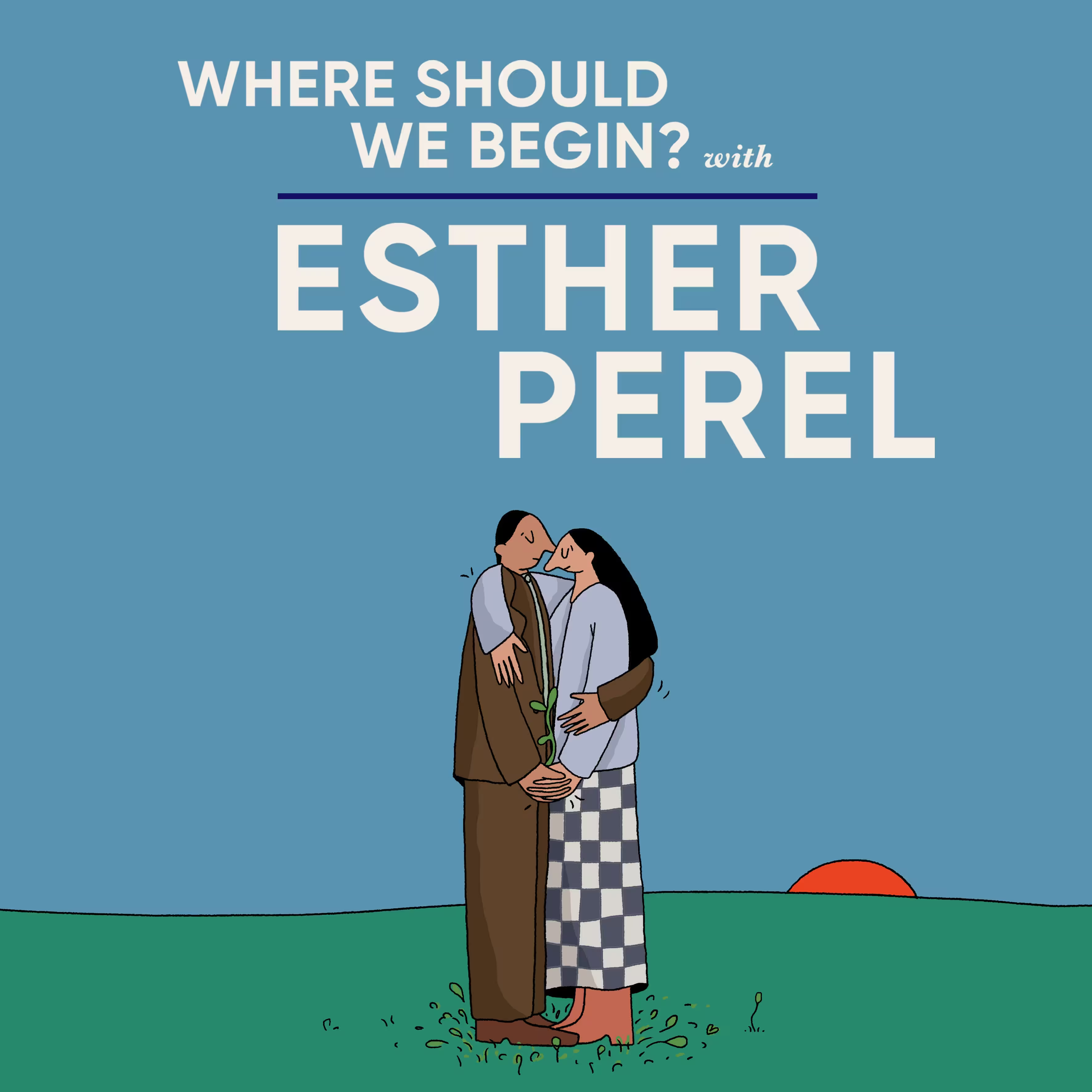
Where Should We Begin? with Esther Perel

Join Esther in her office every Monday to listen in as real couples in search of help bare the raw, intimate, and profound details of their stories.
Listen to the Podcast
Recent Episodes
View All Episodes

Where Should We Begin?

A Game of Stories

where should we begin at work product image
New
Where Should We Begin?
At Work
New
Where Should We Begin?
At Work
Improve team dynamics with Esther Perel’s renowned card game—now available for the workplace.
A live event with Esther

Sessions Live 2026

An unforgettable two-day event on relationships, love, and desire
May 15-16, 2026 | Online & In-Person in New York City
Get Your Early Bird Tickets

Courses Taught by Esther

Turning Conflict Into Connection
Uncover why you keep having the same fights over and over again. Learn how to break free from habitual patterns and responses. Find peace and reconciliation even when you disagree.
Gain new insights in just one hour
Downloadable workbook filled with guided exercises
Improve conflicts with or without a partner
View Course
Playing with Desire
Uncover and learn how to speak about your desires. Bring more aliveness into your sex life. Create rich, erotic rituals. Cultivate a more vibrant and fulfilling erotic relationship.
Perfect for date night
Playful exercises and prompts to tap into new erotic possibilities
Based on the same processes Esther has used to help real couples for 40+ years
View Course
Bringing Desire Back
Uncover what blocks desire. Learn how to tap back into pleasure and get unstuck. Discover a new sense of hope and possibility.
Perfect for date night
Guided exercises to turn insights into action and understanding
Based on the same processes Esther has used to help real couples for 40+ years
View Course
The Desire Bundle
Two courses designed to help you and your partner break out of sexual ruts, explore new possibilities, and build deeper connection.
Understand, communicate, and explore your sexual needs
Spark honest and constructive conversations about sex and desire
Designed to reignite curiosity, intimacy, and deeper connection in your sex life
View Course