All Articles
Thank you! Your submission has been received!
Oops! Something went wrong while submitting the form.
Eroticism
Security vs Freedom
How to be Assertive Without Being Aggressive
Power dynamics and what it means to be in control has changed over time. In today's social context, how can we navigate the line between dialogue and debate?

“How do I assert myself as a man without coming across as too forceful?” – Carl, Washington DC

This is a critical question at this moment in time. Many men, especially young men come to me with this dilemma — how can I be assertive and confident, without being aggressive and arrogant?

Assertiveness is a dialogue that allows for input from others. Aggression is a debate — exerting power to protect oneself.

Power dynamics and what it means to be in control has changed over time. If power was once hierarchical for your father or grandfather, it now lies in one’s ability to take input from others. Manhood has traditionally been predicated on a sense of autonomy and self-reliance. Today, men are embracing a realm of emotions and the benefits of interdependence vs. a forced sense of independence.

So, shift the way you think about compromise and collaboration, and welcome dialogue. Asserting yourself with confidence will come from being open to input. You’ll be surprised by how much power comes from conversation.

Have you struggled to walk this line?

Read More
No items found.
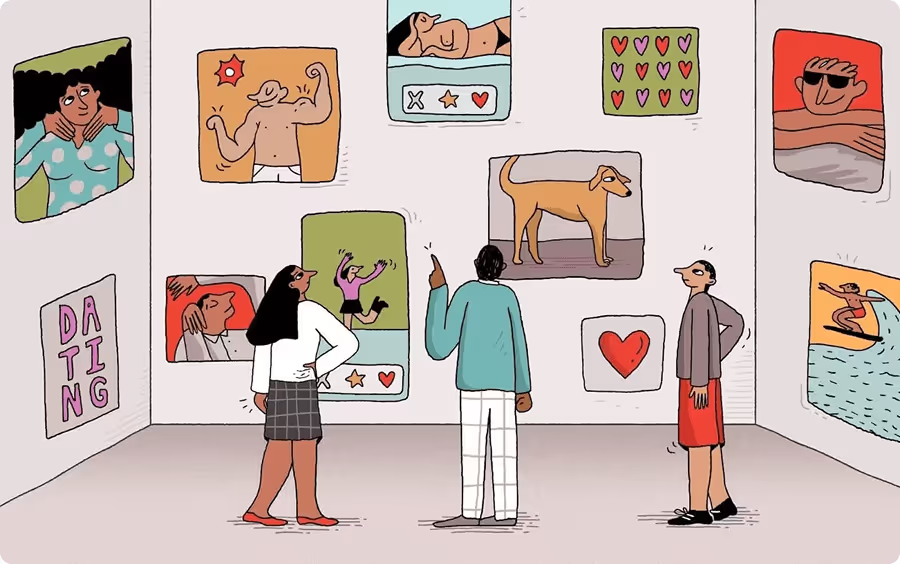
How to Deal with Online Dating Fatigue
When every interaction is curated in advance, how can we find new opportunities for curiosity, playfulness, and real life interaction?

Recently the dating app Tinder gave January 8th, 2017 the moniker “Dating Sunday”. The first Sunday after New Year’s Eve is one of the most trafficked days of the year for those swiping left or right. It is no surprise that as the new year arises you are considering new paths, new resolutions and that new somebody, so I decided to put together a two-part series to help you navigate the complex terrain of the online dating. 

How to Deal with Online Dating Fatigue

“I’ve been online dating for a while and I’m tired of the endless messaging back and forth and having to come up with witty banter that never evolves into meeting up. No one seems serious. How do I actually meet people?” – Tessa, 29

I was at a dinner in Paris recently and everyone was exchanging those stories that never fail to captivate us: the “how I met my partner” fairytale.

One woman told a story about how when she was living in a fifth-floor walk-up, she threw a banana peel out the window that landed on a man’s head. That man walked five floors to return the banana peel and never left.

This narrative of charming happenstance is rapidly disappearing in the digital age where every interaction is curated in advance. With over 40 million Americans dating online, a fatigue has taken hold as a result of the endless swiping, messaging and communicating that it takes to reach the moment of setting eyes upon a flesh-and-blood human being.

So how do you negotiate the never-ending supermarket of people online and reinvigorate yourself so that you can find new opportunities for curiosity, playfulness and real-life interactions?

Be Open To What’s In Front Of You

While online dating has proven successful, with millions meeting and marrying through these platforms, it is not the only path to connection.
It’s no mistake that in parallel to the isolating digital fortresses that we have built around ourselves, there is also a proliferation of festivals, dance parties and events where people gather, brush forearms and enjoy the presence of others. Open your eyes to the people that cross your path every day.

Challenge yourself to counter your discomfort and turn to the person who is smiling at you on the subway, in a café or sitting next to you on the airplane. The most banal chitchat – a snowstorm, the delayed C train, the breed of someone’s puppy – opens intriguing possibilities for interaction and real-life connection.

If you are particularly nervous about approaching strangers, think of a specific question or interest of yours that you want to raise to start the conversation. Remember, life is always unfolding right in front of us. Stay open to the surprises that it holds.

Check Yourself: Are You Delaying Meeting Up?

Online dating has become a form of entertainment for some – there is great appeal to the swiping, the heart-pulsing that jolts with the ding of your phone and the epistolary wonders of writing witty texts at 2am.

As evidenced by the question Tessa asks, this can quickly lead to frustration when you never actually meet in person. But Tessa may also need to ask herself if she is stalling. Delaying tactics, such as simmering or icing, detailed in this relationship chart, are easy online. They can happen for a number of inexplicable reasons – perhaps the other person is not actually serious about dating or they simply feel uncomfortable about meeting face to face.

Engage in the delicious play of flirting and teasing your potential date through words but also try accelerating the meeting process. Send a message to the effect of: “I love chatting online but I’d prefer to get on the phone, here’s my number”. A phone conversation will quickly tell you if you want to meet in person. If you prefer real interaction, set a time and meet at your favorite bar. You have nothing to lose.

Take Breaks

Many people I speak to experience the initial sense of exhilaration that online platforms open up, which can rapidly evolve into frustration, boredom, and fatigue, even more so, feeling defeated when their expectations are not met. These feelings are true to offline dating too but the sheer number of options online can accelerate this exhaustion. But you are free to take a break. You have the agency to log out. Which doesn’t mean you have to stop dating – you can stay open to the possibilities of meeting someone at a concert, on a bus or on your way to meeting your friend. Be kind to yourself so that taking a break doesn’t feel like a failure, just a shift in your current approach.

Put Your Friends On The Case

A recently divorced friend of mine sent out an email to all his friends, letting them know that he is interested in being set up. As his friends, we are well acquainted with his likes and dislikes, the kind of people he would find attractive and his hobbies and interests. We care about his romantic happiness and are willing to play a part.

Send an email to your friends and ask to be introduced or set up with their friends. I always say to people when I set them up that I can’t promise chemistry but I can promise that they won’t be bored and wonder, what the heck am I doing here?

Let me know how your online dating is going. Are you tired, bored or exhilarated by the possibilities online? Or tell me the story of how you met your partner – whether it be in real life or via online dating.

Read More
No items found.
Finding "The One"
Does "the One" exist? And what does this phrase mean in the context of a new dating reality, with all of the choice and lack of certainty it presents?

“How do I know when I’ve found The One?” – Austin, Baltimore, MD

This idea of finding “The One” is problematic for relationships. The paradox of choice creates a real sense of anxiety for people looking to find a long-term partner. The expectations of one person to satisfy all of our many emotional, physical, and spiritual needs is a tall order for one individual. 

Perhaps, instead of looking for a person who checks all the boxes, focus on a person with whom you can imagine yourself writing a story with that entails edits and revisions. As a reminder, there are no perfect stories. 

If you liked this video, please subscribe to our YouTube channel, or simply stay tuned for updates on the blog. 

We'd love to hear your questions and feedback. Submit a question for future Moments videos by reaching out on Facebook, Instagram, or Twitter. 

Read More
No items found.
Fight Smarter: Avoid the Most Common Argument Patterns
Esther talks about conflict patterns and how to fight smarter in her latest installment of "A Moment with Esther Perel".

“Once in awhile I am late and my boyfriend takes it so personally. I can understand why he gets upset but he blows it way out of proportion and it triggers our biggest fights. How can I convince my man that it’s not about him?” – Paul, Fort Collins, Colorado

No relationship is free of conflict.

In the same way that we are comprised of swirling atoms – positive and negative charges that attract and repel – two people are forces orbiting each other, moving towards and away, trying to find a way to coexist and take shape in the world.

There are two parts to Paul’s question.

The first is the fraught nature of his boyfriend’s response to his lateness. The second is that Paul wants to “convince” his partner not to feel the way he does. Unfortunately, we cannot decide for another that their reaction is out of proportion. When it comes to arguments, it is dangerous to think of oneself as the barometer of sanity or the arbiter of overreactions (i.e. “I think you’re taking this way too personally”). Let go of any assumptions you have about how people should or must react to you. It never bodes well.

Now to the meat of Paul’s question…There are patterns in arguments that are well recognized that I see over and over again. Here are three patterns Paul and his partner, and all of us, can examine as we think about how to fight better.

Check your Bias

Damian, Paul’s boyfriend, is convinced that Paul is late on purpose. I can hear the tenor of this argument: “You know how much it upsets me,” he may say to Paul. “Clearly, you behave this way because you don’t respect me.”

This assumption is known as confirmation bias where we pick up evidence along the way to confirm what we think is true and disregard any evidence that will challenge our conclusion, and make us reconsider our worldview. It doesn’t matter how many times Paul has been early or taken special care to be on time, the instances where he is late are magnified.

So why do we persist in thinking other people don’t care about us when they are often trying to convince us that they do? Because we organize our reality around these confirmation biases – they create order for us, structure among the chaos.

Paul, don’t justify, don’t explain, don’t make excuses, give Damian space to be pissed off. Acknowledge his frustration. Simply say: “I know how much you hate this” and “I understand completely that you would feel this way when I’m late”. Leave the other person with the meaning that they have invested in the situation, with the space to feel the way they do and stay connected to them amidst the conflict.

And for Damian (and all of us) think of the times when Paul has done the right thing.

Cut Out the Character Assassination

When I do something wrong (like arriving late) it’s typically circumstantial. But if you fail me, I attribute it to your character.

Damian is convinced that Paul’s lateness is a character flaw; evidence of how disrespectful, uncaring, disorganized and distracted he is. Paul, no doubt, has an entirely different view of his behavior based on the day — for instance, “the subway was stalled” or “I really had to finish this report before leaving the office”.
We call this fundamental attribution error where we attribute our mistakes to the context but the ones of our partners are rooted in their faulty personality.

Another way to phrase this is: I am perfect and you are not.

I suggest a good dose of humor when this pattern appears in your relationship.

Avoid Always & Never

Conflict often creates a contraction between couples, a rigidity, leaving little room for flexibility or nuance. “You’re always late,” says Damian. “You never acknowledge what I do for you,” Paul will fire back. 

These always and never statements become factual – as if what we have asserted is empirically verified data.One important thing to understand about a couple’s communication is that a lot of what is presented as fact is actually an intensification of someone’s experience.

When you say “never!” or “always” to someone, the first thing they will do is disagree, citing a contrary example from the past. Don’t shift your feelings into pseudo-factual talk. The best thing you can do in an always/never situation is say, “It feels like you do this all the time. Probably you don’t but in this moment, I feel like it’s so.”

Read More
Communication & Connection
Dating Advice for Turning a Spark into a Flame
What determines the success or disappointment of a first date? It's not all about the immediate spark. Read more to explore my dating advice that will point you away from playing games and toward creating authentic connections from the start.

First dates run the gamut—they can be exciting, exhausting, mysterious, boring, easy, or laborious. What determines the success or disappointment of a first date has less to do with an immediate spark and more to do with creating the right conditions for turning that spark into a lingering flame that leaves us burning to experience more. When we’re just beginning to connect with a new person, it’s all about context, education, seduction, and connection. When dating is tough, it can feel like a game that we don’t know how to play. But by focusing on these four areas, we can revel in un-gamified playfulness—that quality of romance, humor, and ease that, when combined with an authentic connection, inspires both parties to go deeper.

Context is Key

Going to the same noisy bar for every first date with every new person is a sure way to experience the dreaded first date fatigue that so many singles have become accustomed to in modern dating. Dinner and drinks are great, but playing tennis or a board game can show us how they win and lose (which tells a lot about a person). Asking them to help us pick out a gift for somebody can center an entire date around thoughtfulness and generosity. But if you really want to get to know somebody, invite them and their friends to a party with your friends.

In this context, we get to observe how our date engages with both friends they know well and strangers they’ve never met before. We get to hear about how their friends view them and they get to learn how our friends view us. (And we all know that our friends often have a kinder view of us than we have of ourselves—plus they are happy to share it.) Our friends also have our best interests at heart. They might see our date with more clarity than we do (and we’re going to talk to them about it all anyway). 

If we don’t have a connection with our date, there’s always the possibility that we’ll connect with one of their friends and/or that they’ll connect with one of ours, or that two friends might form a connection. The worst case scenario is that nobody gets along well, in which case, it’s infinitely more pleasant to experience that situation surrounded by friends than all on our own. 

Some Dating Advice? Think of it as an Education, Not an Interview

We all like to think that we come into a first date with an open mind rather than a checklist, but deep down, most of us know it’s a bit of both. For those of us who have been through marriage and divorce, in and out of many long term relationships, or have gone on more dates than we can count, holding tight to our checklist and prepared topics can feel like a necessary safety net to avoid wasting time. We seek to maximize the efficiency of our dates, to get through them so we can skip right to the cost-benefit analysis. But our hyperfocus on being productive can cause us to miss the rich tapestry of what makes a person unique, compelling, or even a surprisingly good match. Just because someone doesn’t check all of our boxes, doesn’t mean they don’t have something to offer that we’ve never thought of before. Answer the following questions honestly: 

  • When you go on a first date, do you tend to talk more or listen more?
  • Do you ever find yourself listing off your resume? 
  • What topics do you tend to focus on during a first date? Why?
  • What topics do you tend to avoid? Why? 

Learning about a new person is also a process of allowing them to learn about us. This mutual education is an intimate and vulnerable act with a stranger that can be intimidating in both directions. We could all benefit from addressing that dynamic more explicitly on first dates. Try asking your date: 

  • What is your favorite topic to be asked about on a first date?
  • What questions would you like to ask me but are too afraid to ask?
  • What is something about you that surprises people when they find out? 
  • What is your least favorite part of dating? 
  • What do you hope for when you go on dates?
  • How do you think this one is going so far? 

To Seduce and To Be Seduced

When a date is going very, very well, the intense physical and emotional fusion we experience is possible because we don’t know each other yet. Desire needs mystery and, in the beginning, everything is mysterious. There is so much depth to be discovered. And that process of discovery can be intoxicating. In the early stages, merging and surrendering feel relatively safe because the fundamental separateness between two new people creates infinite space to play. Seduction is a way to explore the boundaries of each others’ worlds, histories, fantasies, and desires—and that type of play is an education unto itself. If the attraction is there, and if it feels appropriate, try asking:

  • What is your idea of a perfect romantic evening?
  • What is an aspect of sexuality that feels mysterious to you? 
  • Where is the strangest place you’ve had sex?
  • What non-sexual thing feels sexual to you?

Connection or No Connection, Follow Up

Enjoyed the first date? Say so. It is so nice to receive a message or call that confirms mutual interest and a desire to see each other again. That one small, simple gesture can make a person’s whole day. The moment we find out that the person who made such a positive impression on us feels similarly about us, we become flooded with endorphins and excited to flirt, play, and see each other again.

Didn’t enjoy the first date? Say so. You don’t need to find an excuse or supply an explanation. “I very much enjoyed meeting you. That said, I didn’t feel a connection between us so I don’t know that we will meet again. I think you’re a wonderful person and I wish you all the best.” Ultimately, there is nothing you can say that makes rejecting someone or being rejected any easier, but you can communicate in a way that doesn’t make the other person feel devalued or dismissed. And if we find ourselves on the receiving end of one a message like this, it’s okay. If we are willing to keep putting ourselves out there, there will always be more people to learn about who want to learn about us.

Read More
Security vs Freedom
Eroticism
How Erotic Thinking Helps Emotional Connection
Creativity is where Eroticism lives. No matter how effective our routines have been—or how much we’ve even enjoyed them—if they’re not filled with creativity, they inevitably leave us numb. Read more on how eroticism helps emotional connection.

Freedom and security are twin faces of the same coin. Humans require both and we put a lot of pressure on our relationships to sustain the careful balance between them. Over the last few decades, the western experience of freedom and security has existed on a pendulum, swinging toward risk and recalibrating toward safety, back and forth. Birth-controlled sex, normalized divorce, democratized technology, and more have contributed to unprecedented levels of freedom. Reflexively—and in the absence of traditional institutions that once governed behavior, however inadequate they may have been—we’ve imposed measures of safety upon ourselves to keep the balance in check. It’s the kind of internal surveillance French philosopher Michel Foucault called “panopticism.” Security that manages freedom can look like swapping metal for rubber on playgrounds. It can also look like the necessary expansion of our understanding and communication around consent. Perhaps the best example, however, is our ongoing quest to quantify every aspect of our lives through apps that track what we eat, how much we sleep, how long we walk, and how we date. 

We cherish our freedom but we impose structure to regulate it. We value our security, but peace of mind can leave us yearning for mystery and spontaneity, facets of Eroticism which extend to all areas of life. In the past year, as the Covid-19 pandemic has gripped the world, the pendulum that swings between freedom and security has snapped off its hinge. Going into lockdown meant a sudden and extreme emphasis on security as well as a collapse of freedom that, almost a year later, continues to be the norm. For so many of us, our intense focus on safety has meant a stifling of the things that contribute to our Erotic experience of life—trying new restaurants, making new friends, meeting a stranger who becomes a lover. It’s important to remember that Eroticism isn’t inherently sexual; it’s an experience of aliveness which beats back deadness. And if ever there is a time in which deadness needs to be countered, it is these moments of crisis in which the shadow of death is ever-present. 

Flatness Affects Emotional Connection

The many of us who were privileged enough to be able to stay home quickly found that, in a world of uncertainty, we could only control ourselves. We created routines and rituals. We meal-planned. Our calendars filled up with precisely scheduled work calls and video catch ups with friends and family. We drew physical boundaries. I work at the kitchen table. You do your remote learning in the den. And each experience of loss—death of a loved one, getting laid off, the pounding desire for unattainable touch—has made us dig our heels into our need for security all the more. 

In flattening the curve, we’ve also flattened ourselves. We’ve doubled down on our procedures, enduring the monotony of routine for a semblance of safety. How many different proteins can we cook in how many different ways? How many times can we go from the couch to the bed to the kitchen table? Do we want to watch another movie tonight? And after all of this repetition, do we really want to have sex? Make love? Does even masturbation feel like too much effort? Flatness affects our emotional connection, and that affects everything else. 

Finding Our Way Back to the Erotic

No matter how effective our routines have been—or how much we’ve even enjoyed them—if they’re not filled with creativity, they inevitably leave us numb. Creativity is where Eroticism lives. Powered by curiosity, intuition, and the energy of imagination, creativity invites us into the unknown. And Eroticism is about bringing adventure back into play. It’s about bringing creativity into our lives. 

When escapism becomes video games, doom scrolling, and social media—repetitive, addictive activities we can do from the safety of our home while getting the security of a guaranteed dopamine hit—it can be hard to rewire ourselves to get creative about how to feel free. But freedom in confinement comes from the imagination. Just like a child can imagine they are a sea captain navigating an ocean voyage or that a cardboard box is a castle, we can imagine that a neighborhood walk is an exploratory adventure, using all of our senses to experience it. We can imagine that our kitchen, with the lights off, candles lit, and a delicious meal for two is a little hole in the wall restaurant in Paris. This is Erotic Thinking. 

Emotional Connection Requires New Patterns

Trying something new—especially something creative—is a great way to jumpstart emotional connection. Having a project, building something, planting, watching children play, cooking or baking (especially the recipes of our ancestors), setting the table with good linens and china for a change, turning the living room into a hotel, eating a piece of chocolate like it's the first time, creating a playlist for someone specific…. It’s the small, heartwarming, sensual thing that brings light into our lives in a new way. 

And if even that feels difficult, start here: close your eyes and imagine feeling totally flat. What are you thinking? What other feelings come up? How does your body feel? What does it make you want to do?

Now, reverse that. Imagine the most joyful feeling you can conjure. Take it to its extreme. What thoughts inspire that state of mind? How does it feel in your body? What might you feel motivated to do? Sometimes just taking this mindset of peaceful excitement with us as we continue in our routines can help refresh them. And when we’re ready to take it further, our imagination will be waiting, ready.

Read More
Taboo
Coping With Loneliness Around The Holidays
Feeling lonely around the holidays can make us feel as if something is wrong with us. Everybody else seems to know how to be happy, how to be together, how to be festive, merry, and bright. But feeling lonely around the winter holidays is extremely common. Read more about coping with loneliness around the holidays and some resources to help you face it.

Feeling lonely around the holidays can make us feel as if something is wrong with us. Everybody else seems to know how to be happy, how to be together, how to be festive, merry, and bright. But feeling lonely around the winter holidays is extremely common. And even more so during this year of isolation.

Before we can digest our Thanksgiving food, that familiar cheer creeps in. Twinkling lights on trees, menorahs and kinaras in windows, classic films on every channel, carols ringing out in the streets—these holiday symbols can inspire the best feelings in the world, but they can also feel oppressive when we’re finding it difficult to catch the spirit. It can seem as if everyone else occupies their own winter wonderland with people they love, money to buy food and toys, and even time to volunteer. This wrapped-in-a-bow fantasy is rarely the reality for most people. More often than not, the holidays are a time of increased stress and loneliness—even for self-proclaimed holiday fanatics. The National Alliance for Mental Illness cites “extra stress, unrealistic expectations, [and] sentimental memories that accompany the season” as sources of loneliness around the holidays for everyone, but especially for those of us who struggle with mental illness.

This extra pressure around holidays is especially intense in America because it’s often the one time each year when families come together. Some of us feel obligated to choose between families, and to buy plane tickets and gifts even when money is tight. Others among us feel that we have no one with whom to spend the holidays or that the people we long to be with are far away or no longer around—loved ones who have died and former partners, both of whom make up some of our happiest and most painful holiday memories.

The Holidays Evoke Both Pleasure and Pain

There is a moment in our adult lives when we realize that behind much of the holiday magic of our childhood were major sacrifices: our mother who stressed over getting the gifts we coveted; the father who missed many nights of family dinners working overtime to afford the big meal; the eldest sibling who pulled an all-nighter to wrap gifts and stood by while the young ones worshipped Santa Claus, marveling at his stamina. True holiday spirit lives in these profound gestures, but like all spirits, it can be haunting. 

Even holiday memories formed in adulthood can feel like a shattered window to the past. We can barely make out the warm, glowing scene behind the cracks but we feel the heat long after the fire’s gone out. It’s the memories of a former lover with whom we created new traditions, who helped heal childhood wounds, only to eventually create newer traditions with someone else. It’s driving past the apartment where we celebrated with an old friend who’s no longer in our lives. It’s helping our mother downsize, watching her grapple with the decision to get rid of the wrapping paper she hoarded that was too nice to use. It’s buying gifts our children will get bored of in two weeks. It’s buying eggnog for one. There is perhaps no other time of year in which the pleasure and pain of our memories feels so routine, in which we experience such ambivalence about our own sense of joy.

Coping with Loneliness in a Time of Crisis

Holiday cards and social media posts of families in matching sweaters with mugs of hot cocoa present a nice picture, but behind every lush garland and wreath is the unspoken feelings that the holidays sometimes bring. It’s those feelings of scarcity—not having enough and not being enough. And this time of pandemic, economic strife, and global remoteness has amplified this. This year, how many of us can relate to the feelings of:

  • Craving physical contact 
  • Longing to sit at a table together
  • Exhaustion due to counting days since potential exposure
  • Isolation because no one can visit this year, especially in nursing homes
  • Desiring to shop and dine at our favorite local spots that have permanently closed—we miss those familiar faces
  • Wanting to talk to a stranger in line about the gifts they’re buying
  • Family tensions boiling over day after day while we remain on top of each other
  • Navigating political differences that leave us pulling our hair out
  • Not having enough money to get the gift we want for our partner
  • Chronic judgement around pandemic protocol
  • Wanting our kids to see their grandparents (and wanting our parents to help with the kids)
  • Missing the office holiday party 
  • Going on a real first date

It is long-established that the mortality risks posed by loneliness and social isolation is comparable to those posed by smoking and obesity. That feels especially obvious this year. But if there is any silver lining to this year’s specific version of holiday loneliness, it’s that many of these circumstances are largely universal—and so are the resources to face them.

Reach Out & Reach In

We continue to be living through a period that demands collective resilience. Relationships are often the strongest protective factors to keep us tethered to ourselves in times of crisis. This holiday season is an opportunity to create new traditions that challenge the DNA of our society that says we have to do it all alone. This is a time to practice creative collectivism instead of Darwinian survival of the fittest. Send cards. Write letters. Acknowledge the people we think and care about by actually picking up the phone and calling them. Cook for someone; drop it off at their house. Foster a pet. Start an indoor garden. Take a long walk and say hello to those we pass. Identify one or two people in our social sphere and create an oath of accountability to cook healthier together. Cook with each other on FaceTime. Support a beloved local restaurant or small business by purchasing gifts cards and sending them to friends. Schedule monthly check-ins with loved ones and put it on both calendars. Join a virtual group, film forum, or a newspaper’s book club. Volunteer. Reach out to a nursing home to see if anyone wants to talk by phone. If you’re in a city, go listen to street musicians. Join a fan club. Do a live virtual exercise class. 

There are many resources for turning holiday loneliness into strong relational health. But that’s easier said than done. When we’re experiencing loneliness, it can be especially difficult to reach out for help. With that in mind, we reached out to our own community to pull together resources for coping with holiday loneliness. This list was made with you in mind and it is yours to share with anyone you think might benefit from it. Consider it a mini reading club in which you can come together to discuss. 

Our Community Resource Pool for Coping with Loneliness

Our social media channels were flooded with messages about how to cope with holiday loneliness. Here’s a sampling:

I have been feeling lonely during holidays for the last 8 years now. I learned to allow myself to feel sad and cry if needed but then get up and do something that makes me feel good such as going for a walk, doing a workout or have a dance party by myself.

Having something to look forward to everyday even if it’s small—walks, pets, a good book, an episode, a yoga session, cooking a slow meal.

Wake up early. The time that you think you should. A time that makes you proud of yourself just for getting out of bed. Make your bed. It’s a gift to yourself when you’re tired. Yoga 1hr. Put on clothes that you would wear outside the house. No track pants. Healthy breakfast. Fruit. Light filter coffee, but not too much. Work now. Focus. Be decisive and compassionate. If the sun comes out, go outside into it. Exercise. Maybe a quick run. Some pull ups. Or even just a walk. The cold air in your lungs and the sun in your eyes sends some kind of shockwave into the nervous system that makes you happy. Call the family. Use the L word. Meditate. Work more. Cook for yourself or your loved ones. Or let them cook for you. Thank them. Make them laugh. Eat and drink things from happy soil. Don’t eat shit. Chocolate isn’t shit. Chocolate is delicious. Squeeze in a little more work if it’ll help you sleep better later. Know your boundaries. Don’t use electronics in the bedroom after dinner. When your eyes start to sting, write a quick journal, then wash your face, brush your teeth (floss! It shows you that you care about yourself) and then read a book. Anything. Put on pyjamas, not your dirty undies from the day. Sleep in the clean folded sheets that you made for yourself earlier.

Watching Christmas movies from childhood (Home Alone, Christmas Vacation), listening to happy Christmas music that reminds me of happier times with family and baking all the favorite things my loved ones, who are gone, loved. Holidays aren’t as magical as I get older; it’s the memories and traditions that bring me joy.

Taking a walk or run, early in the morning before the kids wake up. I’ve been doing this for months and though I haven’t been feeling my best, spending energy alone and out of the house has helped a bit to cope. I come back home having taken 10,000 steps and the day is just beginning. That’s a good feeling. 

A lot of warm showers and warm socks. Hot tea and a lot of blankets. Funny memes sent to friends and family.

Breathing exercises, taking care of my dog, putting on my favorite Christmas movies, preparing my grandma’s recipes.

I collect recipes of foods that friends and family members cook. I ask them to teach me how to make it. When I miss that person, I cook their dish. It doesn't taste the same of course, but it's more about reenacting the experience we had together.

Writing postcards and thank you cards with the good stuff that we shared during the year. The rest of the year I can't bring myself to do it because it seems too cheesy, but on Christmas and New Years there’s finally the right background mood for it.

I do what I would love to receive from others: I reach out.

Reading old letters and looking through pictures.

Writing down what I’m grateful for.

Let my dog sleep in my bed with me and hot baths.

Seek out ways to volunteer/help.

I go for walks and listen to podcasts.

FaceTime cocktail party with my tribe.

Secret santa with my friends based all over Europe.

Filling my house with Hygge, planning great gifts since we’re not seeing anyone for the holidays (really thinking through what people have talked about as interests and desires), embracing my kids’ innocence about what’s happening around us (their joy is easy), listening to podcasts who keep it real. The hosts start to feel like friends. FaceTiming often.

Expressing gratitude to people in the grocery store or on a customer service call. It helps me to recognize not only their help being important to the world, but also that the world has people in it who help me. It’s a gratitude that refills itself.

I light candles, put on some music, and write postcards to friends. Making postcards is a fun art process (or you can buy them) and postage is still less than 50 cents! Thinking about each person and what I want to say to them becomes a meditation on what I love about these dear ones, and helps me feel closer to them. I enjoy receiving physical, handwritten mail and I hope my little offerings help my friends feel my love for them across the distance!

Allow myself to feel. Watch the movies I love. Cook those holiday classics that remind me of great memories, but also remind myself of all the drama I will spare myself this year and go for a walk enjoying the snow! 

Turn on music and dance—anything that will make me laugh. I create; sewing, painting, writing, designing. Take a calming bath with songs which will soothe me. Call my family and be silly with them. End the night with a tap on my own shoulder, saying you did good today.


Read More
Communication & Connection
Comprehensive Sex Education: Sexual and Relational Health Resources for All Ages
How do you talk to children about sex, relationships, and their body? Here is a resources list to help you start and continue these conversations with all ages.

In the article 5 Ways Comprehensive Sex Education Makes a Difference, I shared why sexuality and relationship education is important to our lives, the lives of our children, and our society as a whole. In response, many of you have asked, “but how?” How do you talk to your child about sex, relationships, and their body? 

Reading is a great way to introduce sexual and relational health talks with your child, but there are many resources available beyond a library of books. I’ve compiled a collection of learning tools from my personal library and the recommendations from my colleagues and team. 

The list includes books, articles, and online tools for parents and youth to learn and become more comfortable and confident in their bodies and connection to others. Use this list to create a sexual and relational health toolbox of your own. 

  1. Online Resources - Parents
  2. Online Resources - Teens 
  3. Reading List - Early Ed + Elementary Age
  4. Reading/Watch List - Middle School + High School
  5. Reading/Watch List - Late-teens + College

ONLINE RESOURCES FOR COMPREHENSIVE SEX EDUCATION - PARENTS

AMAZE Parents | AMAZE Jr. 
AMAZE envisions a world that recognizes child and adolescent sexual development as natural and healthy, a world in which young people everywhere are supported and affirmed and the adults in their lives communicate openly and honestly with them about puberty, reproduction, relationships, sex and sexuality. AMAZE takes the awkward out of sex ed. Real info in fun, animated videos that give you all the answers you actually want to know about sex, your body, and relationships. Amaze has sections for teens, parents, and young children.  

Guidelines for Comprehensive Sexuality Education 3rd Edition - Written by the Sexuality Information and Education Council of the United States (SIECUS) Task Force
Sex Positive Families
Strengthening sexual health and body awareness talks between parents and children through education, resources, and supportive services. The website has a wealth of free downloadable resources, blog posts, and an active Instagram page.

The Porn Conversation
Feminist porn producer, Erika Lust, in consultation with sex educators, created this porn-education website for parents. The Porn Conversation believes that prohibition and shame is not the answer, instead, they believe in education and conversation. By choosing to shed light on the debate about online pornography, they are campaigning for more equipped and alert young beings, who are ready to make better choices; driven by knowledge, and not by fear. The Porn Conversation links to research and articles and provides practical tips for parents.

ONLINE RESOURCES FOR COMPREHENSIVE SEX EDUCATION RESOURCES - TEENS

AMAZE
AMAZE takes the awkward out of sex ed. Real info in fun, animated videos that give you all the answers you actually want to know about sex, sexuality, puberty, reproduction, and relationships. 

Roo
A free sexual health app created by Planned Parenthood to connect curious users to facts. Roo answers all your awkward questions about sexual health, relationships, growing up, and more. Chatting with Roo is free and private, so go ahead and ask the things you don't want to ask out loud.

Scarleteen
Scarleteen is an independent, grassroots sexuality and relationships education and support organization and website. Scarleteen provides inclusive, comprehensive, supportive sexuality and relationship information for teens and emerging adults.

Sex Etc.
Sex Etc. is sex education by teens, for teens. Sex Etc has helped teens with answers to their questions about sex, relationships, pregnancy, STDs, birth control, sexual orientation and more.

READING LIST - EARLY ED + ELEMENTARY SCHOOL

Preschool Age

Elementary Age

Parents

READING/WATCH LIST - MIDDLE SCHOOL + HIGH SCHOOL

Book list courtesy of Sex Esteem® by Sari Cooper

Teens

Parents

READING/WATCH LIST - LATE-TEENS + COLLEGE

Read More
Communication & Connection
5 Ways Comprehensive Sex Education Makes a Difference
Read more about how comprehensive sex education makes a difference in our lives, the lives of our children, and our society as a whole.

Ask any American about their introduction to sex and, depending on where and how they grew up, you’re bound to hear stories involving promise rings, bananas, “down there,” and the oft-spouted main outcomes of our carnal inclinations: danger, dysfunction, and disease. This is not to say that other cultures have it all figured out—my Jewish Polish parents taught me that I came from a stork; thankfully, the Belgium education system taught me otherwise. This is, in part, why it’s so important to consider the intersecting avenues of education; a child forms their ideas about the world from what they learn at school, from their friends, and at home. I’m frequently asked, “How should I talk about sex to my little ones and when should I start? And how should that communication evolve as they grow up?”

Most countries that practice comprehensive sex education have taken a developmental approach starting at age four. Why? Because this is the age when children become natural theologians, when they ask where did we come from and where did grandma go when she died. This is also the age when children develop a separate sense of self and begin to explore how we are all connected. 

Young children engage in behavior that is sexual but they don’t know that it is sexual: when Alex enters the classroom and runs to sit next to Charlie; when Alex wants to hold hands with Charlie while they walk. Or, when Alex or Charlie is by themself practicing self-touch, the most natural form of self-soothing that our little ones discover.

This is all normal behavior. It is up to the adults to help provide context. It’s not just about teaching what genitals do, but the meaning of certain behaviors and when they are private or public. Self-touch is something special you do for yourself. We don’t stroke ourselves in public in the same way that we don’t pee in front of others. We acknowledge that self-touch feels really nice, but, as Freud has said, keeping it private is the price we pay for civilization and its discontents. 

Avoiding these discussions, reprimanding a child for being curious, or worse, providing misinformation, induces fear and shame and may set the child up for a lifetime of misunderstanding about sexuality and relationships. I believe that many of the troubled situations that occur among adults are a consequence of a massive vacuum people experience during youth. And it doesn’t have to be this way. It begins with expanding our definition. “Sex ed” doesn’t cut it. I prefer the phrase “Sexuality and Relationship Education.” In my many years as a cross-cultural psychotherapist, I have found that when we think of sex and relationships as exclusive from one another, we miss the opportunity to more deeply understand ourselves and our partners. 

This brings us to number one on our list of how comprehensive sexuality and relationship education makes a difference.

1. It establishes integration and helps us form healthy connections.

It's taken us a while to understand that human health is an interconnected system. In the same way that we teach children physical and emotional health, sexual and relational health must be taught as an integral part of that. It isn't a second track. Our knowledge and practice of respect, responsibility, mutuality, pleasure, contraception, and consent determines the quality and consequences of the physical and emotional experience of sex. Comprehensive sexuality and relationship education teaches that it isn’t a matter of just “having” sex but that we are sexual beings. It emphasizes the importance of human connection, how to respond to our attractions and our desires and what to do with the attention from others. Teaching children sexual self-awareness helps with the creation of boundaries. When you make it about connection, you’re giving it a meaning. Sex takes place in a context. And integration allows pleasure to flourish in that context of relatedness. 

2. Comprehensive sex education helps us have a healthier relationship with our bodies.

Children should be raised with a clear understanding of their bodies, how bodies work, how to take care of them, and how all bodies are unique and special and must be treated well. Why is it that we name every body part by its actual name except our genitals? Have you ever heard a nickname for knees? Or armpits? Similarly to how we spend countless nights and mornings teaching our children how to brush their teeth and hair, and why good oral health is paramount, we must also teach children how to clean their genitals, what they’re for, how they will change over time, and how to protect them. These conversations go a long way in helping a child become self-reliant in regards to health and hygiene, and help establish self-esteem. Your body is normal and beautiful and functional. It is yours and only yours. It works like this and will change like that. This is how to take care of it. 

3. It normalizes sex and relationships and demystifies them. 

Talking to children about sexuality early on establishes it as a normal topic, and avoids awkward and fraught interventions that inevitably occur too late. Secrecy surrounding sex breeds fear and shame, whereas appropriate openness encourages children to ask questions. It is infinitely preferable to have them ask you for answers than try to figure it out on their own only to stumble upon misinformation. And if you lead the conversation, then you can steer it in the direction of two of the most important aspects of sexual and relationship health….

4. It encourages responsibility and good judgement. 

Let’s get started by dispelling an all too-common myth: teaching children about sex doesn’t make them want to start right away—they’re not going to go running from the kitchen into the sack—but it does create an expectation of responsibility and an infrastructure for how to exercise good judgement. It creates a healthy curiosity. In America, sex is the risk factor. In Europe, being irresponsible is the risk factor. America doesn’t have a public health policy on adolescent sexuality, whereas in Europe, campaigns about safe sex are as prevalent as campaigns that educate citizens about drunk driving. American campaigns like “Not Me, Not Now” encourage abstinence as a means of avoiding teen pregnancy and sexually transmitted diseases, and our public health policies reflect the idea that adolescent sexuality is deviant behavior that needs to be prevented. Our European neighbors, in contrast, view adolescent sexuality as a normal developmental stage on the way to healthy, adult sexuality. Hence the European counter-slogan to “Not Me, Not Now” is “Rights, Responsibility, Respect.” 

5. Comprehensive sex education lifts us as a society. 

We live in a society that is hypersexualized and woefully under-informed. We’ve really only been able to explore our sexuality freely since 1965, when the outcome of Griswold v. Connecticut reversed outlawed use of contraception by “married” couples. The democratization of contraception made way for a sexual revolution, and that revolution to this day is seen as a threat to those who think restricting access to sexual and relationship education will prevent the downfall of our society. But here is the reality: the absence of this education causes us to disassociate the physical act of sex from its consequences. A society that sees even safe sex as “soiled” is a society that thrives on sex scandals rather than sex information. Sex cannot be divorced from emotion and social continuity. We need to help reshape the narrative around sex and relationships for our young ones, and we need to start early. As Amy Schalet so cogently explains, “we see teenagers as helpless victims beset by raging hormones and believe parents should protect them from urges they cannot control… This compounds the burden on parents to steer teenage children away from relationships that will do more harm than good.” When we make sexuality and relational health clear, concrete, and contextualized for children and teens, they come out differently on the other side. Comprehensive education creates self-awareness, responsibility, and empathy. Sending kids into the world without this understanding is a threat to society as a whole. 

And it shows in the data

  • In 2015, the U.S. Department of Health and Human Services (HHS) compiled information from twenty-one countries and found that the U.S. had the highest rate of teen pregnancies
  • This reinforces prior findings, from 2009, by the reputable organization Advocates for Youth, which found that the United States ranks number one in teen pregnancy, birth, abortion, and STD-contraction rates, and ranks lowest in contraceptive use, as compared to France, Germany, and the Netherlands. 
  • Despite this, in July 2019, the HHS granted nearly $1.5 million in federal funding to organizations that promote abstinence-only education, which has been found to have significant negative impacts on adolescents. 
  • Whereas organizations which provide more comprehensive and diverse information about sex, relationships, and family planning, such as Planned Parenthood, continue to be under threat

I encourage you to celebrate World Sexual Health Day by examining the ways in which you’ve been taught about sex and relationships and to take a deeper look at what you can do to be a part of a global solution toward sexual health. It starts small—a conversation at home with a young, loved one makes a huge difference. 

Children's books about sex and relationships 

Additional resources for adults

Read More
Discover more from Esther on Substack.
Explore articles and resources to help you find aliveness and vitality in your relationships.
Subscribe on Substack
Where Should We Begin Podcast COver

Where Should We Begin? with Esther Perel

Join Esther in her office every Monday to listen in as real couples in search of help bare the raw, intimate, and profound details of their stories.
Listen to the Podcast
Recent Episodes
View All Episodes

Where Should We Begin?

A Game of Stories

where should we begin at work product image
New
Where Should We Begin?
At Work
New
Where Should We Begin?
At Work
Improve team dynamics with Esther Perel’s renowned card game—now available for the workplace.
A live event with Esther

Sessions Live 2026

An unforgettable two-day event on relationships, love, and desire
May 15-16, 2026 | Online & In-Person in New York City
Get Your Early Bird Tickets

Courses Taught by Esther

Turning Conflict Into Connection
Uncover why you keep having the same fights over and over again. Learn how to break free from habitual patterns and responses. Find peace and reconciliation even when you disagree.
Gain new insights in just one hour
Downloadable workbook filled with guided exercises
Improve conflicts with or without a partner
View Course
Playing with Desire
Uncover and learn how to speak about your desires. Bring more aliveness into your sex life. Create rich, erotic rituals. Cultivate a more vibrant and fulfilling erotic relationship.
Perfect for date night
Playful exercises and prompts to tap into new erotic possibilities
Based on the same processes Esther has used to help real couples for 40+ years
View Course
Bringing Desire Back
Uncover what blocks desire. Learn how to tap back into pleasure and get unstuck. Discover a new sense of hope and possibility.
Perfect for date night
Guided exercises to turn insights into action and understanding
Based on the same processes Esther has used to help real couples for 40+ years
View Course
The Desire Bundle
Two courses designed to help you and your partner break out of sexual ruts, explore new possibilities, and build deeper connection.
Understand, communicate, and explore your sexual needs
Spark honest and constructive conversations about sex and desire
Designed to reignite curiosity, intimacy, and deeper connection in your sex life
View Course