All Articles
Thank you! Your submission has been received!
Oops! Something went wrong while submitting the form.
No items found.
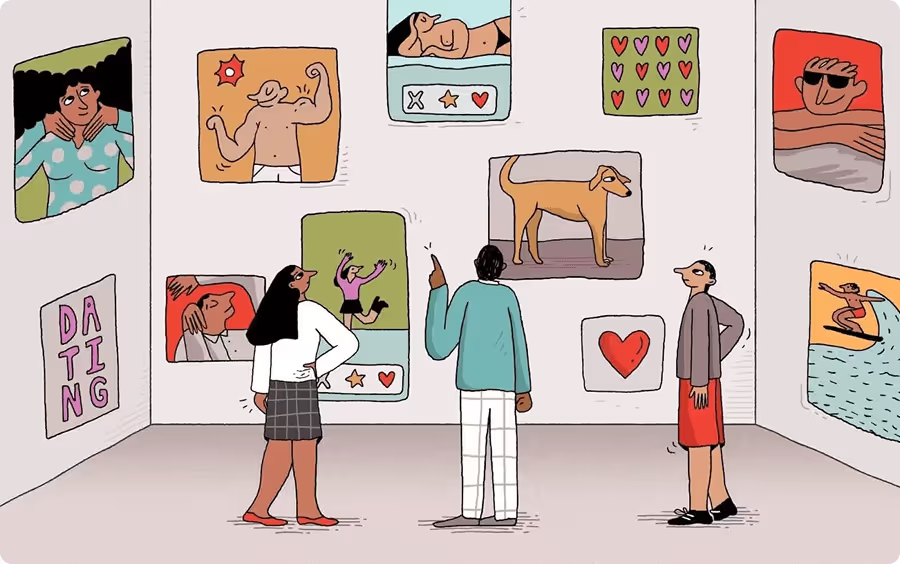
Let Go of Being the "Perfect Partner"
There is no such thing as the perfect partner. It’s time to give up the hope that you can be fault-free, put-together all the time, and just the right amount of independent in a relationship.

There is no such thing as the ideal partner. So you might as well give up the hope that you can be fault-free, put together every day, and just the right amount of independent in a relationship. That idea is utterly unrealistic, puts you in a constant state of not feeling good enough, and can prevent you from developing real confidence in yourself. It can even end up putting unnecessary strain on your mate and bond.
Think about it this way: Relationships are like instruments. If you expect to pick one up and quickly play it like a pro, you’re going to become frustrated and disgruntled, and you may just walk away from a good thing—missing out before you really even began. To foster a long-term, supportive, rock-solid rapport, try to acknowledge your flaws while still holding yourself and your partner in high regard. Start by freeing yourself from these outdated notions of exemplary partner behavior.

“I need to be totally chill.”
Being “chill” or “cool” is not a sign of emotional maturity or intelligence. There are things that you should get worked up about, like if your partner is unfaithful or neglectful. In fact, I would be worried if that didn’t upset you! Some situations demand certain reactions, and this idea of people being “too much” or “crazy” is destructive. It leads you to act fake and pretend that your partner’s hurtful actions don’t bother you—which deprives your relationship of true closeness and connection.
What you want to learn is how to regulate your emotions. As in, you cry, scream, get angry… and then calm down. By doing so, you’re giving your partner a chance to truly get to know you, what upsets you, and how you handle and resolve your feelings. And yes, the right partner will still love you once you open up to him or her this way.  

“I’ve got to be supportive.”
In relationships, there is usually one partner designated as the more nurturing partner, the shoulder to cry on, the emotional rock. But always being there for others can sometimes make you forget to take care of you. And constantly trying to be supportive and uplifting can make you second-guess yourself, asking “Did I say this right? Did I do the right thing?”
The fundamental challenge is figuring out how to encourage your mate while holding on to your own identity and individuality. Instead of adhering to the “right thing to do,” you must find your own voice as a caretaker. That might mean stepping away when you feel overwhelmed or allowing your partner the space to solve his or her own problems.

“I have to have my life together.”
A person who tries to be the perfect partner feels as though he or she must have it all together, as if that just comes naturally. But in reality, you are allowed to make mistakes, search for yourself, and not have all the answers about who you really are. 
Plenty of my clients say things like, “When I met [my partner], they were so poised. They gave off an air of someone who knew what they were doing, who they were, and where they were going…but now that we are together, I’ve found that none of that was true.” If you begin a relationship on the presumption that you have everything figured out, you are setting yourself up for stress later on. Your bond will be built on unrealistic expectations, and your partner may be resentful once you reveal your true self. 

Instead, try to learn to feel good about yourself even when you are flawed, and present that real version to potential mates. That sets you up to have a bond built on trust and truth. You will know they like and are attracted to you for who you really are.

Read More
Communication & Connection
Crisis
Letters from Esther #12: How Your Relationships Will Change
My monthly newsletter and free workshop series is meant to inspire you to reflect, act, and develop greater confidence and relational intelligence in all of your relationships. This month's theme is: How Your Relationships Will Change.

Shall We Begin?

The New Normal is no longer new. As we pass the half year mark since the Covid-19 pandemic began to spread in America, the terrifying novelty of it all has worn down into an uncanny steadiness where I live. But in many parts of America, the Covid-19 spike has arrived relatively recently. I remember, in March, watching the viral video of Italians warning New Yorkers and Washingtonians what was coming for us. Today, no matter where you are, I want to tell you what’s coming for your closest relationships, and what to do about it. 

You will yearn for specific people. For my husband and me, it was our adult children, who we had not seen after months of careful isolation. I still have not seen my oldest son because of international travel restrictions. 

You will establish ground rules unlike any you’ve had before. I haven’t hugged anybody except for my husband and one of my sons. 

You will occupy a “separate-but-together” state and it will even start to feel normal. So much so that…

You will make mistakes. I didn’t think twice about sharing my water with a friend while hiking six feet apart, not realizing that the habit has become a hazard. With one sip, months of worrying, cautiousness, and spatial negotiating were completely undone. I found myself saying what has become one of my most-used phrases these days: “If we can’t stick to our rules, what has all of this been for?”

You will come to find that it’s those tiny moments of intimacy that feel the hardest to restrict. Not just because it’s painful to deprive oneself of touch, but because…

Even the smallest lapse in judgement can set off “Pandemic Paranoia.” My husband and I have a lot in common but, like most couples, our differences become exacerbated in crises. Yours will, too. In the beginning of the pandemic, I was in constant anxiety mode, dreading that my husband would get sick and die. He, on the other hand, was in reassurance mode, which I like, but also frustrates me. One day, he told me he was going to go dig a hole in the yard so that I could throw him straight in the ground since I was so convinced he was going to die at any moment. It made us laugh harder than we had in weeks. (Our fears are quite different; our humor is shared.)

Humor will be a saving grace in your relationships. Humorous banter helps us avoid the ping pong of defensiveness that I see in so many couples. Let’s be honest, just because I’m anxious doesn’t mean I’m consistent. I’m yelling at my husband to put on a mask and then turning around to share my water with a friend. But by playfully chiding me for my hypocrisy, rather than outright calling me a hypocrite, my husband uses humor to help us navigate our stresses.

You may have less sex. Don’t fault yourself if sex isn’t top of mind right now. But try to have honest and open conversations with your partner about it. Articulating the reasons why you may be too stressed or sad to engage in intimacy may help you let go of some of those fears. 

You may have better sex. According to a brand new study conducted by Kinsey Institute executive director, Justin Garcia, and Justin Lehmiller: nearly half of participants “reported that their sex life has declined and that they are less sexually active now,” however, “1 in 5 participants reported having expanded their sexual repertoire by incorporating at least one new activity into their sex life since the pandemic began.”

You will experience a new type of intimacy with strangers, like a shared wink in the supermarket acknowledging the silliness of negotiating proximity in an aisle, or thanking a cashier with new depth of gratitude. 

Despite the anxiety and grief, you will experience a new level of clarity. This is a moment of mass reprioritization. You’ll assess your finances. You’ll assess your health. You’ll assess what’s been working well in your life and what hasn’t been. What you want? Where do you want to be? Whom do you want to be with? What do you want to build? 

But you will also experience a new level of confusion that will lead to fights. And it won’t just be with a partner. Maybe it’s your daughter who wants to take a trip with her friends, or your sibling who refuses to wear a mask around mom and dad. Or maybe it’s the neighbors who have stopped inviting you to barbecues because they think you’re too careful or not careful enough.

You’ll become an expert in other’s rigidity while failing to see your own. You’ll see how unbending and narrow-minded they are, how they lack empathy, and how maddeningly frustrating they can be. But the rhythm of escalation is that one person’s stance reinforces the other’s. The more you hammer that your partner NEVER does the dishes, that you MUST move closer to your parents, or that they’re CRAZY to want the kids to play with other kids in a pandemic, the more they will respond with the same totalistic language.

You and your partner will delegate emotions to each other more than you usually do. One will maximize; the other will minimize. One will explode; the other will implode.

You’ll have to remind each other that you’re on the same team, instead of each becoming the rigid flag holder of half of a dilemma. When your polarization escalates to anger and blame, you’ll engage in one of the three dances: fight-fight, fight-flight, or flight-flight. Polarization is the perfect stalemate. 

You’ll have to acknowledge that neither of you have all the answers. We’re confusing technical challenges with adaptive challenges. As Dr. Ronald A. Heifetz explains: technical challenges can be fixed easily by a known improvement, whereas adaptive challenges have no known procedures or outcomes. They demand that we review our fundamental assumptions and values. Adaptive challenges require new skills, taking divergent positions, and most importantly, greater tolerance for uncertainty. 

You’ll have to remind yourself to hold the multiplicity of solutions as well as your doubt. The possibilities are overwhelming—that’s why dig our heels into strict perspectives in the first place. Make no mistake though, rigidity and false certainty may give an illusion of control, but it’s the opposite of resilience. For me, it helps that my husband is a trauma expert. As he says, resilience is about bouncing back and forward—that demands flexibility, nimbleness, and the ability to adapt. 

You’ll find ways to be softer with each other. After months of this, I can tell you that you’re going to tire yourself out. Navigating the ying yang of your relationships and coping mechanisms to find consensus in an era of prolonged uncertainty is hard work. 

You’ll get to know your loved ones in a brand new way. It will be overwhelming at times and it will be hard. But at the end of day—day after day after day—you’ll find yourself still surrounded, physically or virtually—with many of the same people and the same problems. You will have to navigate many stalemates, but it will make your relationships stronger, with others and with yourself.

Let’s Turn the Lens on You

 When I want to get out of stalemate, I draw on Barry Johnson’s Polarity Management Grid. 

  • Draw a cross. This is your grid. On the left side is Position A. On the right side is Position B. On the top left quadron, the person with Position B will list the positive aspects of the OTHER’S argument. On the bottom left, they will list the negative aspects. On the right side, the person with Position A will do the same for the OTHER ARGUMENT. 
  • Let’s say Position A is letting your kid play with other kids and Position B is keeping them home. Position B will write the positives of Position A (“it will make them less lonely; they will spend less time on screens; they need social time) and the negatives (they have asthma; grandma lives with us). Position A will do the same for Position B.
  • When we only list the positives of our position, the other person becomes tasked with emphasizing the negatives. But if we include both the positives and negatives in our own arguments and for each other’s arguments then it will help us come to a decision that considers all factors and helps us see eye to eye, even if we don’t completely agree.

Let's continue the conversation.

Watch the replay of the Letters From Esther Workshop: In a Relationship Standoff? Here's How To Get Out.

More From Esther

Feeling Alone in a Relationship? You’re Not Alone. / a recent blog
Over the last decade, we’ve experienced a new type of loneliness—the loss of connection, trust, and capital while we are next to the person with whom we’re not supposed to be lonely. Read more about feeling alone in a relationship, how it's intensified in the midst of crisis, and what you can do to reconnect

What Is This Feeling? Anticipatory Grief and Other New Pandemic-Related Emotions / a recent blog
The unprecedented crisis caused by the novel coronavirus has left us with a set of unfamiliar emotions. Read more to learn about these new emotions you may be experiencing and what to do about them

Where Should We Begin? Pod Club / on Instagram Live
In our first Pod Club, producer Jesse Baker and I discussed episode one of season four: “You Want Me To Watch The Kids While You Go Out With Another Guy?”

Conversation Starters

A compendium of highly recommended sources of inspiration and information    

I’m Experiencing:

Read More
No items found.
Our Comfort with Intimacy Has A Lot to do with These 7 Verbs
Love is an active verb. It’s imbued with intention and meaning and contains an implicit call to action. In the language of intimacy, basic fluency comes down to just seven verbs. The experiences that revolve around these shape our beliefs about ourselves and our expectations of others. Read more on the seven verbs of intimacy and how they help us to understand not just how we learned to love and be loved—but how we want to now.

Language shapes our lives before we even know how to speak it. Verbs such as “to begin,” “to grow,” and “to be” describe our entry into this world. Verbs such as “to grab,” “to smile,” and “to resist” aren’t far behind. Ideally, “to learn” and “to love” and “to be loved” fill our days from that point forward but we know these are the ones that carry the most complexity. We learn to love and to be loved from the responses of our caregivers. They form an internal compass that guides us—inward and outward, toward and away—often without our conscious knowledge.

Many of us spend our whole lives wondering why we engage with ourselves and each other in the ways we do. Some of us take quizzes to discover our attachment styles or our partners’ love languages. Some of us avoid the topic of intimacy entirely until a partner begs us “to open up” or “to show affection” or “to share what’s on our mind.” For those of us who struggle with intimacy, these verbs can feel daunting. But “love” itself is an active verb. It’s imbued with intention and meaning and contains an implicit call to action. “To love” contains infinite other verbs, such as “to care,” “to notice,” “to respond,” and the big ones usually reserved for wedding vows—“to have” and “to hold.”

It’s been said that we need fifty words in a foreign language in order to speak it. In the language of intimacy, basic fluency comes down to just seven verbs: 

  • to ask: How comfortable are you with asking? Some of us may think we know what feels good to us, what pleases us, what is meaningful to us, but we don’t feel entitled to these riches. Maybe we weren’t raised to feel we could ask. Alternatively, some of us have no problem asking for what we want and it might drive us crazy to have to guess at what our partner wants when it comes so easily to us.
  • to take: While “to have” may be the verb at the root of desire, “to take” is at the heart of pleasure. When we allow ourselves to take pleasure in something, we permit ourselves to engage fully, to be immersed, to feel deserving, to experience healthy entitlement. In this mindset, we feel that we’re allowed to ask for attention and affection. For those of us who struggle with this, practice reframing phrases such as “I don’t want to take your time” to “may I take some of your time?” 
  • to receive: This is the most vulnerable verb of them all. It demands that we feel good about ourselves as is, that we acknowledge that someone can like and accept us, that they want to give to us and make us feel good. Receiving requires connecting with our senses of helplessness, exposure, and vulnerability more so than when we give. When we receive, we allow another to see us. We allow ourselves to be known. “To take” and “to receive” are not the same, but they are connected.
  • to give: On the positive side, it’s appropriately giving gifts, time, attention, money, help. On the negative side, it’s what we do to avoid conflict. If we give everything, no one can expect anything. 
  • to share: Sharing comes from a sense of mutuality and reciprocity. If we grew up with an abundance mindset, sharing may feel totally natural. If we grew up with a scarcity mindset, or if we were raised in poverty, sharing may feel depriving and unfair or threatening to one’s safety.
  • to refuse: Without a no, we can't develop a yes. But so many of us have a complicated relationship with our own right to refuse. Gabor Maté asks “what do you not say yes to that is as hurtful as what you don't say no to?” Where did we learn that if we say no there will be consequences? What is the story behind our experiences of saying “no”?
  • to play: This is the verb connected to our creativity and problem-solving skills. To be able to play means that we feel safe enough to lift ourselves into our imaginative space. Diane Ackerman says “in deep play, we can lay aside our sense of self, shed time’s continuum, ignore pain, and sit quietly in the absolute present, watching the world’s ordinary miracles.” When we play, we can become any version of ourselves—the superhero or the villain or anyone in between.

These seven verbs are so effective at getting us started in the language of intimacy because they are some of the first ones we practice. Our understanding of intimacy as adults comes initially from our earliest experiences of these verbs. And behind each one are questions about how we learned to love and be loved: 

  • Did our caregivers monitor our needs or were we expected to monitor theirs?
  • Did we learn we could trust others or not? 
  • Could we turn to our caregivers for protection or did we flee to protect ourselves?
  • Were we held, rocked, or soothed or were our early days defined by rejection, humiliation, and abandonment? (Or all of the above, which can be just as confusing.) 
  • Did we learn not to expect too much? 
  • Was it okay to thrive? 
  • Did we learn to hide when we were upset? 
  • Did we learn to receive or to be denied? 
  • To dare or to be afraid? 
  • Was pleasure celebrated, suspiciously tolerated, or simply dismissed? 

Part of this emotional scorecard is obvious, but much of it is often unspoken and concealed even from ourselves. It’s part of the diary that each person brings to the unknown continent of adult love. Having some language to describe the seemingly indescribable and undefinable helps us understand how we formed our expectations, conflicts, hope, and disillusionment with intimate connections. 

The experiences that revolve around these seven verbs shape our beliefs about ourselves and our expectations of others. They influence how we conjugate so many of the other relational verbs: to meet, to listen, to desire, to seduce, to fuck, to rest, to fight, to fight back, to surrender, to console, to manipulate, to empathize, to violate, to protect, to lie, to omit, to admit, to hide, to abandon, to reconcile, to make love, to promise, to be together, to do better, to reveal, to learn, to grow, to change, to inspire…the list goes on for as long as we do and it varies in every relationship. Trace the lineage of any of these verbs and it will bring us back to the original seven.

Verbs are everything we do and everything we do to each other. We didn’t have a choice of how we learned them but we have some say in which ones we prioritize in our relationships with ourselves and each other. Challenging ourselves around the ones that are harder for us is an essential act of intimacy with ourselves. Every time we practice one of the verbs that we feel clunky about, we learn to give up some of the unhelpful coping strategies we developed that were once meant to protect us. It increases our vulnerability and our understanding of not just how we learned to love and be loved—but how we want to now.

Read More
Communication & Connection
Eroticism
Intimacy and Your 5 Senses: How to Invite Eroticism into Your Relationship When You’re Feeling Depleted
Eroticism is fundamental to maintaining intimacy when couples are facing challenges, whether they are coming from inside of the relationship or from external stress in our lives. Read more about how to use the power of your senses to practice eroticism and increase intimacy when you’re feeling depleted.

“Eroticism reveals to us another world, inside this world. The senses become servants to our imagination, letting us see the invisible and hear the inaudible.” - Octavio Paz 

The full meaning of the word Eroticism involves the sense of vibrancy, curiosity, and spontaneity that makes us feel alive, way beyond the mere sexual realm. When we embody our Erotic self, we tune into the worlds around us and within us. We listen a little closer. We touch a little softer. We savor and linger. We observe and embody. Eroticism imbues our experiences with meaning, fosters connection, and—when times are tough—Eroticism is the life force that keeps us connected with our sense of humanity, hope, and joy despite all odds. This life force is fundamental at all stages and in all phases of any relationship. That said, Eroticism is especially important when couples are facing challenges, whether they are coming from inside of the relationship or from external issues such as work stress, climate anxiety, illness, death of a loved one, or a general sense of existential dread. 

When we invite Eroticism into our individual lives, particularly by engaging in our five senses, we give ourselves permission to remember a fundamental yet oft forgotten truth: the essential beauty of the world is available to us, always, even in the darkest of times. When we invite Eroticism into our relationship, that container of permission expands around the couple, holding us together by a shared sense of wonder that both grounds and excites us. Eroticism is a counterforce to melancholy, and accessing it can be as simple as tuning into the senses we have available to us.

How Touch Fosters Intimacy

Touch is the first sense that we develop. As babies, touch is how we learn about the world outside of the womb. It's how we self-soothe, sucking our thumbs and twirling our hair to lower our heart rate and cortisol levels and to release oxytocin. As toddlers, we like to touch everything, exploring what textures and temperatures we like and don’t like. We begin to make things—buildings out of hard wooden blocks, forts out of soft sheets and plush pillows, tiny sculptures made of squishy clay that harden over time. 

How we tune into our sense of touch as an adult is intimately connected to how we liked to play as a child. As we get older, we graduate to new iterations of the tactical experiences that were so formative in our youth. We self-soothe through massage and masturbation if we can carve out the space and time to do so. We take long hot baths if we can squeeze one in after work. Occasionally, we sleep in on a Saturday, luxuriating with our partner in the soft sheets of our bed. We tend to treat these experiences as special circumstances but each is a fundamental expression of embodying our Erotic self. Prioritizing these tactical experiences can be as simple as creating a small altar of items we like to touch, intentionally staying in bed a little longer with our partner, or taking a barefoot walk together and discussing how the grass feels under our feet. Nothing is better, however, than a touch on the shoulder or hug that wordlessly conveys: I see you. I care about you. I’m excited to be with you. We’re in this together. 

Seeing is Believing

In challenging times, our eyes tend to fixate on the aspects of our surroundings that support what we are feeling inside. We notice the mess of the house and the physical objects such as bills or a broken appliance that represent an endless To-Do List. We look at ourselves in the mirror and notice what we wish was different. What would it be like to see ourselves and our environment through a kinder and softer lens? 

  • What if our home wasn’t simply a messy house but a place where children feel free to play—to make couch cushions into boats and sheets into forts?
  • What if our broken appliance was a sign of renewal—that the toaster made wonderful toast until it didn’t, and now it’s time for a shiny new one?
  • What if we intentionally chose to see the body in the mirror as the vessel that carries and nurtures us rather than a punching bag?

Our sense of sight is closely connected with how we perceive. Our eyes take in what’s in front of us but our minds create the story. Dreaming, it could be said, is an extension of seeing. Even if the environment in front of us looks like hell, we can always dream of another version and, if we really tune into the smallest, most beautiful details of our life, we can find evidence of that reality's existence.

The Difference Between Hearing and Listening

Any guided meditation begins with a version of the following: “What do you hear? Sirens, birds, cars, people speaking? Don’t try to block it out; simply accept the noise and let it fade to the background.” We all know that’s easier said than done, but there’s a profundity to this exercise: we have some ability to make choices about how we take in the sounds around us—whether to agonize over them or accept them as a part of our experience.

We may not have a choice in what we hear; but we have flexibility in how we listen, and that makes all the difference. This applies to everything that comes to us by way of our ears. With your partner, try:

  • Getting as quiet as possible and naming all of the sounds each of you can hear.
  • Listening to a favorite album from start to finish, not just in the background while you’re doing something else, but as the main activity. 
  • Singing a favorite song together and attempting to harmonize or remember all of the words. (Even if it’s not pretty; it’ll be fun.)
  • Having a conversation in bed just in whispers. Get close to each others’ ears and speak as softly as possible.

Scent-imental Intimacy

Smell is the most basic of the senses. When we smell something, we know instantaneously if we like it or if we don’t. It’s about biology and chemistry. And smell is deeply connected to memory. The moment we get a whiff of our mother’s perfume, or smell mothballs that remind us of our grandparent’s attic, we are instantly transported. The same is true of our romantic relationships. Ask each other: 

  • What scent reminds you of our first date?
  • What does the air smell like where we live?
  • What do I smell like? Really try to narrow it down to three specific notes.
  • What meal do we make that excites you from the moment you begin to smell its flavors?

That last question also provides a wonderful window into how tuning into our senses is intimately connected with how we experience desire. Just like our mouth begins to drool when we smell something good cooking, our whole body begins to experience desire when our senses pick up on something that turns us on. 

Good Taste

When in doubt, make good food together. Cooking uses all of the senses. We see the beautiful meal, smell it at every stage of cooking, listen to how it boils, crackles, and crunches, touch its textures—and, of course, taste all of its delicious components come together. Cooking also reminds us of our ability to take care of ourselves, to be self-reliant, and to co-create something for each other. These are crucial reminders particularly when we feel deflated or down. 

Our sense of taste reminds us to slow down, to savor instead of gobble, to engage in an esthetic experience because it is pleasurable and nourishing. Try this together: 

  • Split an orange into two halves. Give one half to your partner.
  • Roll it around in your palms. Dig your fingernails into its skin—just a little bit. 
  • Smell the spritz of orange juice that emerges when you do this. 
  • Take a bite. 
  • Roll it around in your mouth. Taste it in every corner. 
  • Observe the brightness, the acidity, then swallow.
  • Kiss. Taste the orange on your partner's lips.

If you enjoy this exercise, consider keeping a small bowl of oranges on your kitchen counter. Even when the day is hectic or you're rushing out the door, just seeing them will serve as a reminder to us and our partner: Slow down. Savor. Connect. And make time today to tune into all of our senses—together.

Read More
Friendship
Letters from Esther #1 - Connection
Letters from Esther is my monthly newsletter to stay in touch and inspire reflection and action in areas that are important for our relational intelligence. This month's theme is Connection.

Shall We Begin?

Last month, as a guest on the podcast Death, Sex, and Money, I was asked interesting questions that people don’t usually ask me—not about sex and romance, but about the importance of friendship. 

I spoke about my models of friendship: how my parents emphasized hospitality and how friendship was a necessity because our extended family had all been killed during WWII. How my move to New York City in my twenties reinforced the importance of community. As a young, undocumented immigrant, I was grateful to be able to cultivate friendships with older people who became like surrogate parents. As I grew, so did my circle. 

Recently, I was invited to speak at the Vivid Ideas festival in Australia to talk about relationships in the digital age, the great paradox of which is that technology makes it both easier to connect with people all over the world and to disconnect from the people right in front of us. 

Australia. The first time I heard that word I was six. My father took me to the harbor in Antwerp to pick up a friend arriving by ship from Australia. He had been at sea for three weeks. He may as well have come from another planet. It was the first time I saw how friendships can be picked up later in life in a completely different context than how they began. And Australia has continued to pop up in my life that way. When I was thirty, my family and I visited the places where my parents were from in Poland. There, I met Helen Gory, also a daughter of holocaust survivors living in, of all places, Australia. She and her father were on a similar trip. We bonded over tragedy—and then over vodka. Children of families who have experienced dislocation, psychosocial trauma, and the tribulation of migration have a way of skipping small talk. It doesn’t matter if you grew up in Belgium or Melbourne, you have the same stories in your veins, the same osmosis of the lived-in experiences of your parents. 

Finally, last month, it was my turn to go to Australia. When I told Helen I would be coming, she said “you’re staying with me and I’m picking you up at the airport,” and so it was. 

Hospitality has remained essential to my family’s lifestyle. Friends and their children often stay with us and we stay with them. I can now help young friends the way I was once cared for, and that intravenous of youth teaches me about where the world is going. Great friendships have enabled me to be the recipient of that transmission of experience, just as they have encouraged me to be the conferrer of such benefits. 

Last year, my husband, Jack Saul, organized a 60th birthday gathering. As Priya Parker explained to us then: when people gather, they are there for you, but they are also there for themselves. For when we know that we matter to others, it gives us a significance. Many of you have heard me explain how, today, we turn to one person, our partner, to provide what an entire village once did: a sense of grounding, meaning, and continuity. Today, I am meditating on the importance of the village: how I have built my village and how you can build and maintain yours. Remember: it is the quality of our relationships that determines the quality of our lives. 

Let’s Turn the Lens on You

No matter how deep your connection is, friendships require emotional maintenance. Connection creates positive by-products; it is an antidote to loneliness. Friends are a lifeline, an oxygen mask. And Object Constancy—our capacity to understand that an absent person or object exists and will return—is a muscle that needs to be exercised. Consider this a workout plan for the friendships that matter most to you:

Write a letter to the friend who’s been on your mind: I don't have diaries, but my letters are the chronology of my life. I have every letter I’ve ever received and even some that I’ve written. Some I sent; others I knew better.

Here’s a way to start: “I’ve been doing the inventory of my life and I thought of you. Last we spoke you were doing X and Y. Is this still the case?” Or, “I told somebody about you this week and, as I was talking about this event in my life, you were a part of the story.”

Map your social network IRL: I always ask patients: who are the people that matter in your life? The answer usually involves friends and family, but also mentors, godparents, neighbors, and teachers. I have had many, many people reconnect with a teacher.

Expand your circle: Try hosting a dinner party or picnic in which each person brings a few other friends who don’t already know each other. It’s a great way to integrate friend groups and that kind of multiplier is especially helpful if you're new in town.

Ask better questions and inspire deeper conversations: So often, we introduce ourselves with what we do, rather than who we are or what’s on our mind. Consider ways to open up new dialogue by asking questions such as what are you passionate about? Or what have you been thinking about lately? Avoid the trap of boring shop talk by focusing on people not things.

More From Esther

Sonnet versus Tweet / Vivid Sydney

My talk about exploring the tricky territories of online dating, screen addiction, social media, and why it’s so easy to plug-in but so hard to stay connected.

Rethinking Eroticism / Armchair Expert Podcast

A wide-ranging conversation with Dax Shepard and Monica Padman about eroticism, parenting, and the unrealistic expectations we put on our partners.

The Shape of Infidelity / Red Table Talk

My talk with Jada Pinkett Smith and Adrienne Banfield-Norris about how infidelity has shaped their views of marriage and about my work with couples in the midst of crisis.

Conversation Starters

A compendium of highly recommended sources of inspiration and information

On connection in the digital age, I’m reading:

  • Dr. Jean M. Twenge’s book, iGen: Why Today's Super-Connected Kids Are Growing Up Less Rebellious, More Tolerant, Less Happy—and Completely Unprepared for Adulthood—and What That Means for the Rest of Us.
  • Greg Lukianoff and Jonathan Haidt’s book, The Coddling of the American Mind: How Good Intentions and Bad Ideas Are Setting Up a Generation for Failure
  • And watching: Priya Parker’s TED Talk
  • Baratunde Thurston’s TED Talk about how to deconstruct racism, one headline at a time

On Women and Leadership, I’m Watching:

  • Erin Bagwell’s documentary, Dream Girl, which features groundbreaking stories of women entrepreneurs.
  • And reading: Joanne Lipman’s book, That’s What She Said: What Men Need to Know (AND WHAT WOMEN NEED TO TELL THEM) About Working Together

I’m Listening To:

I hope these recommendations will inspire conversations with friends old and new.

Read More
Infidelity
Infidelity: Why I Wrote a Book About America's Most Controversial Topic
I knew that writing my new book The State of Affairs would be met with strong reactions on all sides. So why step into the fire?

The State of Affairs: Why I Wrote a Book About Infidelity

Henry VIII and Ann Boleyn. Elizabeth Taylor and Richard Burton. Monica Lewinsky and Bill Clinton. Stories of affairs have consumed, captivated, terrified and titillated us throughout history.

Beyond the voyeurism of these public celebrity affairs, every day I work with couples who have been devastated by infidelity. Despite how common affairs are, the intensity of reactions that surround the topic of infidelity stands in the way of understanding, repair, and resilience — all elements that are crucial to the vitality of a relationship. 

I knew that writing my new book The State of Affairs: Rethinking Infidelity would be met with strong reactions on all sides. So why step into the fire?
When discussing the dilemmas of desire analyzed in my first book Mating in Captivity, the conversation almost always led to a conversation about what happens when desire goes looking elsewhere — no matter where I was in the world. The prevailing questions that people asked were about infidelity. Many people struggle with the spectre, the reality or the aftermath of an affair, yet the subject remains taboo.

I knew that I had more to say on the subject. Why? Because I believe we need to have a new conversation about affairs in order to transform our relationships
I believe that the quality of our relationships determines the quality of our lives. And affairs shed light on our expectations and desires — what we want, and what we feel entitled to want. By understanding the very things that threaten our relationships, like infidelity, lying, betrayal, and breaches of trust, we can build stronger relationships.
The crisis that an affair, like other many life crises, propels us into the essence of things. It’s often the first time that couples broach conversations they’ve avoided for years. Conversations about unmet needs, longings, frustrations, and loneliness that in hindsight, people wish they had engaged in much earlier in their relationships. 
I urge you to engage in these important conversations, regardless of where you are in the journey of your relationship.

So are you ready to step into the fire with me? Or as I say in The State of Affairs 

"As tempting as it is to reduce affairs to sex and lies, I prefer to use infidelity as a portal into the complex landscape of relationships and the boundaries we draw to bind them. Infidelity brings us face-to-face with the volatile and opposing forces of passion: the lure, the lust, the urgency, the love and its impossibility, the relief, the entrapment, the guilt, the heartbreak, the sinfulness, the surveillance, the madness of suspicion, the murderous urge to get even, the tragic denouement. Be forewarned: Addressing these issues requires a willingness to descend into a labyrinth of irrational forces. Love is messy; infidelity more so. But it is also a window, like none other, into the crevices of the human heart."

To go deeper into this topic and conversation, visit Esther's YouTube series on Infidelity.

Read More
Communication & Connection
How to Write Wedding Vows That Set Your Marriage Up For Success
Vows that set a marriage up for success trade promises to do it all for intentions to do our best—especially in the hard times. Anyone who’s been married can tell you that, for all of the joy and love, there’s just as many fights and betrayals. The question is: how will we repair and grow stronger each time? Vows are an opportunity to address this very question. And, when done well, vows can be a compass to return to every time we lose our way. Read more on how to trade promises for intentions and a beautiful writing exercise for wedding vow drafts or as an ongoing activity do to throughout your marriage.

Contained within the small circle of the wedding band are vastly contradictory ideals. We want our chosen one to offer stability, safety, predictability, and dependability—and we want that very same person to supply awe, mystery, adventure, and risk. We want to grow with our partner, but not in a way that infringes on our individuality. We want to cultivate intimacy, but not at the risk of losing our autonomy. We want the familiarity of family and the mystery that ignites our desire. We want everything, typically with the same person, for the rest of our lives. And, as we stand before our family and friends, taking part in our religious and cultural traditions, staring into each others’ eyes—we vow to do it all. 

A gentle reminder: you can’t have your wedding cake and eat it, too. And promising the heavens and the earth is a recipe for mismanaged expectations. The most realistic wedding vows are the ones that acknowledge the contradictions of marriage. Vows that set a marriage up for success trade promises to do it all for intentions to do our best—especially in the hard times. Because there will be many hard times. And the person standing across from us at the altar is the person with whom we’re choosing to navigate life’s difficulties. A great wedding vow takes this reality into account so it doesn’t blindside us later on. Anyone who’s been married can tell you that, for all of the joy and love, there’s just as many fights and betrayals. The question is: how will we repair and grow stronger each time?

Vows are an opportunity to address this very question. And, when done well, vows can be a compass to return to every time we lose our way. This exercise is designed not just to help with wedding vow writing, but as an ongoing activity we can do throughout marriage to infuse intentionality and energy and beat back complacency. So, sit down, pull out a piece of paper and a pen (or a computer or a typewriter or a specially-made vow booklet) and complete the following exercise for writing wedding vows that can actually be kept. 

When Writing Wedding Vows, Start with Yourself

  • What do you think are some of the main things that you bring to your partner—that you know your partner turns to you for? 
  • What are some of the strengths that you bring to relationships in general? Consider your values, characteristics, and the many sides to your personality. 
  • What is something you struggle with in relationships?
  • Who were you before you met your intended?
  • Who are you now?

Then Focus on your Partner

  • What do you turn to your partner for?
  • What do you see as their strengths in relationships in general? Are they reliable? A generous friend? A leader at work? Someone with a close relationship to nature?
  • What is something you think they struggle with in relationships?
  • Which aspects of their individuality—who they are aside from being your partner—do you admire?

Now Focus on your Relationship with Each Other

  • What are your strengths as a unit?
  • Are you there for each other?
  • Do you know when to give each other space? 
  • Do you value each others’ interests, opinions, and passions? 
  • How do you heal after a fight?
  • How did you come to learn these aspects of your relationship?

Write Down Who You Are as a Couple

  • Are you travelers?
  • Are you builders?
  • Are you comfort-seekers?
  • Are you creatives?
  • Are you professionals?
  • Are you friends to many people or just a few core people?
  • How much is extended family integral (or not) to your life together?
  • What do you do better together than apart?

What Does Marriage Mean to You?

  • What do you think are the core themes of marriage? 
  • What does marriage signify for you, individually? 
  • What do you think it signifies for your partner?
  • Have you talked about it? 
  • What does it mean for you as a couple to have decided to marry?

Ezra Bookman, Founder of Ritualist, suggests people begin answering questions like these apart before coming together to answer future-focused, aspirational questions, such as:

  • How would you describe the home you want to build together? 
  • What is the world you want to create together—the world you want to live in? 

When he works with partners on their vows, Bookman encourages them to try to write their answers in 1-2 sentences, almost like a couple’s mission statement. 

  • How do you intend to create this world? 
  • How might your wedding guests be a part of this process?

Set Intentions For Your Vow-Writing

  • What is the meaning of the vows? 
  • How would you like to convey that meaning? 
  • What is the binding nature of those vows for you?
  • What are the main values, needs, and promises being made? 
  • How can you hold yourself accountable for these vows? 
  • How do you want to feel when you say them? 
  • How do you hope your partner will feel as they accept them? 
  • What do you hope your guests will learn about your connection to each other?

Now, Write.

Once you’ve answered these prompts, you’re ready to start incorporating what you’ve learned into a draft. Feel free to share some of the stories that contextualize these answers for you. How did you meet? What was your first impression? Describe the day, the weather, the smells in the air. How have your lives changed since that day? 

Consider making a note to encourage your partner and your guests to notice the details of this day, not just the color of the sky but the love they see before them. Ask them to remind you of these details in the years to come, especially when times are tough. This is one of the main reasons we invite witnesses in the first place. Tell your partner that you know marriage is full of contradictions, so you are prepared to create stability and room for change. Marriage is a foundation with wings. You can’t promise each other there won’t be cracks. But you can vow to show up time and time again to repair them together. 

Read More
Communication & Connection
How to Fix the Fights You're Sick of Having
Esther writes about the fights that are all too common in our relationships.

You promised yourself that you’d never have the same old argument, but here you are having it. It’s time to fight smarter. 

It’s not necessarily a bad thing to fight. There are plenty of strong yet volatile couples, colleagues and friends. But certain lines should not be crossed, and it’s important to repair. To do that, you need to validate the other person’s feelings and appreciate that he or she experiences things differently than you do. 

What most people don’t realize is that you’re not actually fighting about money or commitment or who does the housework. What you’re really fighting about is feeling a lack of affection, respect, power…or some combination of three.

The Form Fights Take 

The content of your fight doesn’t matter nearly as much as the form. If you stood on a courtyard balcony and watched a bunch of other people fighting on their balconies, you would see the same patterns play out over and over again. 

The first dynamic is when you gather evidence that reinforces your beliefs and disregard evidence that challenges them. We call this confirmation bias. You purposefully didn’t call me yesterday because I don’t matter to you. Even if you told me, “I didn’t realize not calling you would make you feel that way, and I’m sorry,” I’m still going to prove you wrong. That’s how crazy it is—I would rather have my confirmation bias proven than to be relieved by hearing it’s not true. 

That’s because a confirmation bias provides us with an order to our feelings, and we’d often rather have a shitty order than no order. 

You’re convinced that only one person can be right—i.e., you—rather than accepting that there’s another person next to you who is having a completely different experience of the same issue and has a whole other point of view. That leads to a standoff. 

The second dynamic at play in an argument is negative attribution theory. If I’m treating you poorly, it’s because I had a bad day. If you’re treating me poorly, it’s because you’re bad at relationships. It’s the thinking that my experience is tied to a situation but yours is based on your character and is about you as a person. 

The third is the negative escalation cycle. This is when we incite from a person the very behavior we don’t want. There’s something in the predictability of this that brings us a defeating certainty, even though it’s the opposite of what we long for. For instance, I’m going to talk until you scream, then I’m going to say you’re a screamer and I can never get through to you. 

None of these dynamics are productive because they lead to the same old fights. Moreover, we blame our partners, our colleagues and our friends for escalating the arguments and fail to see how much we contribute to our own misery.

The Big Mistakes Everyone Makes

Most couples, colleagues and friends think that when they say something during a conflict, it is an absolute truth rather than a reflection of an experience they felt in that situation. 

If I feel it, then it must be a fact. If I feel you don’t care about me, then you don’t care about me. 

Another thing that makes fights go sour is using the words always and never. I always do all the work/You never help with the work. It leaves the other person with no option but to refute what you just said about him, to stonewall you, or to attack you for your offenses. What else is he or she supposed to do? You’ve just said that it’s a fact that they are a terrible person. Nobody likes to be defined by someone else. 

Another mistake is chronic criticism—when you criticize so much that you leave the other person feeling like he can never do anything right. (That’s how contempt builds, and contempt is the kiss of death in a relationship.) The truth is, a criticism is often a veiled wish. When I say “You never do the dishes,” or what I really mean to say is “I’d love for you to do them more.” But I don’t say that because it makes me vulnerable. If I put myself out there and say, I would really like this, and then you don’t do it, I have to think that you don’t care.

The Bad Patterns to Break

A classic form of help comes from switching from reacting to reflecting. When you’re having a conflict, before you disagree, try telling the person you’re speaking with what you heard them say. 

Research shows that when you’re in a disagreement, you’re generally capable of repeating what the other person said for only 10 seconds. After that, you go into your rebuttal or tune out. But it’s important to repeat what was said so they feel acknowledged. 

“What I’m hearing you say is that when I do this at these moments, you feel X.” 

It’s also helpful to use a method developed by relationship scholar John Gottman and colleagues called an XYZ statement: When you do X in situation Y, I feel Z. 
“When we’re out with friends (or in a meeting) and you cut me off, I feel put down.” 

I’m not telling you that’s what you’re doing, I’m telling you how I’m feeling. (You can argue with how a person defines you but not with how a person feels.) This also helps defuse escalating fights because it forces you to slow down and think about what you’re trying to say, and then the other person has to repeat it. 

Next comes validating and empathizing. 

People fight because they want to feel that they matter, that the other person respects what they’re going through. A simple I can see where you’re coming from is deeply validating. 

When your experience is acknowledged, you feel sane. 

The two of you don’t have to agree, but you do have to acknowledge that there’s another person who experiences the event very differently from you. “It makes sense that you would feel unappreciated if you experience my chronic tardiness as a lack of investment or a sign I’m taking you for granted. If I had interpreted my action that way, I could see myself feeling that way too. But that was not where I was coming from.” 

Suddenly, you’re not arguing anymore. (This is not the same as agreeing to disagree, which actually creates a disconnect and means you’ve reached a dead end.) You are holding on to your truth yet are able to acknowledge that there’s another person who has another interpretation of the same event.

Read More
Communication & Connection
Taboo
How to Find the Right Therapist For You
At the heart of therapy lies the relationship between the patient and the therapist, hence finding the right fit is key. Read my thoughts and tips to equip you with the tools to find the right therapist fit for you.

People ask me daily: how do I find the right therapist?

Whether it’s individual, couples, or family therapy, the kind of therapist I always recommend is one who is challenging and direct but not judgmental; is open-minded and willing to let people explore options in life that are very different from their own. Someone who doesn't rush to diagnose and pathologize, and who has a keen understanding of the intricacies of intimacy and sexuality. 

At the heart of therapy lies the relationship between the patient and the therapist, hence finding the right fit is key. There are innumerable modalities of therapy so, landing in a good place with a suitable approach is a process, but you must understand what it is you’re looking for before you start. 

I was at university when I had my first appointment. The therapist sat quietly, waiting for me to talk. The more he waited, the less possible it felt to speak. Time dragged on, painful silence filling up the entire session. It was a terrible standoff during which I could only think, what is wrong with me?

The only thing that was “wrong” was that I didn’t know what to expect. I had only dimly asked myself what I was looking for and I had no idea what to ask the person across from me. All I knew was that I felt bad. It's easy to blame the therapist and say that he did nothing, but it’s also important to acknowledge that I did nothing. Eventually, I left thinking that I wasn’t good at this. Today, I think otherwise. A roadmap, such as the one that follows, can make all the difference.

The Self-Interview

Answer these questions for yourself first. 

  • Why therapy and why now?
  • What would you like to work on?
  • What is your desired outcome?
  • What are you prepared to do to achieve this goal? 
  • What do you expect from your therapist?
  • What have been your experiences in therapy so far, and what was useful? What was not? What are the lessons you have gleaned?

Finding & Financing 

You cannot get out of emotional pain and create economic strain. 

If you have health benefits, consult your handbook or call your provider to see what procedure to follow. Are you bound to working with an in-network provider? Do you need a referral from your GP? Do you get reimbursed from your insurance for outpatient mental health? How many sessions and how much per session? 

Once you have that information, the search begins. If you are in an area where you do not know anyone who can refer you or make a recommendation, professional organizations such as the American Family Therapy AcademySociety for Sex Therapy and Research, and American Association of Sex Educators, Counselors, and Therapists have websites with member listings by city, specialty, and experience. Fees are often listed as well. Your General Practitioner can help, too. 

Most therapists today have websites, blogs, and newsletters. Take a look. You can learn a lot about the practitioner from how they present their work, and how they talk about certain topics. When you look at their website, you can see how long they’ve been in practice and if they’re licensed. 

Go for the most experienced person you can afford. And know that expertise with your particular issues is more important than the letters after the name. 
If you are uninsured, a good and inexpensive way to get help as an individual, couple, or family is to go to a training institute. When I taught at New York University Medical Center, the therapists were early in their training but they were under direct supervision from experienced clinicians and teachers. 

I always recommend people test out two or three therapists to get a sense of how differently each work from one another. You can even start those sessions differently by focusing on different parts of your history. 

The Consultation Interview

Ask direct questions and get clarity before you even make an appointment.

  • Does the therapist have experience working with your particular issues? Whether you are dealing with an eating disorder, trauma, addiction, grief, anxiety, sexual pain, or domestic violence (to name a few), it’s important that you work with someone who knows your problem. 
  • Likewise, if you are looking for couples’ therapy to address sexual challenges, ask if the therapist has experience working in both areas. 
  • If you identify as LGBTQA+, you may want a therapist who has experience working with LGBTQA+ patients. This is a personal preference.
  • Ask how long have they been in practice, what kind of training they have, and if they are a licensed therapist. 
  • Share your answers from your “Self-Interview,” and ask the therapist for their understanding of your situation. You can also ask:
  • How do you envision our work together?
  • How do you describe your approach?
  • Do you specialize in any of the areas that I grapple with?

You may be wondering if it’s okay to ask personal questions. It is! And it is up to the therapist to decide what is appropriate to share when responding. I once saw a couple in which the woman, from New York, wanted me to assure her of my academic credentials, while the man, a Mexican immigrant, wanted to know was if I was married, if I had children, and if I had any experience with divorce. In order to establish trust, he needed to know about my life experience, not my academic record. For many people, therapy is still filled with stigma and talking to a stranger is a bizarre practice. 

When I train therapists, I always remind them that, after the patient has told you so much about themselves in so little time, it is incumbent that the therapist offer the patient the opportunity to ask them about themselves and their work. I prefer that type of collaborative stance.

Evaluating Your First Session

First and foremost is the fit. 

In your first session, you want to experience comfort. You want to feel the therapist has empathy, understanding, and the ability to see ahead of you. They should challenge you to open your vista. A good first session should offer a glimpse of how things can be different from how they have been. 

Consider whether your therapist was active or passive, and determine which you prefer. Some therapists will inquire about your history and will guide the conversation, others will let you drive it. A good therapist will refrain from making quick assumptions and will want to understand more fully before intervening. A good therapist should also stop you from drifting and rambling.

Your therapist should assure you in the first session that this is a confidential process and that they will protect you and your boundaries. You need to be able to speak the truth or else the process will be compromised. But know that therapists are required to report it if there is risk of violence or suicide.

Ultimately it takes time to evaluate if a specific therapist is right for you, but at some point, you want to feel that you are being helped, that you are experiencing relief or change. 

Evaluating The Therapeutic Relationship

After a few sessions, check in with yourself.

My mentor, Salvador Minuchin, talked about how therapy was a combination of empathy and challenge, of kick and stroke, as he called it. If you have a therapist who is constantly validating what you feel and doesn't challenge you, it’s all stroke and no kick. And if you have a therapist who is only challenging you—or if you feel like they’re not rooting for you—that’s problematic. This is even more important if you are a person who isn’t used to feeling supported. You need the kick and the stroke. 

It may not be a good fit if: 

  • you’re coasting and sessions function just as a check-in.
  • your therapist seems threatened by your desire to look into other means of self-care.
  • your therapist and your partner often gang up on you.
  • your therapist and you often gang up on your partner.
  • your therapist rushes to immediate conclusions, or is not in tune with you.

Therapy is a conversation and a collaboration and a therapist is not an all-knowing person that has the truth about you and your life. It is healthy to evaluate your therapeutic relationship, and a good therapist will welcome a conversation about any concerns. It may take a few attempts to find the right therapist, but doing so will change your life.

Other FAQs 

How do I know which type of therapy I should do? Research different modalities, but consider this: if you’re a person that needs to learn to sit with their feelings because you’re always driven to action, you will need a therapist that can help you anchor into your thoughts and feelings. If you’re a person who is more inclined to ruminate and obsess and overthink, you may need someone who helps you to get in touch with your feelings and action. Ironically, we often are inclined to seek the form of therapy that matches our defenses rather than help us change it. It’s important to find the balance.

Is there a therapist I can see online (i.e. if I'm in a remote area)? Yes, many therapists offer Skype or Zoom sessions. There are also apps such as Talkspace, which can be useful, however whenever possible, in-person is the way to go. 

Can a therapist prescribe me medications? If medication is called for, I highly recommend it be prescribed by a psychiatrist rather than a GP for the same reason I don’t buy bread at a butcher. A good therapist can discuss medication with you and recommend a psychiatric consultation, but psychiatrists are the only ones in the mental health field who can prescribe psychotropic medications. That said, the professionals who care for you need to be in conversation every once in awhile to coordinate treatment.

If I see my therapist outside the office, what should I do? I usually take my cue from the patient. If they say hello, I say hello. Maybe I smile and say that we will have lots to talk about. Some people will be offended if they are approached; others will be offended if they are ignored. We must be flexible and use sensitivity. For me, these are situations that will be fodder for deepening the therapy and the relationship.

Correction: An earlier version of this article contained a statement based on incorrect information. It has been removed. I appreciate the kindness and respect with which a number of you have pointed us to this mistake. I like to stand corrected. 

Read More
Discover more from Esther on Substack.
Explore articles and resources to help you find aliveness and vitality in your relationships.
Subscribe on Substack
Where Should We Begin Podcast COver

Where Should We Begin? with Esther Perel

Join Esther in her office every Monday to listen in as real couples in search of help bare the raw, intimate, and profound details of their stories.
Listen to the Podcast
Recent Episodes
View All Episodes

Where Should We Begin?

A Game of Stories

where should we begin at work product image
New
Where Should We Begin?
At Work
New
Where Should We Begin?
At Work
Improve team dynamics with Esther Perel’s renowned card game—now available for the workplace.
A live event with Esther

Sessions Live 2026

An unforgettable two-day event on relationships, love, and desire
May 15-16, 2026 | Online & In-Person in New York City
Get Your Early Bird Tickets

Courses Taught by Esther

Turning Conflict Into Connection
Uncover why you keep having the same fights over and over again. Learn how to break free from habitual patterns and responses. Find peace and reconciliation even when you disagree.
Gain new insights in just one hour
Downloadable workbook filled with guided exercises
Improve conflicts with or without a partner
View Course
Playing with Desire
Uncover and learn how to speak about your desires. Bring more aliveness into your sex life. Create rich, erotic rituals. Cultivate a more vibrant and fulfilling erotic relationship.
Perfect for date night
Playful exercises and prompts to tap into new erotic possibilities
Based on the same processes Esther has used to help real couples for 40+ years
View Course
Bringing Desire Back
Uncover what blocks desire. Learn how to tap back into pleasure and get unstuck. Discover a new sense of hope and possibility.
Perfect for date night
Guided exercises to turn insights into action and understanding
Based on the same processes Esther has used to help real couples for 40+ years
View Course
The Desire Bundle
Two courses designed to help you and your partner break out of sexual ruts, explore new possibilities, and build deeper connection.
Understand, communicate, and explore your sexual needs
Spark honest and constructive conversations about sex and desire
Designed to reignite curiosity, intimacy, and deeper connection in your sex life
View Course