All Articles
Thank you! Your submission has been received!
Oops! Something went wrong while submitting the form.
No items found.
When Their Turn On Is Your Turn Off
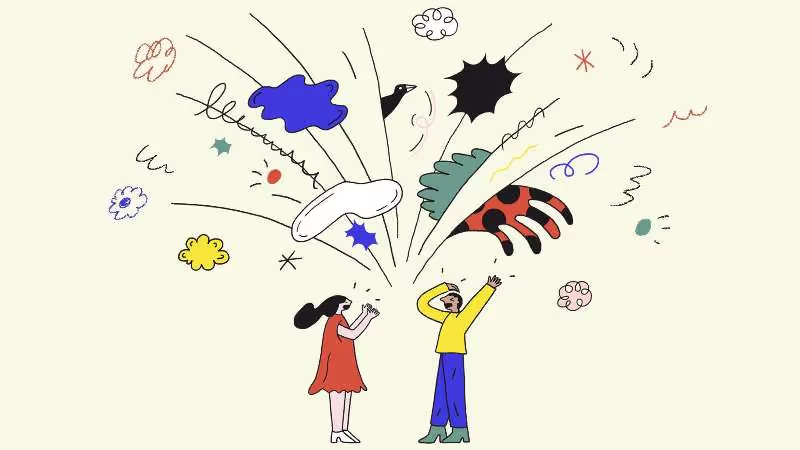
One of the great mysteries of fantasy is that we don’t know why certain things are a turn off and others are the opposite. Here are some things to consider and try out as you open up the fantasy conversation.

This week, Esther explores how to deal with unshared sexual fantasies.

“My husband and I started talking about our sexual fantasies the other day and I was shocked and disgusted. What do I do now?” – Stephanie, Milwaukee, MI

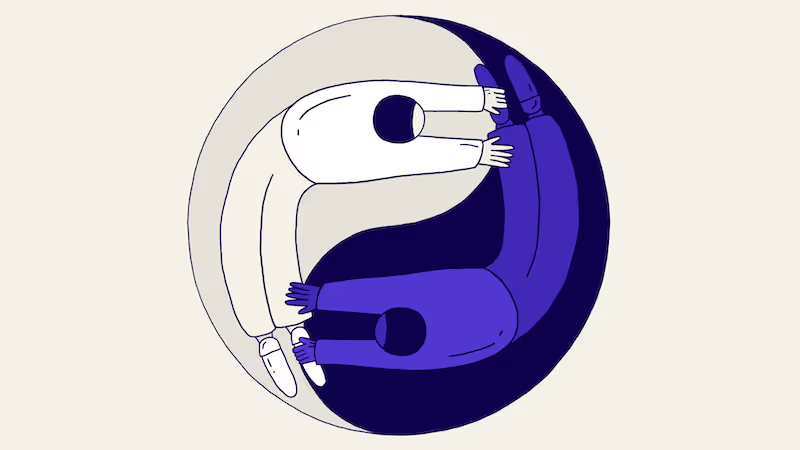
Stephanie’s question resonates with many couples because very frequently one person’s turn on is what turns the other off.
One of the great mysteries of fantasy is that we don’t know why certain things are a turn off and others are the opposite. We don’t understand the preferences of others or ourselves. Sure, we can examine the biography of a person but fundamentally we are in the dark.
So let’s say you want to know what your partner’s fantasies are, like Stephanie. But what if they leave you feeling inadequate, disgusted or just plain turned off? Here are some things to consider and try out as you open up the fantasy conversation:

Fantasy is not reality
Children may play-act that they are in jail. But if they were in jail, they wouldn’t be playing as a prisoner. The first thing that I would say to Stephanie is that fantasy is play, it is not reality, and it is not what her husband wants in the cold hard light of day.
Stephanie may also be asking why her husband has these fantasies? My colleague Michael Bader aptly said that a good fantasy states the problem and offers the solution. In other words, whatever cultural obstacles or prohibitions you encounter in life, you are allowed in the realm of your imagination.
The imagination, of course, is not always politically correct. For instance, a rape fantasy is just that: a fantasy of forced seduction. In a rape-fantasy you never experience the dread that accompanies violence, instead, you are subverting the idea and transforming the meaning of that experience into a source of pleasure and excitement.

Don’t play to the shame game
Stephanie has asked her husband what his private turn on is. And in turn, he has invited her into his secret garden. If she is openly disgusted, she is effectively slamming the gate and running off into the wilderness. By closing off the conversation or reacting with disgust, we induce shame and guilt in the other.
The erotic mind is very sensitive to censorship and it knows when it needs to go into hiding. Stephanie’s husband may promise never to have these thoughts or voice them again but you can’t eradicate someone’s preferences because you don’t like them.
So, if your partner reveals himself or herself to you, don’t shut them down. By shutting down the conversation, you are in effect saying: “I want you open up but only on my terms”. Which becomes a power dynamic that is far removed from the inner erotic sanctum.

Be why-curious
I have a friend who doesn’t understand why people like to eat pickled octopus. Like taste, fantasy can induce the ick factor for others. But instead of turning away with revulsion, and worrying about the implications of a partner’s fantasy, I encourage Stephanie to remain curious.
Stephanie can reopen the conversation and ask her husband: what is it about it your fantasy that is pleasurable? Is it that you get to be passive? Ruthless? Give over power? By remaining curious and open, we are asking the other: who are you? We don’t have to understand them, we can simply find out more about who they are which creates space, acceptance, and room for play.

Try something new
A woman once told me her partner’s fantasy of being seduced in a clothing store change room by the attendant. His fantasy made her feel inadequate and cuckolded: why did he have to imagine another woman? But when they tried playing out the fantasy at home, with her playing the attendant, she found there was pleasure to be had in playing out the fantasy. She could bring her own imagination to it so that they both owned the game. Taste, like our palette as we grow from children to adults, can evolve and change. Be open to trying new flavors, you may find something you like.
Are you ready to get to know your partner? Let me know what you find out and how these conversations change your relationships. I’d love to read your comments on social media.

Read More
No items found.
Want to Build Trust in Your Relationship? Take Risks
From the moment we come into this world to the moment we die, our survival instinct acts as a silent captain navigating every situation we face or desire. And at every step, a subconscious calculation is operating in the background: Is it worth the risk?

Life is a game of risk. From the moment we come into this world to the moment we die, our survival instinct acts as a silent captain navigating every situation we face or desire. And at every step, a subconscious calculation is operating in the background: 

- Is this a harmful situation to avoid? 
- Will I get hurt?
- Do I want to get hurt?
- Could there be a payoff?
- What if it’s great?
- What if I fail?

Is it worth the risk?

We focus a lot on red flags, particularly while dating and early on in relationships. Often, our ability to recognize a red flag is because we’ve experienced it before. When we’ve dated a few too many narcissists, our eyebrows might perk up if our date is bragging a little too much. If a former partner struggled with substance abuse, we might overly-chastise our new mate for occasionally overindulging. When we’ve had past experiences in which our partner was too needy or we felt too needy, we may find ourselves seeking “situationships” where we don’t have to get deep enough to develop any level of dependence. And when we’ve experienced trauma, we will either try to avoid anything similar—or find ourselves experiencing it over and over again without totally understanding why. 

It’s crucially important to look for red flags. But hypervigilance can also leave us feeling constricted and avoidant. How many of us have wanted to run and jump off the dock into new depths of our relationship—only to stop ourselves at the edge because the proverbial water might be too cold, too murky, too mysterious? It’s that mystery that triggers our risk calculations—but it’s also what helps build sustainable desire that allows us to go deeper together over time.

Taking Risks Helps Build Trust Over Time

Over the course of a long partnership, issues can pile up, whether it’s major transgressions or minor mistakes that have compounded. Even small mistakes can be corrosive when they happen again and again. And even when the offending partner is working to heal the wounds, the other partner’s confirmation bias will insist “they’re just going to do it again.” If any of this sounds familiar to you, the last thing you probably want to hear is that it’s on you to open back up to the possibility of being hurt or disappointed again… but taking that risk is the only way to build trust in a possible alternative: that things can be better. 

Deep intimacy, as author Eli J. Finkel explained in The All-or-Nothing Marriage, requires some tradeoff between relationship enhancement and self-protection. He asks “are you more willing to let yourself be highly vulnerable in pursuit of deep intimacy, or are you more willing to sacrifice some level of intimacy to avoid being highly vulnerable?” This paradox is also at the heart of the Catch-22 posed by trust researcher Rachel Botsman: Can we take risks without trust? Or is it the act of risk-taking that allows us to develop trust?” 

Taking risks is not the same as being reckless. We all need both security and adventure in this life. It’s okay to stop at the edge of the dock and assess the dark waters below… but it’s just as important to take the leap of faith. 

Trust Falls—They’re Not Just For Corporate Retreats

Botsman defines trust as “a confident engagement with the unknown.” Trust is the confidence that even if the water is freezing and something bites our toe, we’ll be okay. And if it ends up better than we could have expected, we’ll always remember that day at the lake where we held hands and plunged into the reinvigorating waters together. 

In relationships, trust isn’t a promise to never hurt each other. It’s the risk that we will hurt each other and the confidence that, if we do, we will come together to heal. We will support one another. We will be kind. We will have each others’ backs. And it’s not just something that happens because we’ve decided to be together, or to move in, or to say “I do.” Cultivating that level of trust requires millions of micro-risks that show us we’re not foolish for being confident in our relationship. It requires taking risks together that show us our partner isn’t the same as the people from our past who hurt us. Most importantly, trust requires taking risks together that help us grow into better partners for each other. If we let each other fall in the past, it’s going to take a lot of trust falls to show that we're committed now to always catching each other, to really holding each other at our most vulnerable. The worst case scenario is that they drop us so many times that we finally understand we can’t trust them. That’s important to learn, too. But if we don’t take the risk at all, we might never know either way.

Read More
No items found.
The 3 Types of Relationship Fights You Keep Having—And What To Do About Them
The deeper issues that drive escalation are rarely about the content of our fights—dirty dishes, too much time on our phone, politics, the kids—they’re about the needs, vulnerabilities, and biases that get triggered over and over.

We all know that moment of deeply upsetting bewilderment that pushes a relationship fight over the edge. It’s when we ask ourselves for the umpteeth time HOW could they POSSIBLY be DOING this AGAIN when they know how much it UPSETS me? 

Dishes left piling up in the sink. Too much time spent scrolling social media when we long for quality time. A big decision made solo instead of together. That tone of voice that makes us feel stupid. The past transgression that refuses to leave the room. The cycle of judgement toward one another that underscores and inflames a banal interaction. Looking at our watch as we wait for them yet again. The political conversation that leaves us screaming how can you think that way! The personal jabs that leave us feeling raw. It’s the triggers we pull and can’t take back when we push each other to our most vulnerable soft spots.

In all of these familiar scenarios, our hyper-focus on the content of our arguments leaves us spiraling into escalation, our heart rates and limbic system hijacked until we’re completely depleted and polarized seemingly beyond repair. These ugly crescendos leave us tending to our wounds alone, which is especially hard when we also count on our relationships to help us heal. How many of us know the feeling of wanting to be hugged by the very person with whom we can’t stand to be in the same room?

Your Relationship Fight Isn’t About What You Think It Is

The deeper issues that drive escalation are rarely about the content of our fights—dirty dishes, too much time on our phone, politics, the kids—they’re about the needs, vulnerabilities, and biases that get triggered over and over. Unsurprisingly, when a situation affects us deeply, it’s because it resonates with something else we have experienced before. As Dr. Marion Solomon and Dr. Daniel J. Seigel wrote in Healing Trauma, “the greater the intimacy with another person, the more likely that emotions, even archaic ones, will emerge, along with primitive defenses. A therapeutic approach…help[s] partners acknowledge their sense of vulnerability, discover its roots, tolerate waves of emotion, and find ways to address the underlying pain.”

If our partner not looking up from their iPad when we get into bed with them triggers us, it’s not because they didn’t look up. It’s because it falls into a pattern we experience as neglectful. If our partner makes time every week to play tennis with their friend, but doesn’t show interest in planning a weekly date night, it may trigger our insecurity that they don’t actually want to be with us or that we’re not enough for them. In both cases these triggers act as a funnel to our senses of abandonment and failure. And when these triggers compound over time, it creates a lens through which we view every interaction. So, if we think that our partner doesn’t care about us, then everything they do will be interpreted through that lens. Conversely, if we think that our partner wants our wellbeing, we will interpret most of what they say and do from that angle.

We all know the feeling of defending an action we think is too minimal to have caused such offense in the first place. And we all know the feeling of breathlessly explaining how upset we are without totally understanding why. What would happen if we took a pause, took a breath, and attempted to work together to identify what’s really going on? Often, it comes down to three possibilities.

Identifying the 3 Hidden Dimensions Under Most Relationship Fights

Ever heard the phrase “you’re missing the forest for the trees?” It means that we’re so focused on individual details that we’re missing the bigger picture. Identifying which hidden dimension is causing our relationship fights to escalate helps us get out of the woods, so to speak. Couples therapy researcher Howard Markman explains that there are many hidden dimensions at play under most relationship impasses. But beginning with just the following three can have a profound effect on how we fight—and how we move forward. 

Power and Control - Fights about power and control can sound like:

  • “You undermine me with the kids.”
  • “Because I don’t make as much money as you, I feel like I have to check with you before I buy anything. I know you don’t ask me to but you don’t have to.”
  • “We only have sex when you want to.”

Care and Closeness - Fights about care and closeness can sound like:

  • “Why can’t you support me when I’m anxious rather than make me feel worse about my coping skills?”
  • “Why am I always the one to text or call you? I pursue; you distance.”
  • “Why don’t we have sex anymore?”

Respect and Recognition - Fights about respect and recognition can sound like:

  • “You go out with your friends without asking me what I’m doing.”
  • “You never acknowledge my professional accomplishments.”
  • “I don’t think you realize how much I do around the house.”

Every fight exists within a context. In any fight, there’s usually more than just one of these dimensions making us question our sanity and relationship, but allowing these categories to function as a framework for identifying where our conflicts are coming from inspires language that leads to more productive conversations.

Getting Out of the Loop Requires Creating New Patterns 

It’s hard to remember in the heat of the moment, but when someone is extremely angry or deeply upset, it’s usually because they care. That care can be better utilized. It requires developing the skills and language to identify the underlying dynamics which serve as the backdrop to so many of our fights. When we work together in a healthy way to understand how these patterns came to be, we shift our relational trajectory toward how we can help each other through it.

Getting out of the loop is a process of dismantling entrenched dynamics, reversing them micromovement by micromovement. One step leads to another. It may feel unnatural at first to engage in such choreography—articulating our feelings while consciously allowing room for the other’s perspective—but all relationships are a dance. Eventually, it will become more organic to say “I feel something but that doesn’t mean you’re necessarily doing it, but I need you to hear that,” or “Honey, I’m going to hang out with my friends tonight but I was thinking we could do something special tomorrow—what do you think?” Creating new patterns of mutual self-awareness and affirmation of the other is the key to improving our relational dynamics. Remember, the process shapes the experience. The form is more important than the content. 

Read More
No items found.
The Other 3 Little Words: I Love You, But—What Are We?
Whether we’re happy to keep the status quo (separate lives connected by mutual affection) or desire a more entwined commitment, discussing “what are we” is an important part of creating a shared reality with healthy boundaries and expectations. ‍

Saying “I love you” has long been the ultimate marker of seriousness in the early months of romantic relationships. In the last few decades, however, the rise of the “situationship” has elongated the dating phase, elevating a different set of “three little words” to the pantheon of important relational dialogue. “What are we?” isn’t simply a kickoff to commitment. It’s a question with complex motivations and outcomes. Many of us are happy to avoid it altogether, preferring the freedom and autonomy of non-definition. But for those of us who desire titles and terms, those three little words knock at the front door of our impatience, imbuing our encounters with an anxiety that eats away at the enjoyment. The positive anticipation that once fueled us can shift into negative anticipation—that feeling of waiting for the other shoe to drop, for it all to be over before it ever really started. 

Situationships are difficult to define and even harder to mourn. Many of us worry that asking “what are we” too soon might zap the playful, easygoing nature of nascent love, fast-tracking the arrangement to an uneasy end. But it doesn’t have to be that way. Whether we’re happy to keep the status quo (separate lives connected by mutual affection) or desire a more entwined commitment, discussing “what are we” is an important part of creating a shared reality with healthy boundaries and expectations. 

Why Does Asking “What Are We” Feel So Taboo?

The connection is real. The chemistry is deep. It’s possible that both of us want the same thing. So why does it feel so taboo to initiate the conversation? Because in that early phase, the not-knowing can carry its own magic. (There’s a reason why the literary and cinematic “will they-won’t they” plot has endured all these years.) When there’s no explicit commitment—no decision made about serious versus casual—all options are possible. Each moment spent together is a choice, not an obligation or expectation. The ambiguity can feel erotic, flooding us with its novelty and surprise. But with all that freedom comes a certain amount of insecurity and uncertainty. Some of us like that; some of us don’t. 

We all know how quickly that sexy ambiguity can become “stable ambiguity,” in which we have the comfort of consistency just enough so that we don’t feel alone, but not enough to be committed or to build intimacy. This holding pattern can feel like relationship purgatory, particularly for those of us who might want a more traditional relationship centered around clear labels, commitments, and milestones such as getting married, having children, buying a house, and so on. These are perfectly normal desires. But that’s not what everyone wants. 

These days, people are marrying—on average—ten years later than in previous generations. And many of us date well into middle-age, post-divorce, and as widows and widowers, too. We bring more of our own individual lives into our relationships and fully merging lives is not the systematic rite of passage it used to be. We can love someone and not want to combine lives. We can love someone and want to keep things casual. We can love—and have relationships with—multiple people at once if we’re all on the same page. What helps is honoring what each party needs and wants…and that takes some conversation. 

Modern love comes in many forms. And if we don’t talk about which form we want, we’re left to assume that we want the same things. Through that lens, a lot of misunderstanding and hurt can happen. Asking “what are we” isn’t just about defining the relationship; it’s also about discussing monogamy, polyamory, family structures, life-merging, kids, career ambitions, timelines, and more. That’s a lot of pressure to put on a relationship so early on. If you want to know why asking “what are we” feels so taboo, it’s because these hidden layers revolve around our needs and desires, our pasts and our futures. It’s vulnerable and raw. Part of the magic of those early days is the ability to pretend like none of that exists; to be deeply in the moment. Sometimes, that’s the only place we get to experience that kind of freedom. Who would want to give that up? 

“I’m Not Trying to Put a Label on it, But….”

We all need freedom and we all need security. Some of us need more of one than the other and we look to our relationships to get it. A person who needs more freedom may shirk labels while a person who needs more security may feel as if continuing without a label infringes on their self-esteem and self-respect. 

If it’s a label we want, there’s no need to pretend otherwise. Labels create clarity and it’s perfectly normal to want to call someone we love our partner. If we’d like to turn a situationship into a bonafide relationship—and especially if we’re interested in a long-term partnership—the question of “what are we?” is a standard starting place. The respect and communication that follows can tell us a lot about how the other person would be as a committed partner. 

Keep in mind, though, that just because we want to get serious, doesn’t mean we can’t be playful. A little teasing can be helpful here: “I think you like me. I think you want me to be your girlfriend/boyfriend/partner….” If they bristle at those words, playfulness can help here, too. “Ooh, you don’t like that word. Why’s that?” The answer may reveal a new story. Maybe they want a different arrangement. Maybe they fear commitment. We can’t let one person’s hold ups dictate our own needs. Likewise, we can’t let our desires dictate theirs. Talk it out.

Love Stories Are Not The Same as Life Stories

If the answer to “what are we” has a disappointing outcome, the hit to our ego can be as painful as losing our idea of what the relationship could be—or what we thought it already was. It’s important to remember that the people we love are not necessarily the same people with whom we can make a life. Life stories are not the same as love stories. It’s a different set of ingredients, different aspirations. We can have a wonderful short-lived dalliance, totally disconnected from our realities, and it can be a perfect, beautiful love. But it has little to do with the intricate scaffolding that supports a life together. 

If the answer to “what are we” is mutually satisfying, we’ll be glad we initiated the conversation. If we do end up in it for the long haul, asking “what are we” is a great exercise to periodically return to as a way of reviewing our commitments, expectations, visions, dreams, and boundaries. Relationships are meant to change and grow and a little conversational infrastructure benefits everyone.

Read More
Infidelity
The Myth of Unconditional Love in Romantic Relationships
When it comes to romantic relationships, “till death do us part” isn’t just a vow, it’s a plan. But what happens when plans change? What happens when we’re not meeting each others’ needs?

“I love you no matter what.”
“You’re driving me crazy.”

“That is so thoughtful of you.”
“How could you do that?”

“I want to spend forever with you.”
“I can’t do this anymore.”

“I want more time together.”
“I need space.”

How often have we said and heard these phrases? How often have we said and heard them within one relationship? For those of us who are painfully aware of what makes our loved ones difficult to live with…what do we think makes it hard to live with us?

“Relational Ambivalence” is the experience of contradictory thoughts and feelings—of love and hate, attraction and disgust, excitement and fear, contempt and envy—toward someone with whom we are in a relationship.

We experience it with our parents and our siblings. We feel the tug between the parts of us that are forever entwined with them and the parts of us that want to separate ourselves.

We experience it with our children, those beings who teach us a love we’ve never known as well as an unparalleled frustration that can incite harmful thoughts.

We experience it with our friends, the ones we don’t really want to see but end up feeling obligated to invite to our wedding.

We experience it in the early stages of dating, when commitment to another feels as if it might come with a loss of self. We may want an experience of mutual love, support, and security, but not if it takes away our freedom.

We experience it in a relationship that has not been growing, that feels stuck, when we engage in that treacherous cost-benefit analysis wondering if we could do better.

We experience it in long-term relationships in which—faced with a range of experiences from toxicity to boredom—we can become plagued by the question “should I stay or should I go?” We feel trapped in the relationship but we don’t want to lose what we’ve built together—a home, a family, a little universe that sometimes feels like heaven and, other times, feels like hell.

Ambivalence exists in every relational configuration, but we put a lot of pressure on romantic love, in particular, to rise above it. We are taught that love is unconditional, passion is absolute, and that finding “the one” should clear us of all doubt. But relationships are never black and white. We learn that romantic love is supposed to flood us with certainty and thus there is no room for ambivalence. But ambivalence is as intrinsic to relationships as love itself.

When it comes to romantic relationships, “till death do us part” isn’t just a vow, it’s a plan. But what happens when plans change? What happens when we’re not meeting each others’ needs? What happens when we make mistakes or when the person we love behaves in a way we can’t tolerate? How about when the relationship gets tainted with lies, betrayal, or duplicity? We suddenly remember that love can hurt, and hurt deeply. And one of the most challenging experiences of ambivalence is when we find ourselves still loving the person who has hurt us deeply.

Ambivalence is an uncomfortable feeling. Heavy with contradictions, it makes us doubt our feelings and choices. It can cause us to think we’ve failed or that, no matter what decision we make, we will fail. This discomfort makes us crave a definitive answer. So we force ourselves one way or the other. It usually falls along three lines:

Option 1: We Leave. We cut and run.

  • We end the relationship that has too many ups and downs.
  • We tell our narcissistic parent they won’t be in their grandkids’ lives.
  • We tell our struggling sibling we won’t support their bad habits anymore.
  • We initiate a “friend breakup,” (a heartbreak that doesn’t get nearly enough attention).
  • We move toward the equal and opposite future of our current reality.

Option 2: We justify staying even though it doesn’t feel right.

Whether it’s because we feel we don’t deserve better, because we’re afraid to be alone, or because we feel we don’t have a choice. All of these painful and complicated feelings sometimes hide under the banner of “unconditional love.” It’s beautiful to say “I love you unconditionally,” but love is not an obligation, it’s a gift. When it becomes coercive—when our partner says “if you loved me, you would accept me wholly”—we’re actually experiencing a distortion of love. And, sometimes, these are also situations in which a lack of self-love is disguised as unconditional love for a person who doesn’t deserve it.

Option 3: We hold the ambivalence.

Ambivalence takes up emotional real estate in every relationship; it just depends how much. We often think we need to resolve the tension and come to a resolution. Sometimes we do (in abusive relationships, especially). In most situations, however, holding the ambivalence is, in itself, a form of radical acceptance. This may be true for how we accept our relationships and for how we accept ourselves.

This option asks us to sit with the feeling of ambivalence for a while. Stop trying to justify, stop negotiating, and just sit with it. Can we accept that we can wholly love a person without having to love every part of them? This is a much more realistic expectation of romantic love and relationships. Maybe it’s healthy to allow ourselves to really, really not like the person we love sometimes. Maybe it’s a necessity. Consider this: perhaps the highest form of love isn’t unconditional. Maybe it’s closer to Terry Real’s description of self-esteem: our ability to see ourselves as flawed and still hold ourselves in high regard. Can we do that for our relationships, too?

Read More
No items found.
Six Essential Practices to Improve Listening Skills in Relationships
The qualities that make a good listener may seem obvious, but they can be quite nuanced. It’s a delicate balance of receiving and reciprocating—taking information and giving attention and care.

The qualities that make a good listener may seem obvious, but they can be quite nuanced. It’s a delicate balance of receiving and reciprocating—taking information and giving attention and care. The way we listen shapes the conversation as much as the way we speak or respond. Consider the old saying: if a tree falls in a forest, and no one is around to hear it, does it make a sound? It’s a mindbender that leads us down multiple philosophical pathways involving object permanence and the human impulse to center our own experiences. If I don’t perceive it, does it cease to exist? Of course not. Unlike most riddles, this one has an easy and obvious resolution. So why has it endured for so long? Why do we continue to pose this question? 

It’s because this little nature-inspired conundrum isn’t about the answer. It’s about going down those philosophical pathways. Inside of this question, there’s a poignant commentary about relationships and the reciprocity required to be in one. The tree doesn’t just make a sound; it shakes the earth. And how we respond to those vibrations shapes the experience for tree and man. Was it cut down? Was it healthy? Was it dying? Did it crush anything below? Do we need to clear the debris to make way for new growth or does it need to be left alone? And what does any of this have to do with listening skills in relationships? 

1. Understand the Difference Between Hearing and Listening

No matter the type of relationship—romantic, platonic, familial, or collegial—actively showing that we are listening to the other person validates their experience and their vulnerability. It’s not enough to say “I’m hearing you.” Whether we are sharing a story, a greivance, a need, a want, or even a desire, nothing makes us feel more deeply connected than when we are engaged in a healthy balance of thoughtful speaking and hardcore listening. 

Try this essential practice: Invite the other to engage in a little assessment. Keep it light and be kind. Ask each other: 

  • What time of day do we tend to have our best conversations?
  • What is a tell tale sign that my attention is fading?
  • Show me the face I make when I’m really listening to you intently.

2. Go Back to the Beginning

From the time we are young, we’re told “use your words.” The current Western norm emphasizes direct communication and the ability to clearly articulate one’s needs as an essential step to building confidence and self-esteem. It’s interesting, isn’t it? We make a point of encouraging one another to be assertive—speak up! Communicate! Advocate for yourself! Yell it from the mountain tops!—but we don’t quite prioritize listening in the same way. 

Try this essential practice: Ask each other…

  • As a kid, how could you tell when an adult was taking you seriously?
  • Do you have any memories of realizing that you were funny because of how people reacted to your storytelling?
  • What were you taught at home and in school about listening?

3. Take Your Finger Off the Rebuttal Button

Couples researcher and therapist, Howard Markman, has said that when we listen to something we don’t agree with, we have a capacity of ten seconds before the rebuttal button gets pushed. That’s about three sentences before we interrupt with our defense. Even if we don’t interrupt, we begin making mental notes of everything we want to refute when it’s “our turn.” 

Try this essential practice: 

  • We tend to talk about our feelings as if they are facts, which can turn dialogue into debate. 
  • Instead of listening for flaws or counter-arguments; listen to understand. 
  • Instead of focusing on being right, focus on what may be right about what the other person is saying.

4. Explore Reflective Listening Skills

Developed by Harville Hendrix, PhD, and Helen LaKelly Hunt, PhD, Imago Dialogue is a three step process of reflective listening that focuses on Mirroring, Validation, and Empathy. When we engage in Imago Dialogue, we agree to have a conversation in a judgement-free zone with the understanding that each person’s point of view is valid. This type of inquisitive listening—and the way that the speaker gives direct feedback to the listener—completely changes the dynamic.

Try this essential practice: 

  • Invite the other to dialogue about a specific subject. Start with something benign.
  • Speak from I and me (I feel…. What’s bothering me….)
  • The listener will mirror the speaker by saying “Let me see if I understand. You’re staying X. Did I get that right?” 
  • The speaker will then say “yes, you did” or “you got some of it.”
  • The listener will then ask “is there more?”
  • The listener will validate the speaker by saying phrases such as “what you’ve said makes sense.”
  • The listener will empathize by sharing what they imagine the other person may be feeling. 
  • Switch roles.

5. Read Aloud to Each Other

In a 1974 seminar, psychologist and philosopher Erich Fromm offered six rules for listening, three of which are below: 

  1. “[They] must be endowed with a capacity for empathy with another person and strong enough to feel the experience of the other as if it were [their] own.”
  2. “The condition for such empathy is a crucial facet of the capacity for love. To understand another means to love [them] — not in the erotic sense but in the sense of reaching out to [them] and of overcoming the fear of losing oneself.”
  3. “Understanding and loving are inseparable. If they are separate, it is a cerebral process and the door to essential understanding remains closed.”

Try this essential practice: Fromm’s entire seminar was eventually published as a book called The Art of Listening. Buy or borrow a copy from your local library and carve out a few minutes each week to read a different rule aloud to each other. As each person reads a passage, the other can practice deep listening. You can choose simply to listen or to discuss it afterward. 

6. Ask New Questions About Old Stories

A unique form of communication is joint storytelling. When we listen to a couple tell the story of how they met, how they got engaged, the birth of their child, a trip they took together, a disaster they survived, we learn about their history, their dynamic, and the parts of those experiences that have made them who they are. We can also learn a lot from the details that get left out, misremembered, or forgotten until the right question shakes the memory loose. 

Try this essential practice: 

  • Ask each other to retell an old story from a different point of view—how would a stranger in the background tell the story?
  • What are the dominant colors, scents, and textures you remember from the original experience?
  • What do you think the other person involved in the story would have noticed about the setting that you would not have? Why?
  • If the experience hadn’t happened, how might the rest of the day unfolded?
  • What negative aspects of the experience are you grateful for now? Why?
  • How would the experience be different if you were the age you are now?
Read More
No items found.
Why Do Sexual Taboos Make Up Our Sexual Fantasies?
Our sexual fantasies are a fount of information about our internal lives and the relational dynamics of our partnerships. They comprise a code language.

People love to tell you about their dreams. Ask someone if they had any dreams last night and they’ll tell you how they were chased, that they flew through the air, that they saw an old friend who gave them a message. They will tell you how it made them feel and what they think it all means. They’ll recall memories that perhaps hold the key to decoding every symbol. They’ll tell you: it all felt so real. 

Ask someone how they slept last night and they’ll tell you: good or not well or not at all. Maybe they’ll tell you their back hurts. You’ll suggest nighttime tea, a better pillow, maybe a new position. 

The difference between dreaming and sleeping is also the difference between sexual fantasies and sex lives. Sexual fantasies are the varied scenarios we imagine that make life more pleasurable and intense. It can be as simple as the time of day, the temperature, the quality of the breeze or as complex as the power dynamics or transgressions that turn us on. Our sex lives, on the other hand, are more of a ledger: good or not well or not at all. And yet we’re more likely to talk about our sex lives than our sexual fantasies. Why? 

Layer upon layer of social and sexual taboo, combined with a lack of education and communication has created stigma around discussing that which gets us off and understanding why—not only with our friends, but with our partners. Therapy is often the only place where we feel permission to discuss the erotic recesses of our imaginations, and probe the role sex plays in our lives: a longing for communion, a spiritual union, an expression of love, the feeling of being wanted, taken, ravished, the exuberance of release as well as a safe place to experience aggression, play with power dynamics, surrender. Sex is never just sex. But outside of the therapist’s office that freedom collapses. Not only because talking intimately about our sexual fantasies is a social taboo, but because those fantasies often consist of sexual taboos themselves—that which is considered forbidden, immoral, perverse, a line not to cross, something not to do.. It’s those long standing boundaries created by our cultures, religions, and media that we’re taught from a very young age not to break. 

Plus, just like dreams, our fantasies can be irrational and weird. They can be contradictory to how we see ourselves and how others see us. If sex carries some embarrassment and shame, then our fantasies push us over that edge. What if what turns us on turns our partner off? Or worse, what if they're disgusted by it? Our erotic mind is very sensitive to censorship and when it smells judgement, it knows to hide underground. Many of us wonder if it’s even worth it to go down the rabbit hole of our desire. Doing so is to accept that we are multifaceted, filled with contradictions, and that we want to play with otherness. Just because we put on a costume doesn’t necessarily mean we want to be a witch or a sea captain. When we play in the sexual theater, we want to know what it’s like to not be ourselves. Our fantasies, and the taboos they contain, are symbolic maps of our deepest needs and wishes. Accessing that vulnerability can turn our sex lives from a ledger into something so much greater, but getting there is a taboo in and of itself. It means talking about it.

The Formation of a Fantasy

Chapter six of “Mating in Captivity” details the origins of our erotic dissonance, from the days of the Puritans to now. Though we’re living in a time of unprecedented sexual freedom, in the U.S. a deep ambivalence around sexuality persists, leaving us seasawing between extremes of excessive license and repressive tactics The majority of sex education that litters our teenage years can be summed up as a big DON’T. “The Talk'' is about the dangers and the diseases, rarely the intimate and never the imaginative. But our sexuality is rooted in the psychological details of our lives and our emotional history shapes our erotic blueprint. 

Tell me how you were loved and I will tell you how you make love. But tell me about your sexual fantasies and it will tell me about the needs and expectations that are bundled in your erotic encounters—the longings, hopes, fears, pains and struggles. We invest our sexual experiences with a complex set of needs and expectations. We seek love, pleasure, escape, validation, ecstasy, visibility, unity, and transcendence. Our sexual fantasies are a fount of information about our internal lives and the relational dynamics of our partnerships. They comprise a code language. 

The repertoire of sexual positions is limited, but our imagination is as vast as the ocean and as varied as any forest. It is the central agent of our sexuality and keeps things interesting over time. It’s the place our fantasies come from. It reminds us that sex isn’t something we do, but a place we go—inside ourselves and with each other.
But inevitably, there is the moment of hesitation—what if my fantasy isn’t normal? 

These 5 Sexual Taboos are More Normal Than You Think 

This month on Sessions, my online training program for therapists, coaches, and educators, I spoke with Dr. Justin Lehmiller, a Research Fellow at The Kinsey Institute and an internationally-recognized sex educator, about the most common sexual taboos. The author of Tell Me What You Want: The Science of Sexual Desire and How It Can Help You Improve Your Sex Life, Justin explained his research about why certain taboos are more normal than we think. The following is adapted from his survey of 4,175 Americans that formed the basis for his book as well as our recent conversation. 

1. Multipartner sex, like threesomes, orgies, and gangbangs. 89% of those surveyed said they fantasize about multipartner sex. Why? It could be that when we have multiple partners, we don’t worry about rejection as much. We also are less likely to feel that we are “too much.” We are affirmed that we are sexually powerful because we can take on more than one person. Multipartner sex can be a collective release. A group mentality can make sex feel more legitimitzed, accepted, and normalized and intense.

2. Power, control, rough sex. 65% of those surveyed said they fantasize about BDSM. Keep in mind that BDSM is so much more than just whips and chains. As Dr. Margaret Nichols explains: “BDSM sexual activities seem unusual to those who do not share BDSM proclivities.” However, “these sexual activities share much in common with activities like Iron Man competitions, a penchant for sky-diving, and a love of horror movies. The combination of pleasure with negative sensations is the hallmark of BDSM. It is the source of what is often called a ‘peak experience,’ which many believe are an essential quest of humans once basic needs have been met. Peak experiences can be experienced as spiritual, revelatory and healing.”

3. Novelty, adventure, and variety, such as having sex in a new position or setting. According to Lehmiller’s research, public sex was one of the biggest fantasies for surveyed women. Why? Because novel experiences connect with our imagination, curiosity, and creativity. Sex is an art. But the very thing we might find new and exciting, might point at our own inner contradictions, which is why it can feel taboo. Why would someone who deeply values their privacy want to have sex in public? Why would a CEO want to experience being spanked and dominated? It’s the adventure outside of our normal lives that we find so exciting. 

4. Being in a non-monogamous relationship, such as swinging, polyamory, cuckolding, or having an open relationship. 79 percent of men and 62 percent of women Lehmiller surveyed fantasize about being in an open relationship, while 58 percent admit they think about watching their partner have sex with other people. Consensual non-monogamy offers the union between stable commitment and freedom, belonging, and independence. 

5. Gender-bending and homoeroticism. According to Lehmiller, this is “all about pushing the boundaries of your gender identity/role/expression (such as cross-dressing) and/or your sexual orientation (such as being heterosexual but having a same-sex fantasy).” 59 percent of straight women said they fantasize about sex with other women, while 26 percent of straight men said they fantasize about sex with other men.

Working With Our Fantasies 

For some of us, the transgressive and forbidden invite us to experience a sense of bravery, defiance, and freedom. We’re so often told we can’t do things or that our curiosity is inappropriate. We like to defy the odds and the norms. We like to break out of boxes. As we continue to explore sexual taboos on Sessions, we speak with Angelika Eck about how working with fantasy enables us deeper access to ourselves, our shadow parts, and the emotional maps of our needs. We highlight the interplay between the physiological, the body, and the biological when exploring the challenge of sustaining desire. Remember: fantasies are so much more than the sexual taboos we may associate with them and those taboos are not nearly as strange as we may think. As Angelika says, “they are the imaginative thoughts that take us out of the restraints of our realities.”

Read More
No items found.
Letters from Esther: Play
Play allowed me, as it does for all of us, to transcend the boundaries of family life and the restrictions imposed by society.

Shall We Begin?

Play is the infinite testing ground for creativity. 

As a child, I created entire universes for play. In front of my mother’s bedroom mirror—and using a big chest of costumes—I played Hit Parade and Eurovision. I was the presenter, all of the singers, the judges, and the audience. And boy, did I clap for myself. On my brother’s guitar, I played the same three chords over and over, inventing songs for hours on end. In the real world, I spent a lot of time alone. But in my play world, I was never lonely. How could I be? My reflection in the mirror wasn’t me. It was the many characters who comprised my ever-evolving personal theater. 

At around ten years old, my personal theater underwent a crucial evolution when I began to read the photo romance books my mother kept next to the counter at our shop. You know the ones—with the hulky man and petite woman embracing on the cover. It was my first indoctrination into adult love and its agonies. I devoured every page of soap operatic intrigue. The big wall in the back of our house, which had long been my only tennis partner, became an entire tennis club where love affairs rocked the tight-knit imaginary community. I was the owner, the instructors, and the players. I was the scorned woman, her cheating husband, and her new lover. Is it any wonder that, before I became a psychotherapist, I spent years as a puppeteer? Writing and performing plays, and making costumes for marionettes was the next frontier in my boundaryless world. Play opened up worlds that were far removed from me and identities I wanted to try. Play allowed me, as it does for all of us, to transcend the boundaries of family life and the restrictions imposed by society. 

I remember being told that there is a field of study called psychodrama. I imagine most people who make a career out of their passion are floored to learn that the way they play—how the world transforms with their imagination’s magic wand—is a skill that can be cultivated. It can be a tool that can help in healing. The way we play can become our life’s work. When I learned this, there was no going back. I went to Jerusalem and then to Boston to study psychodrama. I earned a Masters Degree in Expressive Arts Therapy. And as a psychotherapist now, role playing is one of my most-utilized therapeutic tools. When we enter the role of another, especially someone whose perspective challenges us, we get closer to understanding one another.

Play, in general, is about problem solving. It provides space to test new solutions. When kids play, they're exploring the world. They're looking at what works and what doesn't without having to be practical. It involves physical, cognitive, and emotional development, but it is intimately and intricately connected with creativity, daring, boldness, and risk-taking. The importance of play doesn’t end when childhood ends. Sure, we can engage in play as adults because it’s healthy, because it releases endorphins, and so on. But that’s kind of like saying that one should have sex because it burns calories. Just like sex, playing as adults is about pleasure, connection, creativity, fantasy—all the juicy parts of life we savor. Play is the pleasure of being inventive, mischievous, imaginative, and trying something new. Why do we play? Because it helps us grow—and because it’s fun. 

Let’s Turn the Lens on You

Ask yourself, then ask your loved ones.

  • What are your images and associations with the world “play”?
  • As a child, what was your favorite way to play?
  • Is play a part of your adult life? If so, how?
  • What’s one thing you’d like to change about your relationship to play?
  • Are you a good loser or a sore loser?
  • When is the last time you had a great belly laugh?
  • If you created a new game, what would it be? Start writing the instructions.

More From Esther

Rituals For Healthy Relationships At Every Stage / a blog article
Routines and rituals have a lot in common, but what makes them different is the key to elevating our relationships.
Bringing Home the Erotic: 5 Ways to Create Meaningful Connections with Your Partner a blog article
Couples who are plagued by sexual boredom would be well to explore the hidden fantasies and desires that turn them on.
How Erotic Thinking Helps Emotional Connection a blog article
No matter how effective our routines have been in helping us through the last year, if they’re not filled with creativity, they inevitably leave us numb. 

Conversation Starters

A compendium of highly recommended sources of inspiration and information       

On My To Read List:

Read More
Friendship
Communication & Connection
Letters from Esther: Friendship Is Also a Love Story
The beauty of having friendships lies in the quiet, everyday miracle of being known—and still loved.

THIS MONTH ONLY: Get 20% off when you purchase an annual subscription to Where Should We Begin? on Apple Podcasts. Discount automatically applied. Offer valid through July 31, 2025.

Click here to claim your discount.

Shall We Begin?

You can be surrounded by people and still feel lonely.

You can also be single and still feel deeply held.

The difference, often, is friendship.

This spring, we focused a lot on dating—the highs, the lows, and the ways to breathe life into an experience that, for many, has become an exhausting merry-go-round. Swiping. Matching. Picking. Planning. Clicking. Ghosting. Sometimes you really fall, deeply. And sometimes it just fades, strangely. If you decide to try again, it’s easy to get back on the ride. And it’s good to try again, via apps, singles nights, parties, clubs, blind dates, you name it. There are a lot of options for finding connection.

The problem is: when you’re surrounded by (or swiping through) so much possibility for romantic connection without actually connecting to someone, it can be a terrible, lonely experience. But you have to remember: you are not alone.

YOUR RELATIONSHIPS

To anyone experiencing deep loneliness around a lack of romantic connection, know this: not having a romantic relationship does not mean you are “not in a relationship.”

You are likely in many relationships. One of the most important connections in life is the connection we have with our friends, and not just when dating is hard or after a big breakup. The beauty of having friendships lies in the quiet, everyday miracle of being known—and still loved. Friendship is a layer cake of connection, full of the ingredients that make life rich, such as:

  • Witnessing: A friend is someone who sees your life as it unfolds—your heartbreaks and your triumphs—and remembers them with you. And you do the same for them.
  • Shared language: Over time, friendships develop their own rhythm, shorthand, and inside jokes. It’s a kind of poetry—private, earned, and deeply comforting.
  • Chosen constancy: Unlike familial ties or romantic bonds, friendships are often maintained purely by choice, not obligation. That makes their endurance especially beautiful.
  • Mutual reflection: A friend reflects you back to yourself, not as the world sees you, but as they know you to be, especially when you forget who you are.
  • Play and lightness: Amid life’s weight, friends make space for laughter, silliness, and joy. They create pockets of levity that keep us human.

GOING DEEPER INTO FRIENDSHIP

This summer on my podcast, Where Should We Begin?, we’re taking a journey through the love and heartbreak of friendship. Each episode has its own characters, plot points, and insights, but taken together, it’s a patchwork of joy and grief, secrets and advice, listening and holding. We’re kicking off with something very different—and deeply personal.

My friend, Trevor Noah, has been hosting some of his “favorite people” on his podcast. I’m honored to be on that special list of friends, and I’ll be including our conversation on my own podcast as well. We talk about our lives with a depth and candor I rarely engage in publicly. But with a good friend, opening up is easier, more fulfilling. I am happy to do it with Trevor.

And I am happy to go even deeper into the topic of friendship all summer long. Listen in to hear friends navigating hard conversations in my office as well as some of the best advice and storytelling from my own friends. Plus, if you subscribe to my podcast on Apple Podcasts, you’ll hear a very special conversation I had recently with a new friend: Orna Guralnik, the clinical psychologist you may recognize from Showtime’s Couples Therapy. Along with Jesse Baker, executive producer of Where Should We Begin?, we shared our experiences of taking therapy from behind closed doors to center stage.

Enjoy 20% off your annual subscription.

If you like what you hear, consider sharing the series with a friend—old or brand new. Talk about it together. Share some laughs and maybe even some tears. We guarantee you’ll find new connections all summer long.

Let’s Turn the Lens on You

Take five quiet minutes. Grab a notebook, your voice memo app, or just pause for a mental check-in.

Step 1: Name the Relationship

Think of one friend—not your partner, not your family member—who has made you feel deeply seen.

Step 2: Remember the Moment

Recall a time when that friend reflected you back to yourself, created space for joy, or helped you remember who you are. Write about that moment. What happened? How did you feel? What did it mean to you?

Step 3: Reach Out

Before the day ends, send a message to that friend. It doesn’t need to be long—just something simple. If you’d like, you can use this script:

“Hi, [Name]. I thought about that time we [insert memory]. It made me feel [insert feeling]. Thank you for being someone who really sees me.”

That’s it. One memory. One friend. One small act of connection.

More from Esther

SUBSCRIBE TO WHERE SHOULD WE BEGIN? | claim your discount

Subscribe now to enjoy 20% off your annual subscription. When you do, you’ll unlock bonus conversations—including a special episode with Orna Guralnik from Couples Therapy—and behind-the-scenes insights from Esther and her closest collaborators. Discount automatically applied. Offer valid through July 31, 2025.

EXPERIENCE “THE MOST INSIGHTFUL CONFERENCE OF THE YEAR” | register now

Time is running out to access the complete replay of Esther’s two-day annual conference, Sessions Live 2025: Mating in the Metacrisis.

Register today to enjoy transformational talks from leading experts, including:

  • “Technology’s Grip on Our Relationships” with Daniel Barcay (Center for Humane Technology), Sherry Turkle (Psychologist), and Justin McLeod (Hinge)
  • “How To Have Good Conflict” with Amanda Ripley  and Hélène Biandudi Hofer (Good Conflict)
  • “The Healing Power of Pleasure in Challenging Times” with Paul Browde (Psychiatrist)

Plus, you’ll experience a clinical supervision panel with Esther, Zach Taylor (Psychotherapy Networker), Dené Logan (MFT), Alexandra Solomon (Clinical Psychiatrist), and Vienna Pharaon (LMFT) inside the recording vault—but only for a limited time. Replay access ends soon.

ELEVATE WORKPLACE CONNECTION | shop now

I believe that the quality of our relationships at work determines the quality of our work. From my new card game to my Masterclass to my limited podcast series, How’s Work, my suite of workplace offerings are designed to help business owners, managers, and team leaders improve team dynamics and transform their work culture.

Conversation Starters

A compendium of highly recommended sources of inspiration and information

TO READ:

  • The Other Significant Others by Rhaina Cohen asks, “What if the most important relationship in your life wasn’t romantic?” This remarkable book celebrates the intimacy, commitment, and devotion found in deep friendship. It’s a timely invitation to expand how we think about love, care, and the structures that hold us.
  • "It's Your Friends Who Break Your Heart" by Jennifer Senior (The Atlantic) offers a deeply human portrait of a friendship's unraveling, and the grief we rarely name. You'll see your own stories in its quiet wreckage.
  • Inherited Fate by Noémi Orvos-Tóth is a powerful exploration of how the past lives in our bodies, our patterns, and our choices. Orvos-Tóth's new book offers a framework for healing the pain we didn't choose but still carry—a must-read for anyone doing the work of breaking cycles.
Read More
Discover more from Esther on Substack.
Explore articles and resources to help you find aliveness and vitality in your relationships.
Subscribe on Substack
Where Should We Begin Podcast COver

Where Should We Begin? with Esther Perel

Join Esther in her office every Monday to listen in as real couples in search of help bare the raw, intimate, and profound details of their stories.
Listen to the Podcast
Recent Episodes
View All Episodes

Where Should We Begin?

A Game of Stories

where should we begin at work product image
New
Where Should We Begin?
At Work
New
Where Should We Begin?
At Work
Improve team dynamics with Esther Perel’s renowned card game—now available for the workplace.
A live event with Esther

Sessions Live 2026

An unforgettable two-day event on relationships, love, and desire
May 15-16, 2026 | Online & In-Person in New York City
Get Your Early Bird Tickets

Courses Taught by Esther

Turning Conflict Into Connection
Uncover why you keep having the same fights over and over again. Learn how to break free from habitual patterns and responses. Find peace and reconciliation even when you disagree.
Gain new insights in just one hour
Downloadable workbook filled with guided exercises
Improve conflicts with or without a partner
View Course
Playing with Desire
Uncover and learn how to speak about your desires. Bring more aliveness into your sex life. Create rich, erotic rituals. Cultivate a more vibrant and fulfilling erotic relationship.
Perfect for date night
Playful exercises and prompts to tap into new erotic possibilities
Based on the same processes Esther has used to help real couples for 40+ years
View Course
Bringing Desire Back
Uncover what blocks desire. Learn how to tap back into pleasure and get unstuck. Discover a new sense of hope and possibility.
Perfect for date night
Guided exercises to turn insights into action and understanding
Based on the same processes Esther has used to help real couples for 40+ years
View Course
The Desire Bundle
Two courses designed to help you and your partner break out of sexual ruts, explore new possibilities, and build deeper connection.
Understand, communicate, and explore your sexual needs
Spark honest and constructive conversations about sex and desire
Designed to reignite curiosity, intimacy, and deeper connection in your sex life
View Course